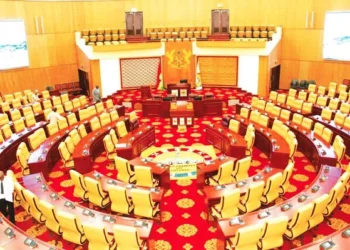

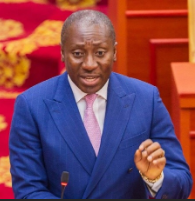
The Minority Caucus in Parliament has strongly objected to the proposed Security and Intelligence Agencies Bill, 2025, describing it as “deeply flawed,” despite supporting reforms in Ghana’s security sector.
In a statement dated Wednesday, 18 February 2026, Minority Leader Osahen Alexander Kwamena Afenyo-Markin said the Minority “supports the need to reform Ghana’s national security architecture,” noting that Ghana requires “a modern, efficient and professional intelligence system that protects citizens and safeguards our constitutional order.”
The Minority Leader said, “Let me be clear. The Minority Caucus supports reforming Ghana’s national security architecture. Our country requires a modern, efficient, and professional intelligence system that protects citizens and safeguards our constitutional order.”
“However, in its current form, this Bill is deeply flawed. It centralises excessive power in the Presidency, weakens independent oversight, expands intrusive surveillance powers, and fails to provide strong human rights safeguards,” the statement said.
7 major concerns
“First, the Bill concentrates too much appointing power in the President. The President appoints the National Security Coordinator, the Directors General of intelligence agencies, and other key officials without any requirement for parliamentary vetting.
“These offices control agencies with coercive powers and access to sensitive national data. It is unacceptable that they operate without legislative scrutiny. The Bill also allows agencies to perform any function directed by the President or the National Security Council, opening the door to informal, untraceable instructions.
“Second, the oversight framework is weak and dominated by the Executive. The National Security Council, chaired by the President, becomes the governing body of the intelligence agencies. That amounts to self-oversight.
“The annual report to Parliament lacks clear disclosure standards, which makes meaningful scrutiny difficult. The internal complaints system requires citizens to first complain to the very officials they accuse. There is no independent inspector-style body with proactive investigative powers.
“Third, the Bill restricts parliamentary scrutiny. It allows security officers to refuse to produce documents before Parliament if the Speaker certifies that disclosure would be prejudicial to national security. There is no requirement to provide reasons or even redacted versions.
“At the same time, the Bill imposes criminal sanctions of five to ten years for certain disclosures, yet provides no explicit protection for whistleblowers who expose wrongdoing.
“Fourth, the surveillance and warrant regime is deeply troubling. Applications to intercept communications can be made to a Superior Court judge or to a senior police officer.
“Administrative authorisation for such intrusive powers undermines the principle that only a court should approve invasions of privacy. The Bill also permits broad warrants that may apply to a class of persons and may last up to sixty days. There is no requirement to notify affected persons after surveillance ends, no periodic review of necessity, and no obligation to destroy irrelevant data.
“Fifth, the structure of Regional and District Security Councils creates risks of politicisation. These councils are chaired by Regional Ministers and MMDCEs, who are political appointees. There is no requirement for cross-party representation. During sensitive periods, especially elections, such structures can be misused to suppress lawful political activity.
“Sixth, the Bill does not embed strong human rights and depoliticization safeguards. Key provisions are framed in broad language, such as protecting against activities intended to undermine the constitutional order. Without precise definitions, this can be interpreted to target legitimate opposition, protest, or civic activism. Although political neutrality is mentioned, there are no enforcement mechanisms or clear sanctions for breaches.
“Seventh, the Bill lacks financial transparency. Parliament approves funding for these agencies, yet there is no requirement for detailed budget breakdowns or structured reporting that allows us to assess efficiency and value for money. While the Auditor General audits the accounts, there is no obligation to publish non-sensitive findings or provide structured briefings to relevant parliamentary committees.
The Minority Caucus noted that, for these reasons, “we cannot support the Bill in its present form.”
It added that “Ghana needs a strong, professional, and accountable security framework, firmly anchored in the Constitution. We must insert independent oversight mechanisms, ensure judicial-only warrant authorisation, strengthen whistleblower protections, embed clear human rights guarantees, and create real financial transparency.
“National security and civil liberty are not opposing goals. We can protect our nation without eroding our people’s freedoms. Parliament must get this balance right,” the statement further added.