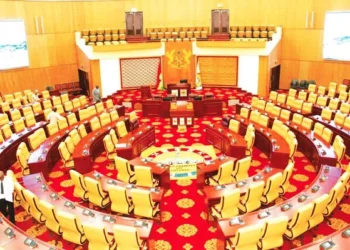

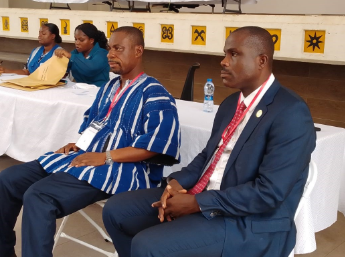
The Kumasi Metropolitan Assembly (KMA) failed to elect a Presiding Member (PM) after two rounds of voting at the Prempeh Assembly Hall on Thursday, 19 February 2026.
Incumbent Patrick Kwame Frimpong and challenger Ernest Baffour Ofori contested the position, with 66 assembly members casting ballots. In the first round, Frimpong received 35 votes to Baffour’s 24. The second round saw Frimpong get 36 votes and Baffour 23.
Both totals fell short of the two-thirds majority required to secure the position. Two other aspirants, Isham Alhassan and Kwame Agyemang, withdrew ahead of the vote. The election was supervised by the Electoral Commission of Ghana, in line with local governance regulations.
Kumasi Mayor
The assembly is now expected to hold further consultations before attempting another vote to fill the presiding member position, leaving leadership in the city’s local authority temporarily unresolved. Kumasi Mayor Richard Ofori Agyemang Bodi says the failure to elect a presiding member at the Kumasi Metropolitan Assembly could delay key projects awaiting House approval.
“For me, I am not surprised at the outcome. Both members have the support of a significant number of members. We can only conduct ourselves within the framework of the law and go and engage a lot more deeply, and have members convinced, so that we will have a presiding member approved. There are projects we need to bring before the General Assembly to proceed. With this development, those cannot be done. What it would mean is that we may suffer the requirement, but when we meet again, we will end this stalemate,” the Mayor posited.
Level-playing field
“I remain neutral”, Ofori-Boadi noted. “These are people I have a good relationship with, and I will continue to remain neutral, and I am ready to work with any member. I am going to do my best to stay neutral. Kumasi residents should also engage their respective assemblymen to get the need to get a presiding member so the assembly can run smoothly.”
Assemblymen
Mixed reactions greeted some of the assemblymen who spoke with our reporter. They were, however, optimistic that the Assembly would elect a new presiding member during the next meeting.
“Very unfortunate”, one of them said. We thought it was going to be a done deal for one of them, but of course, each of us has an opinion. Politics took a different twist today, but I know it will change when we meet again. The Mayor is in a hurry to turn things around, and so we should not disappoint him.”
“For me, I was expecting a one-touch victory, but it didn’t happen. These are all part of the politics. But I am sure we will get back to the conclave and make the right decision in the interest of Kumasi and the people.”
KMA
The Kumasi Metropolis is centrally located in the Ashanti Region of Ghana. Its unique central position makes it accessible from all corners of the country. It is the second largest city in the country and the administrative capital of Ashanti.
It is a fast-growing metropolis with an estimated population of more than 2 million people and an annual growth rate of about 5.4%. The Metropolis is about 254 kilometers in area; its physical structure is basically circular, with a centrally located commercial area.
There are concentrations of economic activities in the city. The first and most important location is the Central Business District (CBD), which embraces the Kejetia Lorry Park, the Central Market, and the Adum Shopping Centre.
The other economic nodes include the Suame Magazine (Vehicle repair centre), the Kaase/Asokwa Industrial Area, and the Anloga Wood Market.
Most industries in Timber processing, logging, Food processing, and Soap making are concentrated in the Kaase/Asokwa Industrial Area.
There is also a number of satellite markets in the metropolis.
These include Asafo Market, Bantama Market, Oforikrom Market, and Atonsu Markets.
It is estimated that 48%, 46%, and 60% of the Metropolis are urban, peri-urban, and rural, respe