

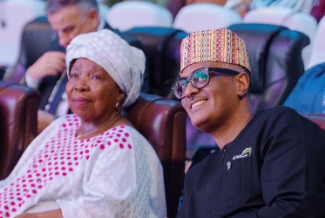
Sidig Faroug El Toum, Chief Executive Officer of the Africa Prosperity Network (APN), has called for urgent, practical action to unlock the full potential of Africa’s small and medium-sized enterprises (SMEs), describing them as the decisive force that will determine whether the African Continental Free Trade Area (AfCFTA) succeeds or fails.
Speaking at the SME Scale-Up Dialogue on the second day of the Africa Prosperity Dialogue (APD) 2026, held at the Accra International Conference Centre (AICC)on Thursday, 5th February 2026, El Toum welcomed ministers, industry leaders, development partners, entrepreneurs, women, and youth representatives, stressing that the conversation was central to Africa’s economic future.
APD 2026, which runs from 4th to 6th February, convened under the theme “Empowering SMEs, Women and Youth in Africa’s Single Market: Innovate. Collaborate. Trade.” The dialogue brought together heads of state, business leaders, innovators, and civil society representatives to discuss strategies for boosting intra-African trade, entrepreneurship, and youth empowerment.
“Today we turn our full attention to an important economic actor who will ultimately determine whether AfCFTA succeeds or fails — Africa’s small and medium enterprises,” he stated.
El Toum highlighted the critical role SMEs play across the continent, noting that they are not marginal players but “transformation agents” driving entrepreneurship, innovation, and employment.
He cited data showing that SMEs account for more than 90 percent of businesses in Africa and employ the majority of the workforce. Importantly, he underscored the sector’s strong demographic significance, with women and young people dominating enterprise ownership and leadership.
“Statistics show that approximately 58% of all African SMEs are women-owned or operated,” he said, adding that youth-led ventures are also reshaping the business landscape, with “65% of startup founders under 30 years.”
Despite their importance, El Toum acknowledged that African SMEs continue to face deep structural challenges, including limited access to affordable finance, fragmented markets, and regulatory systems not designed with their needs in mind.
“Yet too often they remain locked out of finance, fragmented by borders and constrained by systems that were not designed with them at all,” he observed.
He explained that APN was founded on the belief that policy ambitions must be matched with real outcomes, a conviction that gave rise to the Africa Prosperity Dialogues.
“Policy ambition must translate into practical outcomes,” El Toum emphasized.
Under the theme “Empowering SMEs, Women and Youth in Africa’s Single Market: Innovate, Collaborate, Trade,” El Toum said APD 2026 was intentionally designed to move beyond speeches into implementation.
“This SME Scale-Up Dialogue… must serve as a problem-solving space where policymakers, financiers, regulators, and entrepreneurs sit at the same table,” he said.
Discussions during the day, he noted, would confront the real constraints holding SMEs back, including logistics bottlenecks, payments fragmentation, skills gaps, and lack of scalable financing models.
The dialogue will also focus on solutions such as interoperable payment systems, value-chain integration, and practical tools to enable cross-border trade.
El Toum stressed that Africa’s prosperity cannot be achieved by governments or large corporations alone, but only through competitive African enterprises trading with one another and adding value locally.
“Development prosperity will not be delivered by government alone… it will be built by competitive African enterprises trading with each other,” he said.
He reaffirmed that SMEs must be positioned not as beneficiaries but as key partners driving Africa’s single market agenda.
“That’s why APD 2026 places SMEs at the center… not as beneficiaries, but as partners that drive Africa’s single market,” he added.
El Toum urged participants to approach the dialogue with practicality, collaboration, and boldness, stressing that the success of AfCFTA requires courageous reforms, investment, and cross-border trust.
“Africa’s single market will not implement itself,” he cautioned.
He further thanked partners, sponsors, policymakers, financiers, and entrepreneurs for their participation, describing their presence as a strong signal of confidence in Africa’s future.
“The conversation we have today must therefore lead to commitments that endure long after APD 2026 concludes,” he further said.
Pearl Nkrumah, Managing Director of Access Bank Ghana, on her part, has called for stronger financial systems and seamless payment structures to support women-led trade under the African Continental Free Trade Area (AfCFTA). Accordingly, she emphasised that inclusive trade will only thrive if cross-border transactions are made easier and more efficient.
She made the call while contributing to the panel session themed “From Boardrooms to Borders: Women Driving the AfCFTA Agenda” at the 2026 Africa Prosperity Dialogues (APD) on Wednesday, 4th February, 2026, at the Accra International Conference Centre (AICC).
Madam Nkrumah noted that unlocking capital—both within and outside Africa—depends largely on whether countries create enabling environments that facilitate the flow of investments and financing into local economies.
She explained that while Ghana and other African states are already pursuing blended financing arrangements and strategic partnerships with external partners, the real priority must be ensuring that financing directly supports productive trade activities, especially for women entrepreneurs operating across borders.
“For women trading among ourselves, the key question is how do we enable platforms that make it smooth and fluid for a woman in Ghana to ship products to other countries and receive payment back seamlessly,” she said.
Madam Nkrumah highlighted that women-owned businesses require not only access to capital but also functional trade ecosystems—marketplaces, procurement networks, and payment channels—that allow them to move from small enterprises into larger suppliers and regional trade partners.
She pointed out that trade partnerships can also serve as pathways for foreign investment, as businesses abroad collaborate with and fund enterprises in Africa.
As a financial institution, she said Access Bank is working with central banks and other stakeholders to build the governance frameworks, financial products, and payment solutions needed to support cross-border commerce.
Madam Nkrumah referenced ongoing efforts, such as the Pan-African Payment and Settlement System (PAPSS), which facilitate payments among African countries. However, she observed that significant challenges remain, particularly around settlement mechanisms.
“For me, the issue is that after everything is done, we still need to settle in US dollars. That is where the problem is,” she noted.
She argued that Africa’s long-term trade success requires moving beyond dependence on foreign currencies and accelerating discussions toward a single African currency or stronger regional currency frameworks that can support direct settlement between African currencies.
Using Access Bank’s operations across 14 African countries as an example, she explained that customers can already send money across borders in local currencies, but banks still rely on sourcing US dollars behind the scenes to complete settlements.
While acknowledging that progress is being made, Madam Nkrumah called for stronger political will and continental commitment to move from policy dialogue to implementation.
“With continued conversations like this, and the push from talk to execution, we can make the vision of a truly fluid African trade and payment system a reality,” she said.