

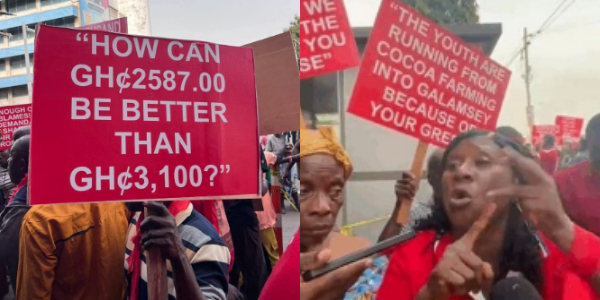
Cocoa farmers from several producing communities converged at the headquarters of the Ghana Cocoa Board (COCOBOD) in Accra on Friday, 20 February 2026, intensifying nationwide protests over what they describe as crippling producer price cuts and persistent payment delays that are pushing farming households into deep economic distress.
Clad in red armbands and carrying placards, the farmers chanted slogans and accused authorities of reneging on commitments to safeguard their livelihoods.
The protest, which took place on February 20, reflected mounting anger across cocoa-growing communities over policies they say have eroded incomes in one of Ghana’s most critical export sectors.
Some of the placards read: “We worked, you lied,” “Government celebrates, but our families mourn,” and “We can’t pay our kids’ school fees.”
The messages underscore the level of frustration among farmers, who argue that, despite their central role in sustaining Ghana’s cocoa industry, they continue to bear the brunt of economic shocks.
Price cut sparks outrage
At the heart of the unrest is the government’s decision to reduce the cocoa producer price from GH¢3,625 to GH¢2,587 per 64kg bag for the remainder of the 2025/2026 crop season — a 28% cut that farmers have described as devastating.
The downward adjustment has sparked outrage, particularly given its sharp contrast with the governing National Democratic Congress (NDC) ‘s campaign promises to improve cocoa prices.
Many farmers say they had anticipated figures between GH¢6,000 and GH¢7,000 per bag based on earlier political assurances.
Standing among the demonstrators in Accra, a visibly frustrated female farmer questioned the rationale behind the price reduction.
“The prices were not reduced under the previous regimes; why is this administration reducing them? We have no problem with the government — they should just leave the prices to remain the same,” she told journalists.
Demands for payment and price review
Protesters are demanding an urgent upward review of the cocoa producer price as well as the immediate settlement of outstanding payments owed to them by Licensed Buying Companies (LBCs) operating under COCOBOD’s supervision.
According to them, delays in receiving payment for beans already supplied have compounded the effects of the price cut, making it increasingly difficult to meet basic household expenses.
“We depend entirely on cocoa,” one farmer said. “When payments delay or prices drop, our families suffer.”
He added that many growers are struggling to mobilise resources to prepare for the next crop season, including land clearing, fertiliser application, and pest control.
Protests spread across the cocoa belts
The demonstration in Accra follows similar protests in key cocoa-growing belts, particularly in the Western North Region, where hundreds of farmers picketed COCOBOD offices and marched through principal streets to demand a reversal of the price reduction.
In Sefwi-Wiawso and surrounding districts, including Bekwai, Asunafo, and Amenfi, demonstrators carried placards bearing inscriptions such as “Save the Cocoa Farmer” and “Our Labour Deserves Better Pay.”
The largely peaceful protest drew elderly farmers, women actively engaged in cocoa cultivation, and young growers who expressed disappointment over what they described as broken promises.
Similar scenes were recorded in the Central and Ashanti Regions, highlighting the depth of frustration within cocoa-growing communities.
In the Assin North District of the Central Region, farmers from Assin Dansame, Asempanaye, Praso, Bereku and Assin Nuaso staged a peaceful protest to register their displeasure.
In Adomfe, in the Asante Akyem area, a demonstration briefly disrupted traffic, prompting the deployment of security personnel to maintain order and ensure calm.
While no major incidents were reported, the scale and coordination of the protests signalled a growing sense of urgency among cocoa farmers nationwide.
Rising production costs deepen crisis
Across the affected communities, farmers cited rising production costs as a major concern.
They pointed to the high prices of fertilisers, agrochemicals, hired labour and transportation as significant burdens that have eroded profitability.
With input costs climbing steadily, they argue that the reduced farmgate price makes cocoa farming increasingly unsustainable.
“Everything has gone up — fertiliser, spraying chemicals, labour — but the price of cocoa has gone down,” one farmer in the Western North Region lamented. “How are we supposed to survive?”
Many smallholder farmers, who form the backbone of Ghana’s cocoa industry, rely almost entirely on cocoa sales proceeds to finance their households.
Income from cocoa is typically used to pay school fees, cover healthcare expenses, support extended family members, and reinvest in farm maintenance.
Any disruption to payment schedules or downward adjustment in prices has an immediate ripple effect on rural livelihoods.
Fears of smuggling and farm abandonment
Some protesters warned that if the situation is not urgently reviewed, a significant number of smallholder farmers may abandon their farms or scale down operations.
Such a development, they cautioned, could reduce national output and undermine Ghana’s standing as one of the world’s leading cocoa producers.
Others expressed fears that the lower producer price could incentivise cross-border smuggling of cocoa beans into neighbouring Côte d’Ivoire, where farmgate prices are perceived as more stable.
Smuggling has historically posed a challenge in border communities, particularly when price disparities widen between the two countries.
Sector under pressure
The unrest comes at a time when Ghana’s cocoa sector is grappling with broader structural challenges, including global price volatility, declining output in some regions, and financial pressures confronting COCOBOD.
While international cocoa prices have experienced fluctuations, farmers argue that domestic price-setting mechanisms must prioritise their welfare and shield them from abrupt income shocks.
COCOBOD has indicated in previous communications that payments have been made to Licensed Buying Companies to facilitate prompt settlement to farmers.
However, many producers insist that the funds have not yet reached them at the farmgate level.
This gap between official assurances and on-the-ground realities has further fuelled distrust and resentment.
Farmer groups say they are not opposed to reforms aimed at stabilising the sector but insist that any adjustments must be transparent and inclusive.
They are calling for direct engagement with policymakers and clearer communication regarding how producer prices are determined.
Analysts note that cocoa remains a cornerstone of Ghana’s economy, contributing significantly to export earnings, rural employment, and foreign exchange inflows.
The welfare of cocoa farmers, therefore, has implications not only for individual households but also for macroeconomic stability.
As the protests spread across multiple regions, observers say the government faces increasing pressure to address the concerns swiftly to prevent further escalation.
While Friday’s demonstrations remained largely peaceful, farmer representatives have hinted at more sustained action if their demands are not met.
For now, cocoa farmers say their message is simple: they want fair prices, timely payments, and policies that reflect the realities of rising production costs. Without these, they warn, the long-term sustainability of Ghana’s cocoa sector could be at risk.
“We are not asking for luxury,” one protester said quietly as the crowd dispersed outside COCOBOD’s headquarters. “We are asking to survive.”