

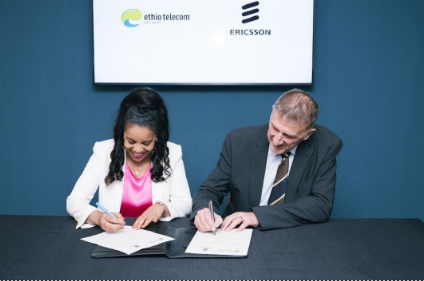
Ethio Telecom has signed a major agreement with Sweden’s Ericsson to expand and modernise Ethiopia’s mobile network, aiming to boost 4G capacity and accelerate the country’s digital transformation.
The agreement was signed on Wednesday at the Mobile World Congress in Barcelona by Ethio Telecom chief executive Frehiwot Tamiru and Ericsson chief executive Börje Ekholm during the annual global telecommunications gathering.
The deal marks one of the most significant upgrades to Ethiopia’s telecom infrastructure in recent years, as the state-owned operator seeks to strengthen connectivity and meet rapidly growing demand for mobile data services.
Under the agreement, the project will expand, upgrade and add 4G technology layers to approximately 1,500 mobile network sites within the Ericsson-managed network circle. The initiative forms part of Ethio telecom’s three-year Next Horizon Strategy, which focuses on strengthening digital infrastructure and expanding high-speed connectivity across the country.
Replacing legacy network infrastructure with modern technology platforms is expected to significantly improve network quality, coverage, and capacity. Ethio Telecom said the upgrades will substantially boost fourth-generation network capacity and expand its fifth-generation footprint.
The improvements are expected to support the high-speed connectivity needed for Ethiopia’s rapidly growing digital economy, where mobile internet is increasingly central to financial services, e-commerce, and public service delivery.
Expanding connectivity beyond cities
Beyond major urban centres, the programme will prioritise expanding “connectivity” to underserved communities.
The project includes the deployment of 75 rural network solution sites designed to operate in areas without access to commercial electricity. These installations aim to “bridge” both network coverage gaps and digital usage disparities between urban and rural populations.
In addition, the modernisation effort will upgrade 502 existing third-generation mobile sites, making them fully compatible with fourth-generation technology and improving overall service quality for millions of users.
Within the Ericsson “managed network circle,” the project will add roughly 2.8 million new 4G-capacity connections. This will raise the network’s total capacity to around 4.1 million connections.
The expansion will also extend LTE services to 157 additional towns, increasing the total number of connected towns to 276.
Ethio Telecom estimates that the upgrades will increase population coverage in the network area by about 45 percent, ultimately reaching roughly 85 percent of the country’s population.
Industry observers say the investment reflects Ethiopia’s broader effort to strengthen its digital infrastructure and support the growth of technology-driven services across sectors, including finance, commerce, and government services.
Improved network reliability and faster mobile internet speeds are expected to support the expansion of digital platforms such as telebirr, ZemenGebeya, and Znexus, which depend heavily on stable broadband connectivity.
Tamena Mulugeta, communication specialist at Ethio Telecom, said the agreement represents a major step in the country’s digital development.
“This is an impressive milestone for Ethiopia’s digital journey,” Mulugeta said. “The partnership between Ethio Telecom and Ericsson not only modernizes and expands the network across urban areas but also ensures equitable digital access for rural communities, including those without commercial power.”
He added that the deployment of advanced infrastructure and 4G and 5G capabilities would help strengthen the foundations for a modern and inclusive digital economy.
Ethio Telecom said that continued investment in advanced technologies and global partnerships remains central to its ambition to position Ethiopia as a leading digital hub in Africa.