

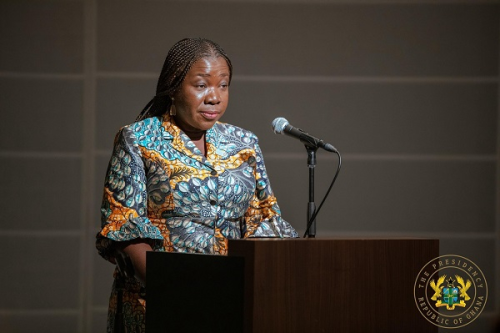
Ghana is losing an estimated $2.5 billion annually due to its continued reliance on exporting raw materials instead of finished or semi-processed goods, according to the country’s Trade, Agribusiness and Industry Minister, Elizabeth Ofosu-Adjare.
Speaking at the Kwahu Business Forum 2026 held at the Kwahu Convention Centre on April 4, the minister raised concerns about structural weaknesses in Ghana’s export economy. She noted that the country continues to forfeit substantial revenue and job creation opportunities by exporting commodities such as cocoa, gold, and timber in their raw state.
She stressed that value addition remains one of the most critical steps Ghana must take to strengthen its economic resilience.
According to the minister, the $2.5 billion loss represents not only foregone revenue but also missed opportunities for industrial growth, employment, and technological advancement.
She further announced that Ghana’s long-awaited national agribusiness policy has reached an advanced stage, having been finalised and submitted for public consideration following months of stakeholder consultations that began in July 2025. The policy is now expected to proceed to Cabinet for approval, in line with earlier indications by President John Dramani Mahama.
Elizabeth Ofosu-Adjare explained that the policy is designed to reverse the long-standing structure of the economy, where primary agricultural products are exported with little or no processing, leaving much of their value unrealised.
“The constraint has been scale and the conditions necessary to achieve it,” she said, pointing to persistent barriers that have limited the expansion of Ghanaian enterprises despite their innovation and potential.
According to her, the policy outlines measures to retain more value within the country by promoting agro-processing and strengthening linkages across the agricultural value chain.
She added that the ministry has also developed complementary industrial policies targeting key sectors—including textiles and garments, pharmaceuticals, and automobile components—to provide clearer regulatory direction, incentives, and standards for investors. These policies are expected to be submitted to Cabinet in the coming months.
The renewed push for value addition also aligns with broader continental goals under the African Continental Free Trade Area, which aims to boost intra-African trade and industrialisation. By exporting more finished goods within Africa and beyond, Ghana could reduce its vulnerability to global commodity price fluctuations.
Mrs Ofosu-Adjare further disclosed that the government is repositioning special economic zones to support agro-processing and light manufacturing, shifting away from their traditional role as export enclaves.
She urged the private sector to respond to this policy direction by investing in technology, skills development, corporate governance, and compliance with standards, stressing that government initiatives alone will not deliver results without active business participation.