

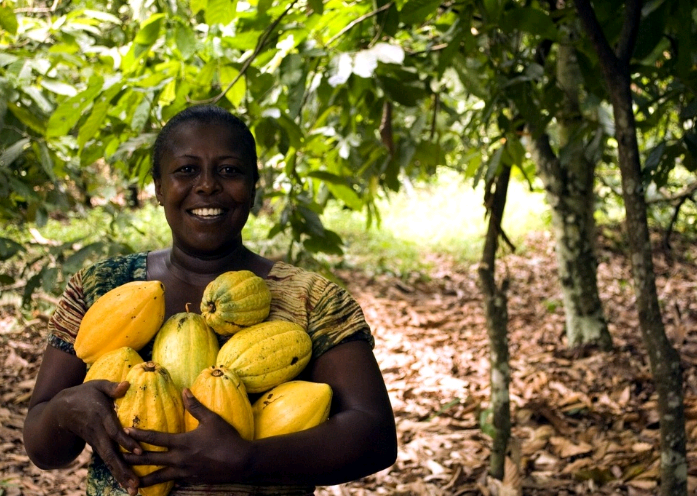
Nigeria’s cocoa farms are showing signs of recovery after early rains revived flowering and pod development, but a deepening labour crisis is threatening to undermine the country’s long-standing export ambitions.
Across major cocoa-producing regions, farmers say improved rainfall has lifted expectations for the 2026/27 season after erratic weather disrupted production earlier this year.
Yet even as conditions improve on the farms, many growers warn they are struggling to find workers to harvest, spray, and maintain cocoa trees — a shortage that is driving up labour costs and squeezing already fragile margins.
The contradiction captures a broader challenge facing Africa’s fourth-largest cocoa producer: while global cocoa markets remain desperate for supply after production troubles in Côte d’Ivoire and Ghana, Nigeria’s own structural weaknesses continue to limit its ability to capitalise fully on the opportunity.
“We expect the cherries to come out bigger once the leaves turn green, as the rain increases,” David Onyenweaku, a farmer in Amuzuoro in Umuahia North Local Government Area in Abia State, told Allen Dreyfus.
Farmers say the early rains have already improved harvests during the light-crop season, the second and smaller phase of the cocoa cycle that marks the close of the 2025/26 season, which officially ended on May 11.
The previous season, however, was heavily affected by delayed rainfall across several cocoa-growing regions, disrupting flowering cycles and reducing yields.
Now, attention is shifting from weather to labour.
Nigeria’s cocoa farms are running out of workers
Farmers across southern Nigeria say labour shortages have become one of the industry’s biggest threats, with younger Nigerians increasingly abandoning farming communities for cities and white-collar employment.
“We don’t see labor to employ.
That is the problem we are facing now,” Onyenweaku said. “My operational vehicle has been parked since the beginning of the year because there is no driver. The young people are not interested in agriculture.”
The crisis is particularly severe in rural communities where cocoa farming depends heavily on manual labour for pruning, spraying, harvesting and transporting beans.
In Ikom, one of Nigeria’s major cocoa-producing areas, farmer Richard Ndoma said rural-urban migration has steadily drained villages of working-age labourers.
“Many of them go to school in the cities, and when they graduate, they do not return to the village,” he said.
The result is a sharp escalation in wage costs at a time when cocoa prices are becoming increasingly volatile.
Farmers say wages have doubled in some areas over the past two years.
In Umuahia, daily wages have climbed to N4,000 for a workday stretching from around 8:30am to 2:30pm, according to Onyenweaku. In Ikom, labour costs have risen even more sharply.
“The daily wage rate has risen to N10,000 per worker, up from N5,000 two years ago,” Ndoma said. “Today, you also pay an additional N2,000 per worker for feeding per day; two years ago, it was N1,000.”
For many farmers, the labour shortages are now directly affecting productivity and reducing profitability.
“We buy chemicals at high costs, feed workers, pay high wages, and prune the farms,” Ndoma said. “You can have the money, but if there is no worker to handle the sprayer, you cannot spray the farm.”
The labour squeeze has intensified just as cocoa prices, which surged to historic highs last year amid global shortages, have begun easing.
Ndoma said prices paid to farmers in Ikom have fallen sharply from around N1 million per 65kg bag last year to roughly N260,000. “Prices are not helping the farmers; they are helping only the middlemen,” he said.
Farmers say wage pressures have been building for several years but worsened significantly during the cocoa price boom, when workers demanded higher pay to match rising revenues across the industry.
Nigeria’s cocoa expansion plans face a reality check
The labour crisis now poses a direct challenge to Nigeria’s wider economic ambitions. Successive governments have promoted cocoa as a strategic non-oil export capable of helping diversify Africa’s largest economy away from crude oil dependence.
Nigeria has repeatedly announced plans to expand production and strengthen agricultural exports as part of broader economic reforms.
But output growth has consistently fallen short of official targets.
Nigeria had aimed to produce 500,000 metric tonnes annually by 2025 before later unveiling a longer-term plan to increase production to 1 million metric tonnes by 2030.
Yet production reached only 344,000 metric tonnes during the 2024/25 season. Final figures for the just-ended 2025/26 season are not yet available.
Analysts say the gap between ambition and reality reflects deeper structural weaknesses within Nigeria’s agricultural sector.
Many cocoa farms remain old and less productive. Mechanisation is limited. Rural infrastructure remains weak. Access to finance is uneven. And labour shortages are steadily eroding production capacity.
Those challenges are becoming more significant at a moment when global cocoa markets remain unusually fragile.
Production problems in Ghana and Côte d’Ivoire — which together account for more than half of global cocoa supply — have already tightened global inventories and fuelled extreme price volatility over the past year.
That has created an opening for smaller producers such as Nigeria to increase exports and gain market share.
But farmers warn that without urgent reforms, Nigeria risks missing the opportunity.
Improved rainfall may support yields in the coming season, but producers say weather alone cannot solve deeper structural problems undermining the sector.
Without mechanisation, farm renewal programmes and stronger incentives to keep young people in rural agriculture, many believe Nigeria’s cocoa industry could struggle to sustain meaningful long-term growth.