
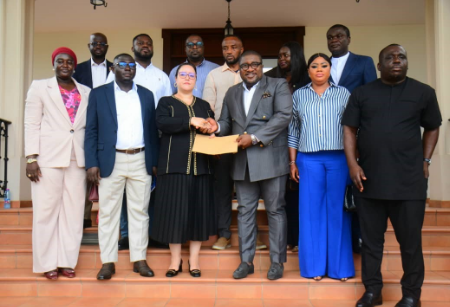
The opposition New Patriotic Party has formally petitioned members of the diplomatic community in Ghana over an alarming deterioration in democratic governance, constitutional freedoms, and political tolerance under the administration of John Dramani Mahama.
In a petition dated May 19, 2026, and jointly signed by the General Secretary of the NPP, Justin Kodua Frimpong, and the Minority Leader in Parliament, Osahen Alexander Kwamena Afenyo Markin, the party accused the government of orchestrating what it termed a systematic campaign of political intimidation, suppression of dissent, and weaponization of state institutions against critics and opposition figures.
Addressed to foreign missions, development partners, and international human rights organizations, the petition warned that Ghana’s democratic reputation, once admired across Africa and beyond, is facing a serious test due to what the NPP claims is the growing abuse of state power to silence opposing voices.
According to the party, recent developments in the country reflect a dangerous return to what it describes as a “culture of silence,” in which citizens increasingly fear arrest, prosecution, and detention for expressing political opinions critical of government officials or state institutions.
The petition argued that the Mahama administration is gradually reviving criminal libel through indirect means despite the repeal of the Criminal Libel and Seditious Laws in 2001 under the government of former President John Agyekum Kufuor.
The NPP maintained that the repeal, championed at the time by former Attorney General Nana Addo Dankwa Akufo-Addo, marked a historic turning point for press freedom and democratic accountability in Ghana.
However, the party alleged that the current administration is now relying on Sections 207 and 208 of the Criminal Offenses Act to prosecute political speech and dissenting commentary.
The petition cited the recent arrest and remand of the Bono Regional Chairman of the NPP, Kwame Baffoe, as one of the clearest examples of what it described as the criminalization of political expression.
According to the NPP, Abronye DC was arrested and arraigned before an Accra Circuit Court on charges, including offensive conduct conducive to breach of peace and publication of false news, following comments he allegedly made about judicial impartiality.
The party argued that criticism of judges or public officials should not subject the critic to criminal prosecution in a constitutional democracy, insisting that civil remedies already exist for reputational disputes through defamation proceedings.
The petition further criticized the court’s decision to deny Abronye DC bail, describing the reasoning that he might continue making similar comments if released as an affront to constitutional liberties and the presumption of innocence.
Beyond the Abronye case, the NPP listed several individuals it claimed have become victims of politically motivated intimidation and prosecution since the National Democratic Congress returned to power in January 2025.
Among those named were Rev. John Ntim Fordjour, Paul Adom Otchere, Mohammed Zakou, Kofi Ofosu Nkansah, Alfred Ababio Kumi, Gordon Asare Bediako, Abubakar Yakubu, and David Essandoh.
The NPP claimed that state security institutions, including the National Investigations Bureau, EOCO, and the Ghana Police Service, are increasingly being used as tools of political intimidation through dramatic arrests, prolonged detentions, dawn raids, and punitive bail conditions.
The petition expressed concern over what it described as the growing use of national security detention facilities for matters related purely to political speech and commentary.
It further alleged that some opposition figures have been subjected to humiliating public arrests intended to intimidate not only the individuals involved but also the wider opposition political community.
On the issue of selective justice, the NPP accused law enforcement agencies of ignoring alleged acts of violence and threats involving individuals linked to the governing National Democratic Congress while swiftly prosecuting members of the opposition.
The party referenced incidents connected to the Akwatia by-election, claiming that despite petitions and evidence submitted against some NDC-affiliated persons over alleged attacks and threats against NPP officials, no significant action had been taken by the police.
The petition also raised concerns about judicial independence following the removal of Chief Justice Gertrude Araba Esaaba Sackey Torkornoo.
According to the NPP, there is growing apprehension within legal and judicial circles that judges who issue decisions perceived as unfavorable to the Executive may face professional victimization or political retaliation.
The party warned that public confidence in the judiciary risks being undermined if courts are perceived to be endorsing politically motivated prosecutions or punitive detention orders in speech-related matters.
The NPP therefore appealed to the diplomatic community and international democratic institutions to closely monitor developments in Ghana and publicly reaffirm support for freedom of expression, judicial independence, due process, and political pluralism.
Among other requests, the party called for international engagement with the Government of Ghana on what it termed the increasing misuse of criminal prosecutions against opposition figures and dissenting voices.
It also urged development partners and democratic institutions to encourage Ghanaian state agencies, especially the judiciary and security services, to operate within constitutional limits and without partisan bias.
Concluding the petition, the NPP stated that the matter transcends partisan politics and concerns the broader future of constitutional democracy in Ghana.
The party warned that democratic erosion often begins gradually through selective prosecutions, intimidation of critics, suppression of dissent, and the normalization of fear.
The NPP pledged to continue defending democratic freedoms and civil liberties through lawful means. It called on the international community to stand with the people of Ghana in protecting democratic accountability and the rule of law.