

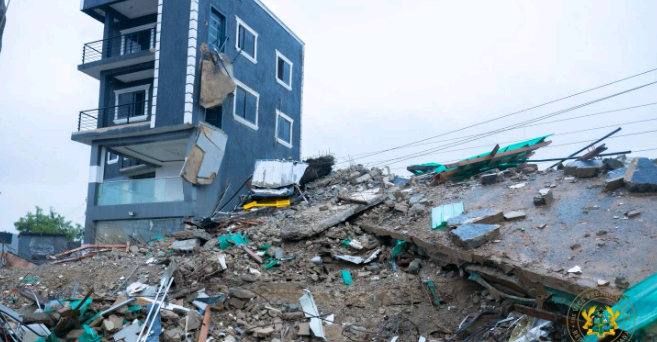
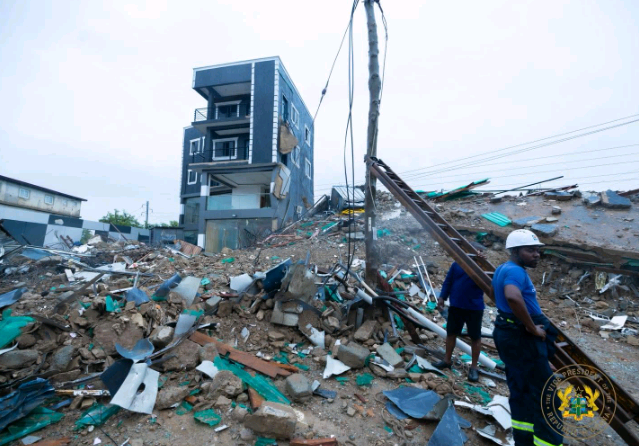
Rescue teams have retrieved one more body from the rubble of the collapsed building at Avenor in North Kaneshie, located in the Greater Accra Region, bringing the confirmed death toll to two.
The tragic incident, which occurred on Sunday, June 7, has left families and the surrounding community in distress as emergency responders continue efforts to locate and rescue individuals who may still be trapped beneath the debris.
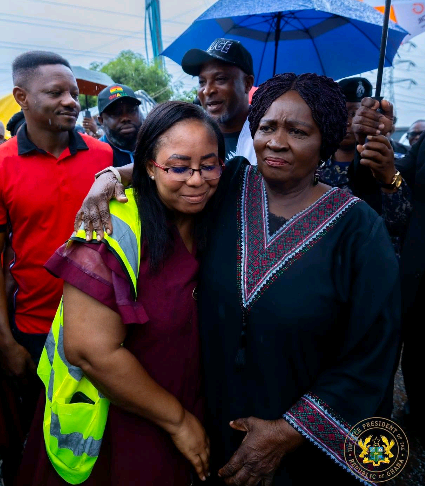
In addition to the confirmed fatalities, two other victims have been successfully rescued from the collapsed structure and were quickly transported to the Ridge Hospital in Accra for urgent medical attention.
The collapsed building, which reportedly housed both residential and commercial occupants, came down suddenly, prompting panic in the densely populated area.
The structure’s failure triggered an immediate response from emergency services, including personnel from disaster response units, security agencies, and medical teams who have since been working tirelessly at the scene.
Search and rescue operations remain ongoing, with responders carefully combing through the debris in an effort to ensure that no additional victims are left trapped.
Heavy-duty equipment and manual rescue methods are being deployed to remove layers of rubble while maintaining caution to prevent further injury or collapse of unstable sections.
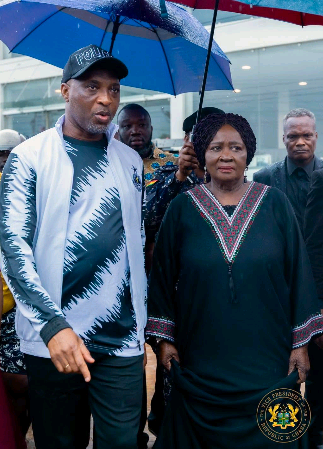
In this regard, Vice President Professor Naana Jane Opoku-Agyemang has called for strict adherence to building regulations and greater accountability following the collapse of a building at Avenor in North Kaneshie, near Melcom Plus
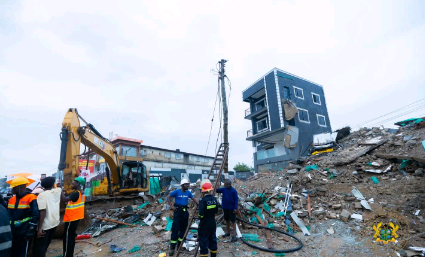
She made the remarks on Sunday, June 7, when she visited the scene of the incident, where one person has been confirmed dead and two others remain trapped under the debris as rescue efforts continue.
Speaking to journalist, she stressed that many such incidents are preventable if stakeholders consistently do the right thing and comply with established rules and safety standards.
She noted that while rules may not always be popular, they are essential for order and safety, adding that failure to enforce them often leads to avoidable tragedies.
“There are many things we can all prevent, and it is about doing the right things—we know them. We don’t need to wait. As we are standing here, we are being told that somebody is trapped in there. Why should this happen?
“So please, all I am saying is that let us abide by the rules. I said only yesterday or so that rules may not always make sense, and nobody likes them, but we need rules. Otherwise, nothing will function” she said.
The Vice President further called for thorough investigations into the collapse and urged all responsible parties to cooperate fully with accountability processes.
She emphasized the need to learn from the incident to prevent similar occurrences in the future, insisting that collective responsibility is key to safeguarding lives and property.
“And we need to do proper investigation. We must all open ourselves to be held to account. It’s all of us. This really maybe needn’t have happened. But what could we have done? What do we do to ensure that going forward, we are not seeing many like these? We all know the right things to do. Let us make them possible” she added.
In a related development, Road and Building Consultant, Ing. Abdulai Mahama, has noted that recent wave of building collapses reflects persistent construction violations rather than a sudden or isolated failure.
He explains that many structural failures in Accra are linked to deviations from approved building designs, poor material quality, and weak enforcement of construction standards.
According to him, although building plans are often properly vetted and approved by local authorities, the real problems begin at the construction stage where specifications are frequently altered.
“The assemblies would have their drawings properly approved, but when it comes to the execution of the construction, that is where some of the owners of the buildings decide to shortchange their own designs.”
“In terms of the number of iron rods they are supposed to put in the building and then the concrete mix, let’s say if I know that one cement bag is supposed to produce 30 blocks… people go and do 60 or 40 blocks with one cement bag.”
He noted that such compromises significantly weaken structural integrity over time, even if buildings initially appear stable.
Ing.
Mahama also pointed to weak site supervision and limited regulatory inspections as contributing factors, saying assemblies are expected to conduct stage-by-stage checks but often lack the capacity to do so consistently.
He further highlighted the importance of soil testing before construction, stressing that failure to assess ground conditions can lead to long-term structural instability, particularly for multi-storey buildings.
The consultant also cautioned against altering the intended use of buildings after construction, explaining that converting residential structures into commercial spaces without redesign increases structural load beyond design limits.
He said such changes often manifest as cracks, column stress, and eventual structural failure if not professionally assessed.
The comments come in the wake of the Avenor building collapse in North Kaneshie, where rescue operations are still ongoing, and authorities continue to assess the cause of the incident. So far, one person has been confirmed dead.