

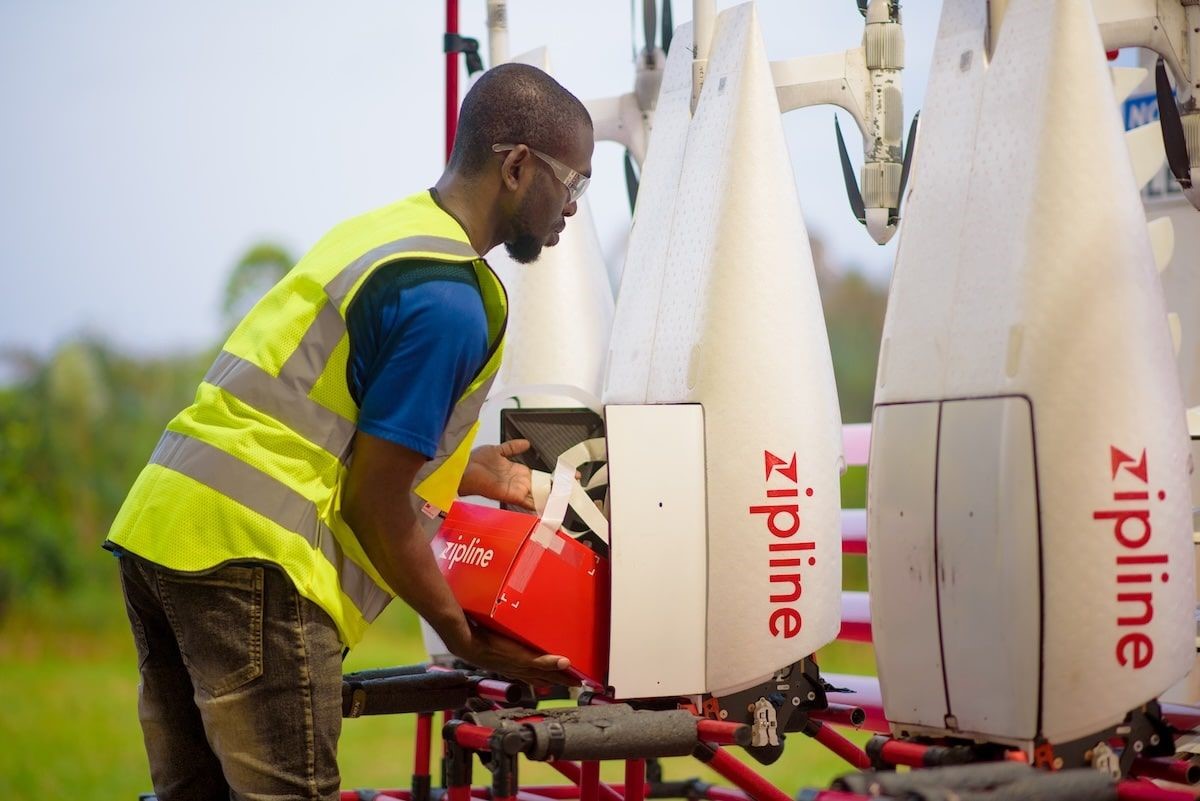
The Minority in Parliament has revealed that the medical drone delivery company Zipline is shutting down three of its operational centres due to the government’s indebtedness of GH¢175 million.
The caucus warned that the move poses a grave danger to public health, as the closures will severely disrupt the delivery of blood, vaccines, and other life-saving medical supplies, particularly to hard-to-reach communities that rely heavily on the drone service.
Raising the concern during debate on the 2026 Budget on Tuesday, November 25, the Ranking Member on the Health Committee, Dr Ayew Afriyie, criticised the government for failing to engage the company and honour its financial obligations, despite recognising Zipline’s critical role in the health delivery chain.
“Zipline is decommissioning three of its centres, Centres 4, 5, and 6. There has been no engagement, and the government has been unable to provide funds.
“The allocation for Zipline was only GH¢20 million, even though the government currently owes the company GH¢175 million,” he said.
In 2019, before the coronavirus pandemic upended the world, the Government of Ghana partnered with Zipline to deliver medical supplies, including vaccines, from local distribution centres directly to health facilities through a network of autonomous drones.
Several years later, Zipline has delivered over 8 million doses of routine and COVID-19 vaccines in Ghana. And early research suggests this partnership is transforming public health in ways that neither Zipline nor the Government predicted.
It turns out, better vaccine access creates a ripple effect. Vaccines prevent deadly diseases, but they do much more. They open the door to better health by changing expectations around access, a shift we’re only just learning.
Imagine a woman, a farmer, who lives in the North East Region of Ghana, near the Burkinabé border. She has two children, a newborn and a two-year-old. Her baby is sick, so she stops farming early and walks several hours with both children to the hospital in Walewale.
They wait in the heat for half the day to see the doctor. During the visit, the doctor realises the baby hasn’t started its series of tetanus, diphtheria, and pertussis vaccines.
This is a crucial moment for the family’s health, and it hinges on the contents of the hospital’s refrigerator. Here, one of two things can happen.
First, the hospital has the DTaP vaccine cocktail in stock, and the doctor gives the child a shot. In the second scenario, the hospital is out of stock, which means the doctor will treat the baby, then refer the mother to another clinic to start the vaccine series, or tell her to return when the hospital has the vaccine.
From a public health standpoint, the second scenario is catastrophic, according to Pedro Kremer, Head of Global Health Impact at Zipline. “In remote areas, when someone reaches a health facility, there’s an opportunity to vaccinate,” he says. “If the vaccine is stocked out, that person will go home and may not make contact with the health system again for years. We call that a missed opportunity, and it is a serious public health problem.”
A missed opportunity means the baby may never receive routine vaccines, putting it at risk of contracting or spreading life-threatening diseases. Children with whooping cough, or pertussis, a bacterial infection that can cause flu-like symptoms in children and respiratory damage in babies, spread the disease to an average of 15-17 other people in unvaccinated communities.
To prevent this, the Government of Ghana partnered with Zipline to increase the reach of its vaccine distribution program. During the official program launch in 2019, Vice President Alhaji Dr Mahamudu Bawumia declared it a “major step towards giving everyone in this country universal access to lifesaving medicines.”
At that point, Zipline had already built the largest autonomous delivery network in the world, having flown more than 11,800 deliveries in Rwanda, where it launched in 2016.
Zipline had spent three years in Rwanda solving the last-mile problem for medical products, such as blood, that need to stay cold. Zipline’s two distribution centres stored refrigerated blood processed by the Rwanda Biomedical Centre.
Doctors and nurses then ordered the blood they needed for resupplies or emergencies, and a Zipline drone delivered the chilled blood within 45 minutes.
The Government of Ghana wanted to take the on-demand cold-chain model developed by Zipline for blood and apply it to medical products, including vaccines.
Ghana’s program launched with four Zipline distribution centres that could reach more than 2,000 hospitals and health centres across the country.
By the beginning of March 2020, the program was growing steadily. Zipline was delivering several hundred doses of routine vaccines per month.
Then, on March 22, 2020, President Nana Akufo-Addo issued the order to close Ghanaian borders to prevent the spread of the novel coronavirus, initiating a national lockdown.
Still a year out from the first COVID-19 vaccine, Ghana’s system for delivering routine, life-saving vaccines hit a wall.
Before Zipline, Ghana’s system required health workers, particularly those in the hard-to-reach communities, to drive to a regional cold room, put vaccine doses in a cold box, and transport them to a health centre.
Also, at the time, 15 of Ghana’s 216 districts lacked the cold-chain equipment they needed. And seven out of Ghana’s 16 regions hadn’t installed walk-in cold rooms.
This meant Zipline’s ability to ship vaccines while protecting workers’ health mattered more than ever.