

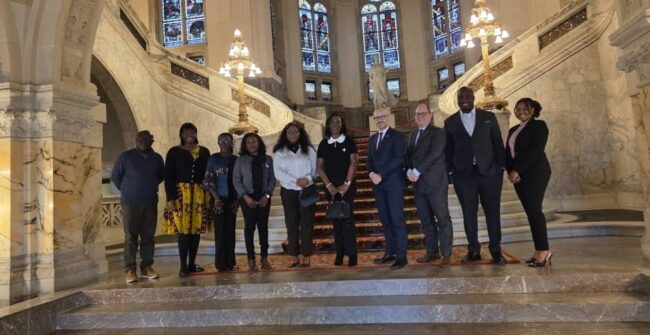
The Dean of the Law School of the Ghana Institute of Management and Public Administration (GIMPA) Law School, Dr Kwaku Agyeman-Budu, recently concluded a landmark visit to The Hague as part of the Ghanaian delegation attending the 24th Annual Assembly of States Parties to the Rome Statute of the International Criminal Court (ICC).
Alongside senior officials from the Ministry of Foreign Affairs and the Ministry of Justice, the Dean paid a courtesy call on H.E. Marcin Czepelak, Secretary‑General of the Permanent Court of Arbitration (PCA), at the historic Peace Palace.
The meeting focused on accelerating Ghana’s accession to the Hague Conventions for the Pacific Settlement of International Disputes (1899 & 1907) and unlocking the attendant benefits for Ghana’s legal and dispute-resolution framework.
During the discussions, Dr Agyeman-Budu highlighted GIMPA Law School’s commitment to internationalisation and invited the PCA Secretary‑General, Marcin Czepelak, to visit Ghana.

The invitation aligns with the Law School’s track record of hosting high‑profile visitors from the International Criminal Court (ICC) and other international tribunals, who deliver public lectures, interact with faculty and students, and engage with Ghana’s three branches of government whilst in Ghana at the invitation of GIMPA.
GIMPA Law School, therefore, hopes to explore a potential partnership with the PCA that could mirror the existing Memorandum of Understanding (MoU) between the African Centre of International Criminal Justice (ACICJ) (hosted by GIMPA Law School) and the International Criminal Court (ICC).
A collaboration with PCA would broaden academic exchange, joint research, and capacity‑building initiatives, especially given GIMPA’s innovative Master of Laws (LLM) programme in Dispute Resolution Law and Practice, which will provide students with hands‑on exposure to international arbitration and mediation mechanisms.
The potential visit to Ghana by the Secretary‑General at the invitation of GIMPA would mark the first PCA leadership visit to the country, reinforcing Ghana’s role as a hub for international law in Africa.
Dr Agyeman-Budu remarked that: “This visit will underscore GIMPA Law School’s mission to be a centre of excellence where theory meets practice. Partnering with the PCA will not only enrich our curriculum but also empower Ghanaian legal professionals to engage confidently in global dispute resolution.”The meeting was put together by Ms Christine Amankwa, a distinguished alumna of the GIMPA Law School and now an Assistant Legal Counsel at the Permanent Court of Arbitration in The Hague.

Ghana’s accession to the Hague Conventions of 1899 and 1907 on the Pacific Settlement of International Disputes will enhance Ghana’s participation in peaceful dispute settlement mechanisms and open pathways for foreign investment and development cooperation.
About GIMPA Law School
GIMPA Law School, a pioneer in legal education in West Africa, blends rigorous academic training with practical engagement.
The GIMPA Law School is one of the ideal law schools in Ghana for the pursuit of legal scholarship and training of would-be lawyers, legal academics, and policymakers.
Since its establishment in 2010, GIMPA Law has quickly emerged as a preeminent centre of learning, emerging among the Ghanaian Law Faculties as the Faculty of choice.

The school’s rigorous standards and tested pedagogies prepare its students for an increasingly competitive legal educational environment and a complex legal marketplace.
The carefully crafted atmosphere at the school creates a congenial environment for students to realise their potential and fully develop nascent talents in law.
With its deep-rooted belief in the efficacy of practical lawyering, GIMPA Law provides clinical legal education, including student participation in law clinics, moot courts, international exchange programmes, and practical courses of study from the first year of enrolment through to graduation.
Through its African Centre of International Criminal Justice (ACICJ) and the African Centre on Law and Ethics (ACLE), and a growing network of international partners, the school prepares the next generation of lawyers, judges, policymakers, and advocates to navigate both local and global legal landscapes.