
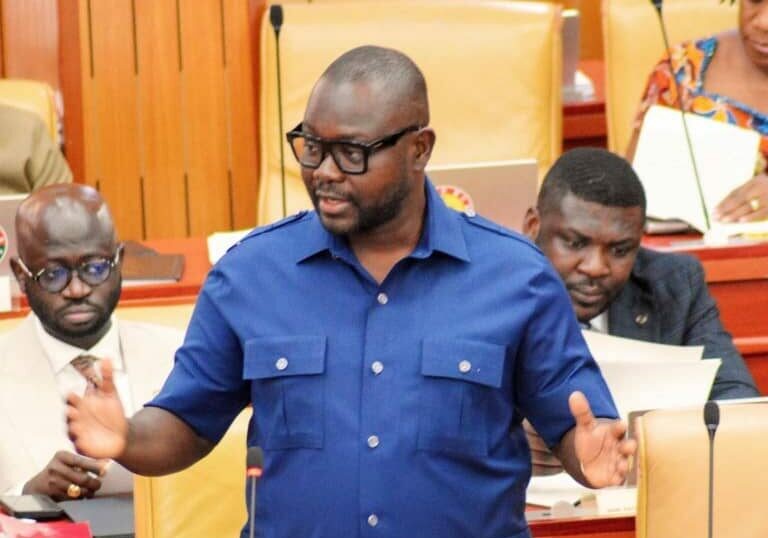
The Ranking Member of the Committee on Local Government, Chieftaincy and Religious Affairs, Hon. Francis Asenso-Boakye, has cautioned the government against what he described as “creeping centralisation” that threatens the constitutional foundation of Ghana’s decentralisation agenda.
Speaking during a motion to approve the 2026 Budget Estimates of the Ministry of Local Government, Chieftaincy and Religious Affairs—amounting to GH¢4.79 billion—the Bantama MP praised the Ministry for achievements recorded in 2025, but warned that growing central interference in local governance decisions is undermining accountability and service delivery.
He cited Articles 240–252 of the 1992 Constitution and the Local Government Act, noting that the increasing practice of prescribing operational guidelines and project choices from the centre contradicts decentralisation principles.
“Assemblies cannot be accountable to their people if they lack discretion and timely resources,” he stressed.
Hon. Asenso-Boakye outlined concerns, including compensation consuming 65% of the Ministry’s allocation, inadequate technical staff and logistics at the MMDAs, and delays in funding release. However, he singled out the rise in central directives as the most worrying trend, describing it as a “structural threat to local democracy.”
The Committee recommended strengthening the capacity of MMDAs, rebalancing resource allocation, and restoring local autonomy through predictable financing and reduced central control.
Despite the concerns, the Ranking Member supported the approval of the GH¢4.79 billion budget, urging the government to protect the integrity of Ghana’s decentralisation architecture.
Wide Gap Between Budget and Actual Releases Delaying Key Local Government Projects — Committee Report Reveals
In a related development, Asenso-Boakye says a significant discrepancy between approved budget allocations and actual fund releases is crippling essential local government projects across the country.
Commenting on the committee’s report, ranking member of the committee on Ministry of Local Government, Chieftaincy and Religious Affairs, Francis Asenso-Boakye, revealed that the persistent shortfall in releases—particularly for Capital Expenditure (CapEx) and Development Partner funds—has stalled several ongoing projects, including regional coordinating council (RCC) office complexes, staff bungalows, and spatial planning facilities.
“The gap between what is approved and what is actually released is undermining the Ministry’s ability to deliver on its mandate,” he stated.
The Committee noted that Compensation alone accounts for 65% of the Ministry’s 2026 allocation of GH¢4.79 billion, leaving limited fiscal space for service delivery and infrastructure. Even the reduced allocation for Goods & Services and CapEx is further weakened by delayed or partial releases.
These funding inconsistencies have also affected monitoring activities, logistics support to MMDAs, and human resource strengthening—critical pillars for effective local governance.
Despite acknowledging the Ministry’s achievements in data system upgrades, civil registration improvements, and temporary employment for over 65,000 vulnerable persons, the Committee described the financial gaps as a “major structural challenge” that threatens project continuity and undermines value for money.
Hon. Asenso-Boakye urged the Ministry of Finance to improve the predictability of releases and prioritize critical service areas to avoid stalling national development at the local level.
Parliament is expected to approve the GH¢4.79 billion budget, subject to the Committee’s recommendations for enhanced financing discipline and improved resource flow.