
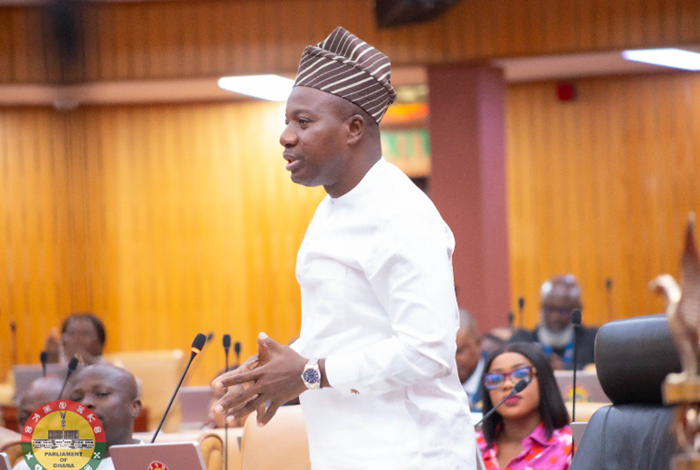
The Majority Leader in Parliament and Member of Parliament for Bawku Central, Mahama Ayariga, has indicated he would feel compelled to champion a third-term agenda for President John Dramani Mahama should the National Democratic Congress (NDC) formally direct him to do so.
Ayariga explained that in such a scenario, his personal reservations would likely be superseded by his duty to the party as the Leader of Government Business. He stressed that his only alternative to executing the party would be to resign from his leadership role.
“If my party takes a decision that it is something they want to pursue, and if I initially oppose it but am unable to convince them otherwise, and they convince me of their position, then in my role as Leader of Government Business, I would be obliged to pursue it… If I don’t accept, then I would have to resign.”
The Majority Leader offered this perspective during an appearance on JoyNews’ AM show on December 10, 2025.
However, Ayariga was quick to clarify the current position of the ruling party. He asserted that the NDC presently has no intentions of pursuing a constitutional amendment for a third term.
He suggested that the persistent accusations from the opposition are counterproductive and could inadvertently fuel the very idea they are trying to prevent.
“I think that the Minority are rather trying to incite us to do something that we have clearly said we are not thinking about now,” he stated.
These comments follow repeated allegations from the Minority caucus and the New Patriotic Party (NPP), accusing the President and the NDC of attempting to manipulate key state institutions.
The opposition claims this alleged manipulation is intended to facilitate an amendment of the Constitution, which would allow Mr. Mahama to contest the 2028 election for a third time.
Most recently, the opposition raised similar concerns following the Tamale High Court’s order for a rerun of the 2024 Kpandai parliamentary elections, suggesting the government was steering the legal process to serve its interests.
It is noteworthy that President John Dramani Mahama, who is currently serving his second and final term under the existing constitutional limits, has publicly denied having any plans for a third term.
In a related development, Minister of State in Charge of Government Communications, Felix Kwakye Ofosu, has dismissed claims that President John Dramani Mahama intends to seek a third term in office, describing the allegations as unfounded.
The comments follow claims by the New Patriotic Party (NPP) that President John Dramani Mahama has a hidden plan to seek a third term in office, despite the constitutional two-term limit.
They cited statements by some National Democratic Congress (NDC) supporters and activists on social media calling on Mahama to remain in office beyond two terms.
Speaking on Channel One TV’s Face to Face on Tuesday, December 9, with Umaru Sanda Amadu, Mr. Kwakye Ofosu rejected the claims, saying;
“The NPP has whipped itself into needless frenzy. President Mahama has stated emphatically that he will respect the Ghanaian Constitution. Because he’s a consummate democrat, so there’s no third term anywhere for him or any other person as far as the constitution is concerned.
“Anyone can say what they want. The fact that some people have gone on Facebook to say he should go for a third term doesn’t mean that will happen. The man himself has said he’s not interested.”
Mr. Kwakye Ofosu urged the opposition to refrain from what he described as needless speculation.
“So NPP should stop wasting their time and everybody’s time, and purporting to be angry. It’s an absurd fantasy they’re getting themselves into. The President has not expressed any intent. Any talk about it is a complete waste of everybody’s time,” he added.
President John Dramani Mahama, on August 27, reaffirmed his commitment to Ghana’s constitutional two-term presidential limit, saying his absence from the 2028 ballot would strengthen efforts to enforce fiscal discipline and curb the recurring election-year overspending that has contributed to cyclical economic crises.