
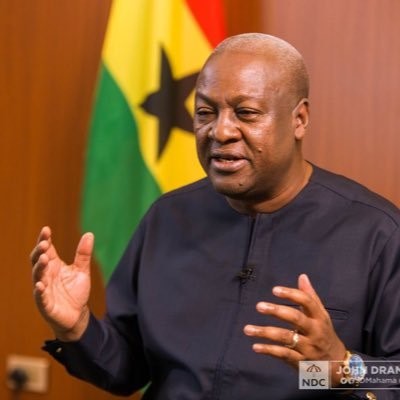
President John Dramani Mahama has expressed his determination to make his second term count, reaffirming his commitment to strengthening Ghana’s economy and improving the country’s governance systems.
Speaking at the opening ceremony of the University of Ghana’s 77th Annual New Year School and Conference on Tuesday, January 6, the President said his second mandate will focus on implementing enduring economic and governance reforms that future administrations cannot undo.
President Mahama returned to power on 7 January 2025 for his second term in office following eight years in opposition, having won the 7 December 2024 general elections. President Mahama noted in his address that Ghana must set an example at a time when democratic governance is under pressure in parts of the region.
“I have decided to make this second mandate so graciously granted to me by Ghanaians count. I have pledged to raise our economy and governance to a level that no succeeding government can reverse.”
“In a region where democracy is backsliding, we must demonstrate that democracy works and that our people can have faith in their leaders to uphold their interests and create opportunities for national prosperity,” he stated.
He further assured Ghanaians that his administration would maintain fiscal discipline and sound economic management throughout his tenure.
“I can assure Ghanaians also that we will not relax the current fiscal discipline and efficient management of the economy even in the election year of 2028,” the President added.
The President vigorously defended plans for the Accra–Kumasi Expressway, noting that recent traffic congestion on the highway underscores the urgent need for the project.
The President’s comments follow widespread public frustration after motorists and passengers spent 12 to 24 hours in traffic on sections of the Accra–Kumasi highway between December 31, 2025, and January 1, 2026.
The gridlock, which affected areas including Juaso, Asankari, and Dwaso, was linked to large-scale church events that drew thousands of worshippers from across the country.
Despite the Ministry of Roads and Highways’ explanation that the congestion was a one-off occurrence, Mahama maintains that the incident exposes deeper structural challenges and reinforces the need for a modern expressway between Accra and Kumasi.
Speaking on the flagship infrastructure initiative under his government’s Big Push agenda, Mahama said critics of the proposed expressway would better understand its necessity if they had experienced the severe traffic gridlock recorded over the New Year period.
According to the President, a single church convention brought traffic on the Accra–Kumasi Road to a standstill for more than seven hours, underscoring the limitations of the existing road network linking Ghana’s two largest cities.
“One of the iconic projects under our big push is going to be the Accra-Kumasi Expressway. And for those who have spoken against this Expressway, I wish they had been in the traffic jam over the new year when a single church holding a convention brought the Accra-Kumasi road into gridlock for more than seven hours,” President Mahama Remarked.
“Accra is the biggest city in Ghana and the capital. Kumasi is the second-largest city in Ghana, and the traffic between the two is a shame, given that we have a single-lane road linking them. This will be a thing of the past, and I am looking forward to cutting sod early this year for the construction,” Mahama further remarked.
In his address, President Mahama announced plans to construct a 10,000-bed student hostel at the University of Ghana, describing it as a significant step toward easing accommodation challenges for students and improving their safety.
The President said the project is the result of an agreement signed during a recent visit to Singapore and will be delivered using prefabricated building technology.
“When I went to Singapore, we signed an agreement for a 10,000-student hostel in the University of Ghana,” President Mahama disclosed. “This is going to be a prefabricated building. It means the building will be manufactured somewhere and then assembled on campus.”
He revealed that preparations for the project are already underway, noting that the machinery for the factory that will manufacture the hostel components has been shipped from Singapore and is currently en route to Accra.
President Mahama placed the announcement in the context of growing public concern about student accommodation, referencing a recent social media post by academic Professor Kweku Azar, who compared his university experience to the difficulties faced by today’s students.
“He talked about how, in his time, you could simply walk to the porter’s lodge, your name would be checked, you’d be handed your room key, and that was it,” the President recounted. “Today, most of our students have to live off campus and travel to lectures every day.”
According to the President, the accommodation deficit has gone beyond inconvenience and has become a serious safety issue. He cited incidents in which students commuting from off-campus residences were knocked down by vehicles or attacked by armed robbers, sometimes with fatal consequences.
“There have been a few unfortunate incidents where students have either been knocked down by vehicles and died, or in some cases been attacked by armed robbers and lost their lives,” he said. “It is preferable that we have as many of our students living on campus, or as close to campus as possible.”
The 77th Annual New Year School and Conference, hosted by the University of Ghana, is being held under the theme “Building the Ghana We Want, Together for Sustainable Development.”
The event brings together policymakers, academics, civil society actors, and students to reflect on national development challenges and policy solutions.
President Mahama said the proposed hostel project aligns with broader efforts to improve access to education and student welfare, adding that he had shared the “good news” with the Vice-Chancellor as part of the government’s commitment to supporting public universities.
The University of Ghana, like many public universities in the country, continues to struggle with limited on-campus accommodation, forcing most students to seek housing in surrounding communities amid rising rents and security concerns.