

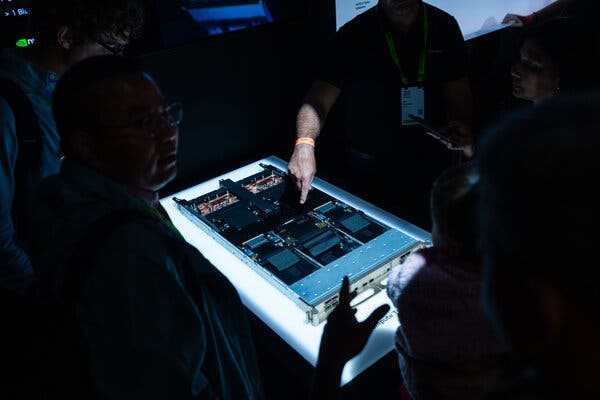
Jensen Huang, the chief executive of the chip-making giant Nvidia, put his company at the forefront of the artificial intelligence boom by making semiconductors more potent than any of his rivals’. This year, he’s promising to do it again.
On Monday, Mr. Huang said the company would begin shipping a new AI chip later this year, one that delivers more computing performance with less power than previous generations.
Known as the Vera Rubin, the chip has been in development for three years and is designed to fulfill AI requests more quickly and cheaply than its predecessors.
Mr. Huang, who spoke during CES, an annual tech conference in Las Vegas, also discussed Nvidia’s surprisingly ambitious work around autonomous vehicles. This year, Mercedes-Benz will begin shipping cars equipped with Nvidia self-driving technology comparable to Tesla’s Autopilot.
NVIDIA’s new Rubin chips are being manufactured. They will be shipped to customers, including Microsoft and Amazon, in the second half of the year, fulfilling a promise Mr. Huang made last March when he first described the chip at the company’s annual conference in San Jose, Calif.
Rubin chips as its predecessor, the Blackwell. It can provide information for chatbots and other AI products at one-tenth the cost. They will also be able to install chips in data centers more quickly, thanks to redesigned supercomputers with fewer cables.
If the new chips live up to their promise, they could enable companies to develop AI at lower cost and at least begin to meet the soaring electrical demands of data centers being built around the world.
“This is how we’re going to get everybody to the next frontier and push AI to the next level and, of course, to build these data centers energy efficiently and cost efficiently as well,” Mr. Huang said.
The Rubin chips are named for the astronomer Vera Rubin, who did groundbreaking research on dark matter. The new chips are key to maintaining Nvidia’s dominance of the AI industry and its perch as the world’s most valuable company.
NVIDIA’s AI chips, which account for more than 90 percent of the market, are highly sought after by businesses and governments worldwide. It sells them for about $30,000 each, with nearly three-quarters of the price representing pure profit.
But the company is facing increased competition from chipmakers and even some customers eager to seize a slice of the lucrative AI industry. Last year, Advanced Micro Devices (AMD) and Google, which buys Nvidia chips and also makes its own, struck deals to provide their technology to OpenAI, one of the world’s largest users of AI chips.
The rising threat contributed to Nvidia’s deal last month to license technology from the chip start-up Groq. The agreement is expected to help Nvidia develop chips that allow AI to more efficiently fulfill requests through a process known as inference.
As more people use AI, chip makers are working to make delivering it less expensive and less power-hungry, said Daniel Newman, the chief executive of Futurum Group, a tech research firm. “That’s the name of the game because utilization is very early,” he said.
The competitive challenges have buffeted Nvidia alongside a series of geopolitical headaches. Mr. Huang spent much of last year lobbying President Trump to allow Nvidia to sell its AI chips to China. At the same time, he was trying to fend off Beijing’s efforts to discourage Chinese companies from buying Nvidia’s chips due to security concerns.
In December, Mr. Trump granted the company permission to sell its second-most-powerful chip to China. But Beijing has not decided whether to allow its companies to purchase Nvidia products.
NVIDIA’s business has flourished during the AI boom of the past three years. In November, the company reported a quarterly profit of $31.9 billion, a 65 percent increase from a year earlier and 245 percent from the year before that. It expects about $500 billion in sales through the end of this year.
Still, Mr. Huang has been eager to diversify Nvidia’s business and expand its customer base. He has been pushing the company to become a major player in robotics and autonomous vehicles.
On Monday, he said Nvidia had developed new A.I. software that would enable customers such as Uber and Lucid to build cars that navigate roads autonomously. It will share the Alpamayo system to expand its influence and the appeal of Nvidia’s chip technology.