

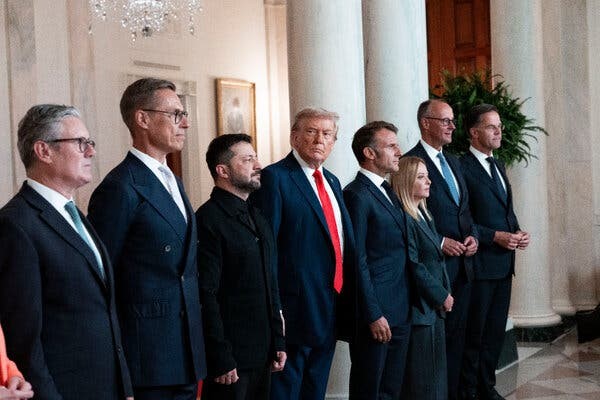
By Michael D. Shear
What happens to an 80-year-old diplomatic alliance when its leading power threatens a military invasion of one member, wages economic war on the others, and vows to cultivate political and cultural resistance to their governments?
Is the alliance doomed? That question is being asked in capitals across Europe as leaders rush to respond to President Trump’s rapidly escalating campaign to acquire Greenland over the objections of the people who live there. At issue most urgently is whether resisting Mr. Trump’s territorial ambitions risks permanently damaging Europe’s relationship with the United States.
Some leaders — like President Emmanuel Macron of France and Lars Klingbeil, Germany’s finance minister — appear willing to take that risk, urging Europe’s nations to consider deploying an economic “bazooka” in response to Mr. Trump’s latest tariff threats.
Leaders from across Europe are expected to gather in Brussels this week to present a united response to Mr. Trump’s provocations. Veteran observers of European politics said the alliance between Europe and the United States that formed in the aftermath of World War II had already been fundamentally altered.
It is no longer an alliance designed primarily to advance the interests of like-minded democracies, they said. Instead, it is a relationship on Mr. Trump’s terms alone — one in which he wields the leverage that comes from American power to force Europeans to cater to his whims.
“To use what is essentially economic warfare with allies is unprecedented in this way,” said Ian Lesser, who leads the Brussels office of the German Marshall Fund, a research group.
There appears to be a consensus across much of Europe that it needs to build new economic and military capacities to reduce its dependence on the United States. But that will take years, if not decades.
In the meantime, Europe’s businesses and financial markets will still be intertwined with the buying power of consumers in the United States, and Ukraine will still need American weapons to defend itself against Russia.
In fact, months of diplomatic effort to negotiate a cease-fire in the Ukraine war have only underscored that NATO, which was formed to defend Europe, is unable to fend off Russian aggression without security guarantees by the United States.
“It would be foolish at a time of war in Europe to jettison all of the sort of strategic and operational benefits that come with the alliance,” Mr. Lesser said. “But if the United States is no longer a reliable partner in that alliance, then Europe needs to do something else.”
That effort is already underway, slowly.
The same day that Mr. Trump announced his latest tariff threat on social media, Ursula von der Leyen, the president of the European Commission, and António Costa, the president of the European Council, were in Paraguay to sign a major trade deal with a bloc of Latin American countries, one that was 25 years in the making.
Mr. Trump has so far been happy to welcome European money to purchase American-made arms for Ukraine and other countries in Eastern Europe. And he relishes surprising his so-called allies, as he demonstrated on Saturday when he announced tariffs on a group of European nations, including Britain, unless Greenland is sold to the United States.
That raises the stakes for the decisions Europe faces in the days ahead. It must decide how aggressively to confront Mr. Trump, without knowing what the always unpredictable president will do.
“Is he serious? What does Europe do now? How does the U.S. respond?” Mr. Lesser said. “There will be those who say, ‘OK, how do we get through this?’ Is it possible to simply engage in a kind of negotiation or investment or whatever it may be, that will defer anything radical?”
Mr. Trump has already made it clear that he views America’s European allies with disdain.
In his annual National Security Strategy, released last month, officials from Mr. Trump’s administration questioned whether some European countries would remain “reliable allies” in the future.
The document conceded that Europe was “strategically and culturally vital” to the United States. But it said the continent faced the “stark prospect of civilizational erasure” unless the United States helped like-minded “patriotic European parties” — a phrase widely understood to mean the far right — win power.
For Europeans on the receiving end of those assertions, the president’s threats to acquire Greenland “the easy way” or “the hard way” have further eroded the trust that has been central to their alliance with the United States for decades.
“Going back to the level of trust that we saw beforehand would require, I think, generational change,” said Rosa Balfour, the director of Carnegie Europe, a political think tank. “The attack on Europe is not just coming from an individual, you know — it’s been turned into an ideology.”
Since the latest Greenland threats, more voices have begun urging assertive action.
In a statement over the weekend, Mr. Macron vowed that “no intimidation or threat will influence us — neither in Ukraine, nor in Greenland, nor anywhere else in the world.”
He called Mr. Trump’s tariff threats “unacceptable” and vowed, “Europeans will respond in a united and coordinated manner should they be confirmed. We will ensure that European sovereignty is upheld.”
Others, like Prime Minister Keir Starmer of Britain, have argued for a diplomatic solution and cautioned against grandstanding. “That’s an understandable instinct, but it’s not effective,” the prime minister told reporters on Monday morning. “It never has been. It may make politicians feel good, but it does nothing for working people whose jobs, livelihoods, and security rely on the relationships that we build across the world.”
Still, Ms. Balfour said that more leaders were beginning to realize that capitulating to Mr. Trump’s demands was not always in Europe’s interests. In fact, it often leads Mr. Trump to demand more concessions.
If true, that could have implications for the alliance with the United States and whether it survives in the future.
“Reality, I think, is sinking into the mind-sets of those people who have been advocating caution, dialogue, and ‘Let’s listen to what Trump has to say,’” Ms. Balfour said. “You can feel that kind of change.”