
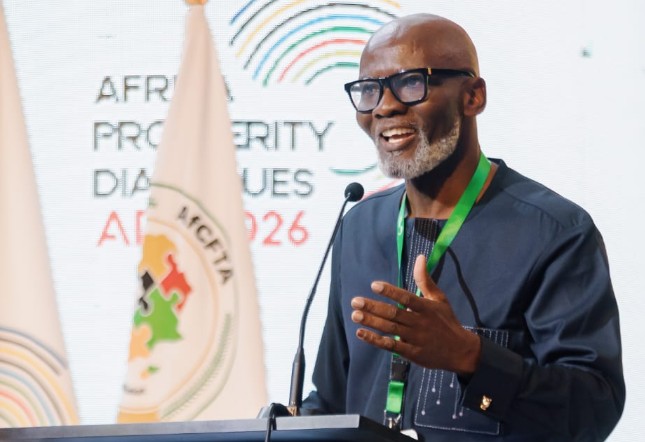
Founder and Executive Chairman of the Africa Prosperity Network (APN), Mr. Gabby Asare Otchere-Darko Esq., has called for a shift in Africa’s integration agenda from elite-level discussions to a people-driven movement that directly benefits ordinary citizens, particularly young people and small businesses.
He made these remarks at the High-Level Symposium on Advancing a Visa-Free Africa for Economic Prosperity, a side event organised by the African Union Commission’s Department of Health, Humanitarian and Social Affairs and the African Development Bank (AfDB) Group, during the 39th Summit of AU Heads of State and Government on Friday, 13 February 2026, at the Radisson Blu Hotel in Addis Ababa, Ethiopia.
African Integration
Speaking during the segment titled “How Can We Move Faster Towards a Visa-Free Africa? and Why Mobility Matters for Regional Integration, Agenda 2063 and the Africa We Want,” at the High-Level Panel Discussion, Mr. Otchere-Darko, observed that the idea of African integration has, for decades, remained largely confined to summit halls and intellectual circles, without being fully embraced by the wider population.
He noted that despite the presence of major continental institutions such as the African Union, Africa still struggles to implement basic integration measures, including visa-free travel, even among host countries.
“The whole idea of Pan-Africanism and African integration has been restricted to the elite. It has never really been owned and driven by the people,” he said.
Integration Conversation
Mr. Otchere-Darko explained that APN is working to move the integration conversation beyond conference rooms into factories, shops, campuses, and marketplaces across the continent.
According to him, the ordinary African, especially SMEs and young entrepreneurs, must understand that their economic future is directly tied to a borderless Africa and a larger integrated market.
He argued that a wider economic space would unlock job-creation opportunities for Africa’s growing youth population, enabling businesses to expand across borders more easily.
Mr. Otchere-Darko outlined several priority reforms that the Africa Prosperity Network is championing under a 12-point call to action.
He explained that one of the key proposals is promoting visa-free travel across Africa, enabling the free movement of people and goods throughout the continent.
He also stressed the need for open skies and the full implementation of the Single African Air Transport Market, in line with the Yamoussoukro Decision, to make air travel and trade more efficient across African countries.
Interoperability
In addition, he highlighted the importance of achieving continent-wide mobile money interoperability, enabling Africans to transact seamlessly across different currencies and borders and thereby expanding economic opportunities for businesses and individuals.
He highlighted the enormous potential of Africa’s digital finance space, noting that the continent hosts nearly one billion mobile money accounts and accounts for about 65 per cent of global mobile money transactions.
He illustrated how cross-border payment systems could empower SMEs, allowing a trader in Accra, for example, to purchase goods advertised in Nairobi using local currency while the seller receives payment instantly in their own currency.
“That is how we create economic opportunities for ordinary SMEs,” he stressed.
Slow Progress
Mr. Otchere-Darko also raised concerns about Africa’s slow progress in industrialisation and standardisation, pointing to the establishment of the African Standardization Organization (ASO) in 1977 as a key milestone that has yet to achieve its full purpose.
He argued that a functioning single market of 1.5 billion people requires harmonized standards so that goods manufactured in one country can compete and circulate freely across the continent.
Referencing the Abuja Treaty, ratified in 1994, Mr. Otchere-Darko reminded African leaders that they had committed to building a common market within 34 years, culminating in free movement, rights of residence and settlement, and even a single currency and a central bank.
However, he criticised what he described as a familiar pattern of African governments signing protocols without implementing them.
“Our leaders sign up to treaties and then go back home to do business as usual,” he said.
10 Billion Signatures
As part of efforts to compel political action, Mr. Otchere-Darko announced a new signature campaign to mobilize Africans to demand the implementation of agreed integration policies.
Using a QR code-based sign-up system launched last week, he said the initiative has already attracted more than 80,000 supporters.
The campaign’s target is to secure 10 billion signatures within 24 months, which would be presented to African leaders as a clear message that citizens are no longer willing to accept delays.
“Enough is enough. This time, the people are saying implement what you signed,” he declared.
Mr. Otchere-Darko further stressed that African politicians must recognise integration as essential to solving the continent’s unemployment crisis.
With over one billion young people in Africa, more than 400 million of them of working age, he cautioned that the continent must create between 15 and 20 million jobs annually to meet demand.
According to him, only a truly integrated African economy can generate the scale of opportunity needed for the youth.
“It is in their interest to have a broader market of play so that we can create jobs for our young people,” he added.