
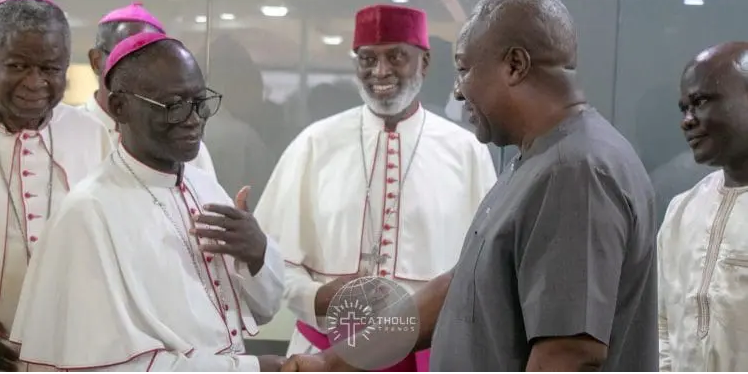
The Ghana Catholic Bishops’ Conference has rejected claims that debates on family values and LGBTQ+ issues are unimportant, urging President John Dramani Mahama to honour his pledge to assent to the Human Sexual Rights and Family Values Bill if Parliament approves it.
In a statement dated April 10 and signed by Matthew Kwasi Gyamfi, the bishops responded to recent remarks attributed to the President and Government Communications Minister Felix Kwakye Ofosu.
They cited reports that Mahama, speaking at the World Affairs Council, described LGBTQ+ issues as “not the most important issue we face as a nation,” while the Minister reportedly characterised such matters as “not a major priority for Ghanaians” and a “waste of time.”
“Even if intended to prioritise urgent socio-economic concerns, such descriptions risk conveying that certain moral questions may be set aside as inconsequential,” the bishops said. “Yet no question that touches the structure of human identity, family life, and social continuity can be trivial. Nations do not live by bread alone.”
Rejecting what they described as a false choice between economic progress and moral values, the bishops argued that strong family structures are fundamental to development outcomes.
“To weaken the moral ecology of the family is to erode the very conditions that make sustainable development possible,” the statement said.
They reaffirmed both the dignity of all persons and the importance of upholding the family as traditionally defined, adding: “No individual, regardless of sexual orientation or identity, may be subjected to violence, hatred, or unjust discrimination. Such acts are moral failures and social wounds. We condemn them without reservation.”
Recalling Mahama’s earlier assurance, they added: “Democratic integrity rests, in part, on the fidelity of leaders to their publicly stated commitments. Should Parliament complete its deliberations and pass the Bill, we urge the President to honour this assurance.”
While acknowledging concerns about aspects of the Bill, the bishops called for careful parliamentary scrutiny and urged respectful national dialogue across all sectors.
“The Church remains committed to participating in this dialogue, not as one who imposes, but as one who proposes, confident that truth, when patiently articulated, has a quiet persuasive power.”