

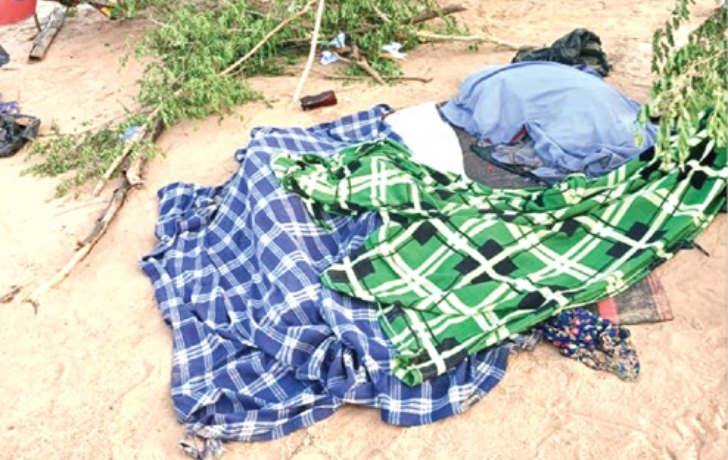
A man has lost his mother, three wives and five children in a tragic boat disaster on the Volta Lake.
The man, believed to be in his late 50s, is reportedly a herdsman who was relocating his family to another community.
Sources indicate that he travelled separately on a pontoon, while his mother, three wives and five children were aboard a smaller canoe.
Five passengers have since been rescued, while two others remain missing.
The nine deceased were part of a group of 16 passengers—none of whom wore life jackets—on board the small canoe on the Volta Lake near Mataiko in the East Gonja District of the Savannah Region.
The passengers were travelling from Yeji to a local community, Congo, when the wooden vessel capsized last Wednesday amid stormy weather.
The Salaga District Police Commander, Deputy Superintendent of Police (DSP) Gabriel Kofi Alorsey, who confirmed the incident, said five male passengers were rescued, while search efforts continue for the remaining victims.
He added that search teams were still looking for the missing persons as of yesterday morning.
Burial
The Savannah Regional Crime Officer, Assistant Superintendent of Police (ASP) Richard Osei, stated that the nine victims were buried in accordance with Islamic tradition before the arrival of the police.
ASP Osei also confirmed that the victims were travelling from a community known as Congo when the canoe encountered a storm on the Volta Lake.
Avoiding loading areas
Meanwhile, the Ghana Maritime Authority (GMA) has expressed grave concern over the incident, noting that none of the passengers wore life jackets, in violation of maritime safety regulations.
The authority suspects that the boat operator may have bypassed designated departure points, thereby evading mandatory safety checks and supervision.
According to the GMA, official departure stations—staffed by its officers and personnel from the Ghana Navy—have been established to ensure that passengers are provided with and wear life jackets before any vessel departs.
The Director-General of the GMA, Dr Kamal-Deen Ali (Naval Captain retd), told the Daily Graphic that preliminary investigations suggest the canoe did not depart from an approved location.
“As a result, the vessel escaped safety inspections and supervision,” Dr Ali said.
He further noted that although many passengers comply with safety rules at the start of a journey, some remove their life jackets while en route.
The GMA emphasised that the absence of life jackets significantly contributed to the loss of lives and reiterated that their use is mandatory for all water transport.
Dr Ali explained that the authority’s safety regime is guided by a Code of Operation, which requires boat operators to ensure all passengers wear life jackets and that vessels do not exceed their approved capacity.
He added that in areas such as Yeji, where GMA officers and Navy personnel are stationed, these rules are strictly enforced, including the removal of excess passengers from overloaded boats.
However, he noted that some private operators deliberately avoid official stations to escape monitoring and regulation.
“While there are currently no direct legal sanctions against passengers who refuse to wear life jackets, boat operators are required to sign a formal undertaking committing them to comply with all maritime safety rules,” Dr Ali stated.
Review of legal framework
Dr Ali disclosed that the GMA is reviewing the legal framework to introduce stricter measures against operators and boat owners who disregard safety protocols or bypass designated departure points.
Under the proposed reforms, operators who breach these undertakings will face immediate legal consequences.
The authority is also considering the deployment of remote monitoring technology to address what it described as “blind spots” on the lake.
These measures include the use of Automatic Identification System tracking for larger wooden vessels, as well as drones and GPS-enabled surveillance to monitor illegal routes and detect non-compliant operators.
Dr Ali said the technology would help identify repeat offenders and improve response times during search and rescue operations.
As part of efforts to strengthen enforcement, the GMA also plans to introduce a specialised Water Safety Guards unit to patrol key transport routes and conduct random checks on life jacket use and vessel stability.
“In addition, the authority is preparing to roll out a programme to make life jackets more accessible and affordable.
“Under the plan, passengers would be able to rent life jackets for a small fee at designated departure points, while regular commuters and boat operators would also have access to subsidised, standardised jackets for purchase,” he said.