

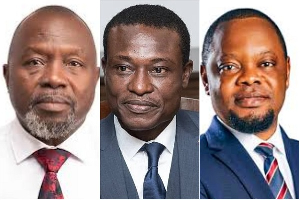
Ghana is indeed a nation of sheer theatre! So let me get this straight. The same Attorney General who is busy facilitating processes to haul Ken Ofori-Atta back from the US to come before the Office of the Special Prosecutor is, at the same time, in court arguing that the very same Office of the Special Prosecutor may not even have the constitutional authority to prosecute in the first place.
Ah ba! On one hand, come and face the Office of the Special Prosecutor. On the other hand, by the way, the Office of the Special Prosecutor probably should not be prosecuting you at all.
You could not script this better. It is a comedy of curiosity. So the Attorney General is now telling the Supreme Court of Ghana that prosecutorial power belongs solely to his office and that Parliament itself erred in 2017 when it enacted the Office of the Special Prosecutor Act, 2017 (Act 959) to confer independent prosecutorial authority on the Office. The argument goes further.
That under Articles 1(2), 88, 93(2) and 296 of the Constitution, such power cannot be exercised independently or in parallel with the Attorney General, and that any attempt to do so is null, void and of no effect.
In fact, the Attorney General’s position is that the Constitution only permits him to delegate prosecutorial authority to natural persons, not to an independent statutory body. In that sense, the Office of the Special Prosecutor, being a juridical person, cannot lawfully exercise such power outside his control.
Therefore, the very foundation upon which the Office claims independence in initiating, conducting and terminating prosecutions is now being called into question by the State itself.
Yet, somehow, the machinery of the same State moves forward with confidence, pressing to bring a former Finance Minister before that same Office to face what is described as prosecution.
This is where the contradiction matures into something far more profound. For if the legal foundation is uncertain, then the process built upon it becomes equally uncertain.
Interesting times indeed, where law meets drama and consistency takes a well deserved holiday. Indeed, a concert party government.
Scripture speaks with striking consequence on moments such as these. In the Bible, it is written that “if Satan casts out Satan, he is divided against himself; how then shall his kingdom stand?”
In that imagery lies a deeper warning. When forces that appear united against a common target turn inward in a struggle for authority, they do not defeat their opponent; they expose their own instability. The battle ceases to be external and becomes self-consuming.
Our elders say that when the left hand fights the right, the body suffers. But here, the greater danger is that the body may collapse under the weight of its own contradictions. For a State that argues one position before the Court and pursues another in practice risks not only confusion, but a quiet erosion of the very authority it seeks to exercise.
Gideon Kwasi Annor
annorgideonkwasi@gmail.com