
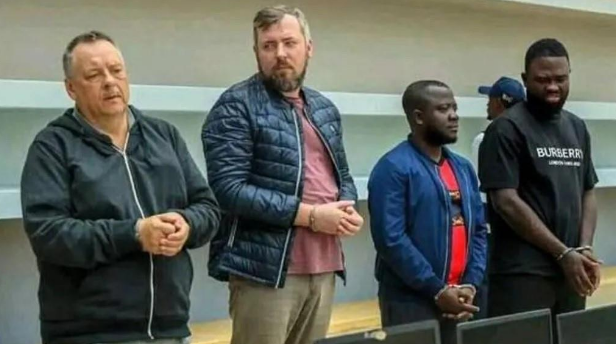
Two Russians are due to go on trial in Angola accused of stirring up anti-government protests, conducting a campaign of disinformation, and attempting to interfere in next year’s presidential election.
Arrested last August, political consultant Igor Ratchin and translator Lev Lakshtanov are facing 11 charges, including terrorism, espionage and influence peddling.
The BBC has obtained a copy of the indictment, which includes charges related to an alleged operation to change the political course of Angola.
The Russians’ lawyers challenge the indictment on the grounds that it lacks “concrete and objective facts”.
According to the prosecution, the Russians acted on behalf of Africa Politology, a shadowy network of operatives and intelligence officers in Africa that emerged from the now-defunct Wagner Group, whose founder Yevgeny Prigozhin died in 2023 in a plane crash.
Political operatives linked to Wagner have been active across Africa for more than a decade, in particular in the Central African Republic, Mali, and Madagascar.
The Russians’ defence team says they are not connected to Africa Politology or the Wagner Group, were not acting on behalf of the Russian state, and were instead cooperating to create a cultural “Russian House” in Luanda.
Angola is a top African oil producer and diamond exporter. Its natural resources and strategic position make it a country of continued interest for Moscow. But while ties date back to the Cold War, Angola has been gradually drifting away from Russia’s sphere of influence.
Russian diamond mining company Alrosa and bank VTB were forced to leave Angola due to international sanctions imposed because of the Ukraine war.
Angolan President João Lourenço has pivoted towards the West and has not met his Russian counterpart, Vladimir Putin, since 2019.
The Russian operatives in Africa were breaking new ground by moving into Angola, it is claimed.
“This is indicative of Russian anxiety about the direction of travel of Angola under the Lourenço administration,” says Alex Vines, Africa programme director at think-tank European Council on Foreign Relations.
“There’s clearly an element of Russian disinformation to try and build up more sympathy towards the Russian Federation.”
Alongside the Russians, two Angolans will also face trial for their alleged part in the Russian-linked influence operation.
The prosecution alleges that the Russians hired sports journalist Amor Carlos Tomé and political activist Francisco Oliveira to carry out their activities in the country.
They are facing nine and five charges, respectively, including terrorism, espionage, and influence peddling.
The legal team representing the Angolan defendants says there isn’t sufficient evidence against them and that “the accusation is based on mere conjecture”.
Prosecutors say the first team of Russian operatives arrived in Angola’s capital, Luanda, in 2024 under the pretext of opening a Russian cultural centre, a project that never materialised.
Among the initial arrivals was Maxim Shugalei, a prominent Wagner-linked political operative sanctioned by the European Union (EU) for overseeing disinformation campaigns, whose activities in Africa were turned into a film trilogy, seemingly sponsored by Prigozhin.
He travelled to Angola with his long-term translator, Samer Suaifan. The BBC has contacted both men.
While Suaifan has acknowledged being acquainted with the defendants, Shugalei has denied knowing them.
According to the indictment, during 2024-2025, the defendants made multiple payments to local journalists and experts to disseminate propaganda and disinformation in local media with the goal of “provoking political change”. The payments add up to over $24,000 (£17,900).
Angolan authorities see this work as part of a broader influence operation intended to undermine trust in Western partners and discredit President Lourenço’s foreign policy.
One insider, who previously worked with Prigozhin on African projects, criticised these efforts as amateurish.
Russian political operative Maxim Shugalei is the main protagonist of the Shugalei film trilogy about his escapades in Africa
“This year [2025], they handed the whole African topic over to some complete idiots. It feels like they were just picked up at the Sadovod market [a street market in Moscow].
“And right before new year they really wanted publications in Angolan media. But I told them all to go to hell,” a political strategist told the BBC, without revealing who the employers were.
The prosecution cites some publications as evidence of the disinformation campaign carried out by the two Russian men.
A January 2025 post on a Facebook page that imitated a recognised local news site, Angola 24 Horas, calling itself a satirical page, warned that Angola could be drawn into the Ukraine war.
In December 2024, a post on the same page criticised the Lobito Corridor, a Western-backed rail project, which moves minerals from central Africa to Angola’s ports.
The post claimed foreign firms gain near-total access to Angola’s minerals. The BBC contacted the satirical page Angola 24 Horas but did not receive a response.
The post about the Lobito Corridor appeared on the news website Lil Pasta News a day later. Another article published by the website speculated whether the country had “signed a pact with the Devil” by joining the project.
Lil Pasta News told the BBC that the articles in question were not written by its team but received through an intermediary. The team said that it had no contact with the author and was not paid for the publication.
The lawyers representing the Russian defendants argue that there is no evidence to suggest that Ratchin commissioned any of the articles.
Angolan prosecutors portray the group as a small but effective network. Ratchin was allegedly at its centre.
He had previously worked on several regional election campaigns in Russia that, as he claimed in a video seen by the BBC, ended in victories for his candidates.
Lakshtanov has worked as a translator in Angola since the Soviet era. Prosecutors believe he played a supporting role in the operation, acting primarily as a translator.
The local connection was supposedly provided by Francisco “Buka Tanda” Oliveira, a youth leader for Angola’s main opposition party, Unita, who speaks Russian after having studied chemical engineering in Russia between 2015 and 2019.
The prosecution claims he was tasked with introducing Angolan politicians to the defendants.
“He [Oliveira] doesn’t know this organisation [Politology] and any activity related to this organisation. All he knows is that they wanted to create a Russian culture house,” says defence lawyer Pedro Cangombe.
Tomé, a sports journalist at Angolan state TV channel TPA, is accused of gathering information on the country’s political landscape and potential presidential candidates, as well as helping to produce and publish content linked to the alleged influence operation.
The defence for Tomé argues that “none of the subjective or objective elements” of crimes are “minimally” demonstrated in the indictment.
The indictment names six more Russian members of the network who allegedly rotated in and out of Angola at various times in 2024 and 2025.
Angolan authorities also claim in the indictment that Lakshtanov and Ratchin met several senior political figures from both the ruling MPLA party and Unita, offering support and funding for campaign activities.
By: Maria Jevstafjeva
BBC Global Disinformation Unit,
Ilya Barabanov & Investigations Team,
BBC Russian and Leandro Prazeres, BBC Brasil