

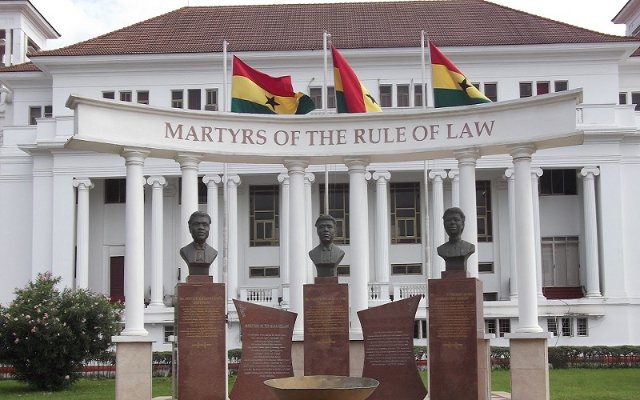
In a landmark decision, the Supreme Court of Ghana has overturned the Tamale High Court judgment that annulled the Kpandai parliamentary election result, restoring the legitimacy of declared winner Matthew Nyindam.
The ruling was delivered by a four-to-one majority, with Justice Gabriel Pwamang dissenting.
The legal battle began after the Tamale High Court nullified the election over alleged irregularities in the voting process, a decision that triggered widespread political debate and intense public interest.
Upon review, the Supreme Court held that the High Court’s annulment lacked sufficient legal and evidential basis. The apex court affirmed that the election was conducted in line with the Electoral Commission’s regulations.
The justices underscored the importance of protecting democratic processes and stressed that clear and compelling evidence is required before overturning an election outcome.
The Kpandai parliamentary contest has been the subject of sustained legal dispute following disagreements over the constituency’s election, culminating in the Supreme Court’s intervention.
On November 24, 2025, the Tamale High Court, presided over by Justice Emmanuel Brew Plange, nullified the Kpandai parliamentary election results on grounds of “widespread irregularities” and ordered the Electoral Commission (EC) to conduct a rerun within 30 days.
Gary Nimako Marfo, counsel for Matthew Nyindam, the New Patriotic Party (NPP) parliamentary candidate, argued that the High Court committed a jurisdictional error by assuming authority to hear the election petition filed by the first interested party on January 25, 2025.
He noted that the election results were gazetted by the EC on December 24, 2024, and cited Article 99(1) of the 1992 Constitution, which grants the High Court jurisdiction to hear parliamentary election petitions only if filed within 21 days of the gazetting of official results.
Nimako Marfo further submitted that the petition filed by Daniel Wakpal, the National Democratic Congress (NDC) parliamentary candidate, on January 25, 2025, was filed out of time.