

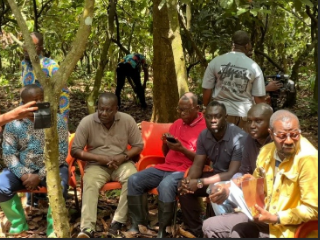
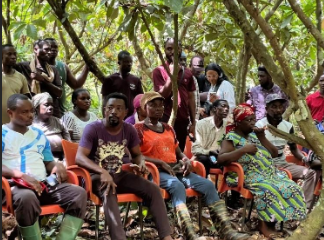
The simmering controversy over the National Democratic Congress (NDC) government’s recent reduction in cocoa producer prices has shifted from Parliament to the farms, as Frank Annoh-Dompreh, Minority Chief Whip and Member of Parliament for Nsawam-Adoagyiri, led a delegation of Minority Members of Parliament on a tour of cocoa-growing communities in the Eastern Region.
The visit forms part of the caucus’s growing campaign against what it describes as an unjustified price cut that places additional strain on cocoa farmers already grappling with rising production costs and economic hardship.
The NDC government has defended the adjustment, explaining that the reduction reflects declining global cocoa prices and prevailing international market conditions.
Officials argue that as a commodity traded on the global market, cocoa prices are influenced by international supply and demand dynamics, leaving limited room for domestic discretion.
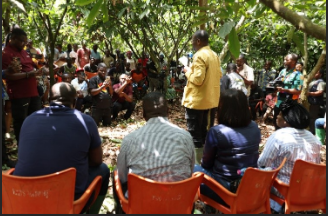
However, the Minority Caucus insists that farmers should not be made to bear the full brunt of global market volatility, particularly at a time when input costs, including fertilizers, agrochemicals, and labour, continue to rise.
During interactions with farmers, Mr. Annoh-Dompreh described the price reduction as a “rip-off,” arguing that producers are being unfairly shortchanged.
He maintained that, instead of cutting producer prices, the government should explore a financial bailout or subsidy package to cushion cocoa farmers and protect the long-term sustainability of the sector.
According to him, the cocoa industry remains a backbone of Ghana’s economy and foreign exchange earnings, and policies affecting farmers must prioritise their welfare and productivity.
The tour delegation included prominent Minority MPs such as Kwabena Okyere Darko-Mensah, Kojo Oppong Nkrumah, Isaac Yaw Opoku, Samuel Awuku, Ida Adjoa Asiedu, and Gideon Boako.
Their presence underscored the political weight the Minority is attaching to the issue, signalling a coordinated parliamentary pushback against the price policy.
The Minority Caucus has indicated that the Eastern Region tour is part of a broader engagement strategy with cocoa farmers across producing regions.
The caucus says it will continue to advocate for policies that safeguard farmer incomes, strengthen incentives for production, and ensure the long-term viability of the cocoa industry.
The government, on 12 February 2026, announced a new producer price for cocoa, setting it at GH¢41,392 per tonne for the remainder of the 2025/2026 crop season in a move aimed at stabilising the sector and supporting farmers.
The new price, approved by the Producer Price Review Committee (PPRC), takes effect from Thursday, 12 February 2026. The revised rate translates to GHc2,587.00 per bag, down from GHc3,625.00.
Addressing the press on Thursday, 12 February 2026, Finance Minister Dr. Cassiel Ato Forson explained that the decision was informed by prevailing conditions on the international cocoa market.
He said the adjustment reflects current global cocoa prices and is intended to restore confidence across the industry.
The Minister further indicated that the new rate is expected to inject immediate liquidity into the cocoa value chain, helping to fast-track payments to farmers who have experienced delays in recent months and easing financial pressures at the farm level.
The price revision, he noted, forms part of broader reforms to ensure the long-term sustainability of Ghana’s cocoa industry. He described the measure as necessary to stabilise the sector, strengthen its financial footing, and secure better outcomes for cocoa farmers.
“As a result of that, the PPRC thereby announces that effective today, Thursday 12th February 2026, the new producer price for the remainder of the 2025–2026 crop season will now be 41,392 Ghana Cedis per ton and 2,587 Ghana Cedis per bag,” he said.
The new rate represents a downward revision from the initial price announced at the start of the 2025/26 crop season.
The producer price was fixed at US$5,040 per tonne, representing a 62.58 percent increase in dollar terms. In cedi terms, that translates to GH¢51,660 per tonne or GH¢3,228.75 per bag.
The Cabinet also directed the immediate transfer of cocoa road liabilities amounting to GH¢4.35 billion to the Ministry of Roads and Highways and the Ministry of Finance, in a move aimed at restructuring COCOBOD’s financial commitments.
Finance Minister Dr. Cassiel Ato Forson explained during his address that the decision follows a comprehensive rationalisation of cocoa road contracts awarded over the past decade.
Between 2014 and 2024, COCOBOD awarded contracts worth GH¢26.5 billion, with GH¢21.5 billion of those figures committed between 2018 and 2021.
Dr. Forson noted that under Ghana’s 2023 IMF programme, COCOBOD’s road contract exposure of GH¢21.7 billion was to be reduced to GH¢6.9 billion. However, he stated that the previous board and management failed to carry out the required rationalisation exercise.
He disclosed that the exercise has now been completed under the supervision of the Ministries of Finance and Roads and Highways. According to him, the joint review significantly reduced COCOBOD’s exposure on cocoa roads from GH¢21.7 billion to GH¢4.35 billion.
“Cabinet has also directed that with immediate effect, there should be a transfer of road liabilities worth 4.35 billion Ghana Cedis to the Ministry of Roads and Highways and the Ministry of Finance.”
The President also directed the Attorney General and Minister for Justice, Dr. Dominic Ayine, to initiate a comprehensive investigation into the finances and operations of the Ghana Cocoa Board (COCOBOD) over the past eight years.
Dr. Forson said the Cabinet took the decision as part of broader efforts to restore transparency and accountability in the sector’s management.
“To ensure accountability and transparency in the management of COCOBOD and the cocoa sector as a whole, cabinet also directed the Attorney General to commission concurrent forensic and criminal investigations into the activities of COCOBOD over the last eight years,” he said.
The government says the investigations will run alongside broader structural reforms aimed at restoring financial stability to COCOBOD and safeguarding the livelihoods of cocoa farmers nationwide.
The cocoa industry has recently faced significant turbulence, particularly over delays in payments to farmers across the country.
The situation has raised concerns among stakeholders and sparked fears about the long-term sustainability of Ghana’s position as one of the world’s leading cocoa producers.