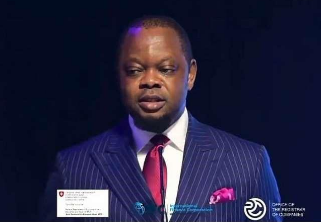

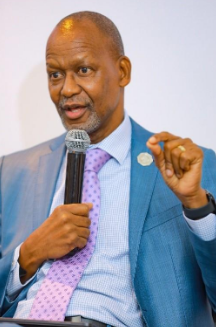
H.E. Elias Mpedi Magosi, Executive Secretary of the Southern African Development Community (SADC), has called for stronger political commitment and leadership across Africa to accelerate the implementation of free movement protocols and deepen regional integration for economic development.
He made these remarks at the High-Level Symposium on Advancing a Visa-Free Africa for Economic Prosperity, a side event organised by the African Union Commission’s Department of Health, Humanitarian and Social Affairs and the African Development Bank (AfDB) Group, during the 39th Summit of AU Heads of State and Government on Friday, 13 February 2026, at the Radisson Blu Hotel in Addis Ababa, Ethiopia.
Speaking at a high-level discussion on mobility and continental integration, Mr. Magosi noted that while some progress has been made within regional blocs such as SADC, Africa as a whole continues to face major challenges in translating agreements on free movement into practical reality.
He expressed concern that despite the African Union’s adoption of key continental instruments aimed at facilitating the movement of persons, only four out of the continent’s 54 countries have ratified them.
“That says a lot about our commitment as a continent,” he said, stressing that the slow ratification process raises serious questions about Africa’s readiness to fully embrace integration.
Mr. Magosi explained that regional economic communities (RECs) such as SADC were established primarily to promote development through integration, since individual countries cannot achieve meaningful progress in isolation.
According to him, integration requires coordinated legal and policy frameworks that allow member states to harmonise laws, facilitate trade, and support the movement of people and services across borders.
He acknowledged that within SADC, many member states have ratified regional protocols on the facilitation of movement, but others remain hesitant, often citing security concerns as a major reason for resisting full openness.
The SADC Executive Secretary highlighted that mobility is not only about tourism, but also about enabling traders, businesspeople, and professionals such as lawyers, engineers, and service providers to operate more freely across countries.
He emphasised the need for simplified border systems, including the expansion of one-stop border posts, to reduce delays and make cross-border trade more efficient.
Mr. Magosi also pointed to Africa’s deep communal and cultural ties, noting that many communities have families and relatives spread across borders, often crossing informally for weddings, funerals, and social gatherings.
“We are communal in nature,” he said, adding that borders should not unnecessarily divide people who share long-standing cultural and family connections.
He praised some SADC member states for taking steps toward visa liberalisation, singling out Zimbabwe, Mauritius, and Seychelles for granting visa-free entry to citizens from across the region. He noted that other countries have also made progress by easing restrictions for the majority of SADC states, although full free movement has not yet been achieved.
Mr. Magosi further highlighted innovative bilateral arrangements within the region, citing Botswana and Namibia as an example of countries that have introduced cross-border travel using national identity cards instead of passports.
He described such initiatives as a practical step toward achieving the broader vision of seamless mobility, similar to what has been accomplished in the European Union and partially within ECOWAS.
However, Mr. Magosi stressed that the pace of integration across Africa ultimately depends on political will at the highest level.
“Everything rises and falls on leadership,” he said, arguing that leaders are responsible for ratifying protocols, allocating resources, and implementing the reforms needed to support mobility, trade, and private sector growth.
He warned that Africa risks falling behind if commitments remain only on paper without concrete action, adding that the lack of development and economic opportunity continues to push young Africans into dangerous migration routes, including attempts to cross the Mediterranean and the English Channel.
“The reason why we see some of our kids dying… is because we’ve not created huge opportunities,” he stated.
Mr. Magosi emphasised that sustainable job creation will come through a thriving private sector supported by integration-friendly policies, improved mobility, and stronger regional development.
According to him, Africa can only unlock its full potential when leaders demonstrate seriousness in implementing the instruments they have already signed and ensuring that economic integration becomes a lived reality for ordinary citizens across the continent.