
Through lectures, scoldings, and outright threats, President Donald Trump and his aides are ratcheting up the pressure on journalists to cover the war in the Middle East the way the administration wants.
The Republican president has fumed on social media about stories he doesn’t like and berated a reporter on Air Force One. The government’s top media regulator has warned that broadcasters risk losing their licenses if they don’t stay away from “fake news.”
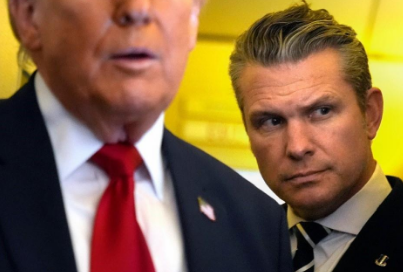
Trump and his defense secretary, Pete Hegseth, have questioned the patriotism of news outlets because of their reporting.
Trump has complained about war coverage in both specific and general ways. In a social media post, he said news reports exaggerated the damage to planes that were attacked by Iran at an airport in Saudi Arabia.
He attacked “Corrupt Media Outlets” for falling for AI-generated false reports created by Iran and said the media “hates to report” how well the U.S. military has performed.
All presidential administrations tangle with the press; it’s the natural byproduct of journalists’ watchdog roles in a democratic society. But the incidents of the past few days speak to a hostility toward the very idea of being questioned — in a way that, some say, scratches up against the First Amendment itself.
A contentious gaggle on Air Force One
Meeting with reporters on Air Force One while returning to the White House from Florida late Sunday, the president objected to a question from ABC News’ Mariam Khan about a fundraising message that used a photo taken at last week’s dignified transfer ceremony of the remains of U.S. service members.
Khan was working as the pool reporter on the plane, but when she told Trump she was with ABC, he said, “I think it’s maybe the most corrupt news organization on the planet. I think they’re terrible.”
Federal Communications Commission Chairman Brendan Carr cited Trump’s Truth Social message about the planes struck in Saudi Arabia in warning news outlets to be careful about what they report.
“Broadcasters that are running hoaxes and news distortions — also known as fake news — have a chance now to correct course before their license renewals come up,” Carr wrote on X over the weekend. “The law is clear. Broadcasters must operate in the public interest, and they will lose their license if they do not.”
Decades of court decisions have generally sided with the press over government attempts to regulate the content it produces. But Carr said making changes is in the best interest of legacy media outlets because so many people don’t trust them.
His ability to make changes, however, is limited
The FCC does not regulate networks like CBS, NBC, and ABC — although it does have the authority to reject the licenses of individual affiliates of those networks when they come up for renewal. Cable news networks CNN, Fox News Channel, and MSNBC are not under the FCC’s purview.
The Trump message Carr retweeted mentioned only The New York Times and The Wall Street Journal, and the FCC has no authority over newspapers.
Punishing a television affiliate for war coverage that Carr objects to is likely to run afoul of the law, noted First Amendment attorney Floyd Abrams in an interview Monday.
“The broadcast media is always at risk in a way that newspapers are not. But at its core, they are protected by the First Amendment,” Abrams said, “and these statements by the chairman seem to me to be directly threatening First Amendment interests and First Amendment principles.”
Abrams said he’d argue that robust war reporting is just the sort of public interest work that television stations should be doing to justify their licenses.
Intimidation may be Carr’s motive. And that doesn’t have to mean intimidating a news outlet to pull its punches, said Barbara Starr, a former CNN Pentagon correspondent. “The risk is the climate they create,” she said. “Are people going to be afraid to talk to reporters? Some of them will be, and that’s a serious matter.”