

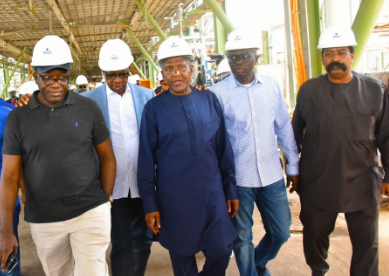
Dangote Cement Plc has signed a $1bn agreement with Sinoma International Engineering to construct 12 new cement plants and expand existing facilities across Africa.
The deal, disclosed by Market Forces Africa, follows the signing of a Memorandum of Understanding in Lagos on Friday and establishes a framework for engineering, procurement, and construction (EPC) delivery across several African markets.
Sinoma, a leading global cement engineering contractor, is expected to supervise the phased implementation aligned with Dangote Cement’s production roadmap.
The expansion underpins Dangote Cement’s ambition to increase installed capacity to 80 million tonnes per annum (MTPA) by 2030, strengthening its position as Africa’s largest cement producer.
“Dangote Cement Plc, a subsidiary of Dangote Industries Limited, at the weekend in Lagos, signed a landmark agreement with Sinoma International Engineering for the construction of 12 new projects and the expansion of others across Africa,” Aliko Dangote, president and CEO of Dangote Industries Limited, said.
“The landmark agreement, with an estimated investment of over $1 billion, reinforces the company’s long-term growth strategy and aligns with the broader aspirations of the Dangote Group’s Vision 2030,” the Market Forces report read.
Dangote added that the projects would strengthen the company’s dominance in Nigeria, increase export volumes, optimise existing assets and improve operational efficiency across its African footprint.
Investor implications and macro ripple effects
The $1bn expansion signals confidence in Africa’s structural infrastructure and housing deficit at a time when many economies face currency volatility and high borrowing costs.
Dr Muda Yusuf, CEO of the Centre for the Promotion of Private Enterprise (CPPE), described the move as a vote of confidence in the continent’s long-term demand fundamentals.
“Urbanisation rates and demographic growth continue to support long-term construction demand,” Yusuf has consistently maintained in previous sector analyses, adding that large-scale manufacturing investments signal resilience in domestic private capital formation.
For equity investors, the transaction reinforces Dangote Cement’s long-term volume growth outlook. The plan to raise capacity to 80MTPA by 2030 reflects management’s confidence in sustained demand across key African markets and enhances forward production visibility.
However, the scale of the buildout implies a multi-year capital expenditure cycle that could moderate free cash flow generation before new volumes are fully commissioned and monetised.
Markets are likely to scrutinise leverage ratios, interest coverage and return-on-invested-capital (ROIC) metrics, particularly if a significant portion of the project is financed through debt. Transparency around project phasing and funding structure may prove critical for equity valuation and investor sentiment.
From a fixed-income perspective, the financing mix will shape credit market reactions. If external borrowing — including hard-currency instruments — is substantial, headline leverage could temporarily increase, potentially widening credit spreads if investors perceive heightened refinancing or foreign-exchange risk.
Beyond company-level metrics, the expansion has broader macroeconomic implications. Large-scale industrial investments of this magnitude can stimulate employment, attract foreign direct investment inflows and support GDP growth in host countries.
Successful execution could modestly improve current account balances through increased export capacity and enhance fiscal revenue prospects, potentially supporting sovereign Eurobond sentiment in markets where Dangote operates.
Still, analysts caution that such macro benefits are likely to materialise gradually rather than trigger immediate structural shifts.
For Dangote Cement, the $1bn bet underscores a strategic calculation: that Africa’s infrastructure deficit, demographic expansion and urbanisation trajectory will sustain cement demand well into the next decade — and that scale, efficiency and regional reach will determine who captures that growth.