


Ghana’s approach to counter-terrorism has indeed been characterized by strategic ambiguity, allowing the country to navigate complex security challenges while maintaining relative peace. This approach involves cooperating with international partners, like the US and Nigeria, while maintaining discretion.
Strategic ambiguity can be an effective tool in counter-terrorism, as it allows countries to avoid alerting potential threats, maintain operational flexibility, protect sensitive information, and build trust with partners.
Ghana’s security architecture has benefited from this approach, but it’s not without challenges. The country still faces security threats, particularly from the Sahelian region.
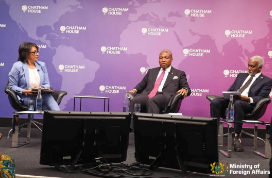
However, on March 9, 2026, at the plush podium of Chatham House in London, Foreign Minister Samuel Okudzeto Ablakwa chose to trade that shield of invisibility for a moment of international applause.
By publicly confirming that Ghana assisted the U.S. in its Christmas Day bombing of ISIS targets in Sokoto, Nigeria, the Minister didn’t just share a success story. He signalled a dangerous departure from the very stealth that has kept us safe.
The Operational Own-Goal
The first casualty of the Minister’s disclosure is Operational Security (OPSEC). As noted by security experts recently, extremist groups like the Islamic State Sahel Province (ISSP) and JNIM thrive on narratives of foreign interference. They seek symbolic targets to justify their expansion into the Gulf of Guinea.
By identifying Ghana as a kinetic partner in a drone or missile strike, the Minister has effectively moved Ghana from the logistical periphery to the operational centre in the eyes of these terror cells.
We have gone from being a neighbour watching the fire to being the one who helped throw the match. In an era of lone wolf attacks and border infiltrations, why would a sovereign state voluntarily paint a bullseye on its own back at a public forum in London?
A Constitutional Crisis in the Name of Diplomacy
Beyond the physical risk, there is the matter of our democratic foundation. The Minority in Parliament, led by Ranking Member Samuel Abu Jinapor, has raised a chilling question: Under what legal authority did this happen?
Article 181 of the 1992 Constitution is clear: international business or security agreements with significant implications must be ratified by the representatives of the people. Yet, Parliament was kept in the dark.
Former Defence Minister Dominic Nitiwul has rightly pointed out that no existing defence cooperation agreement between 1998 and 2018 permits Ghana to be used as a launch pad for military strikes.
If the Minister’s claims are true, the administration has bypassed Parliament’s sovereign oversight. If the claims are exaggerated for diplomatic clout, the Minister has unnecessarily heightened our national risk for a lie. Either scenario is an indictment of our current foreign policy management.
The Regional Fallout
We must also consider our neighbourhood. West Africa is currently a fractured landscape. With Mali, Burkina Faso, and Niger withdrawing into the Alliance of Sahel States (AES) and harbouring deep suspicions of Western military activity, Ghana’s public boast of assisting a US bombing run in a neighbouring state complicates our role as a regional mediator.
How can we lead the Accra Initiative or foster trust with our northern neighbours when we are seen as the primary local enabler of foreign kinetic operations? Diplomacy in West Africa currently requires a soft tread; the Minister, instead, chose a heavy boot.
Return to Stealth
Intelligence is a currency best spent in silence. The Minister’s London disclosure may have played well to an audience of Western diplomats and think-tankers, but it resonates with a terrifying frequency in our border towns in the Upper East and West regions.
True security leadership lies in the attacks prevented behind closed doors, not in the exclusive revelations shared at foreign dinner tables. It is time for the government to stop the strategic posturing and return to the quiet, professional, and constitutional discipline that has historically been Ghana’s greatest defence.