
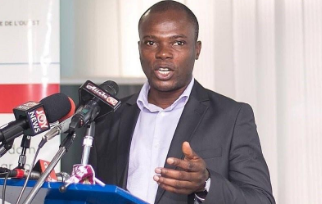
The Executive Director of the Media Foundation for West Africa(MFWA), Sulemana Braimah, has stated that the fight against corruption can only succeed with a strong and independent media.
Speaking at the National Forum on Media and the Fight Against Corruption in Accra, on Thursday, March 26, he said corruption remains deeply entrenched in the country.
He indicated that Ghana is stagnating rather than making progress and is falling below the halfway mark in its anti-corruption efforts.
“Initiatives like ORAL give some semblance of hope that we’re taking efforts against corruption seriously. These efforts can only succeed if they are supported by strong and independent media,” he said.
On his part, the former Executive Director of the Ghana Integrity Initiative, Vitus Adaboo Azeem, called on Transparency International and the Ghana Anti-Corruption Coalition to intensify their efforts in tackling corruption.
“Institutions like the Ghana Anti-Corruption Coalition, Transparency International Ghana, and others must intensify their fight against corruption,” he suggested.
He also urged journalists to boycott what he described as frivolous press conferences.
“Journalists should be able to boycott press conferences that are frivolous and a waste of time. If MPs abandon Parliament and go and sit at the EOCO, the media should not appear there at all. If after an hour, the media don’t show up, they will leave,” he said.
Vitus Adaboo Azeem further urged stronger commitment in the fight against corruption, calling on both institutions and the media to step up their efforts.
Mr. Azeem emphasized that organisations leading the anti-corruption agenda must do more to achieve tangible outcomes.
The former Executive Director of the Ghana Integrity Initiative highlighted the critical role of the media in promoting accountability, stressing that journalists must be intentional in Ghana tourism packages
“Institutions like the Ghana Anti-Corruption Coalition, Transparency International Ghana, and others must intensify their fight against corruption.
Journalists should be able to boycott press conferences that are frivolous and a waste of time. If MPs abandon Parliament and go and sit at EOCO, the media should not appear there at all. If after an hour the media don’t show up, they will leave,” he stated.
His remarks come at a time of growing concern over the effectiveness of anti-corruption measures in the country, with increasing calls for closer collaboration between state institutions and the media to confront the challenge more decisively.
Ghana enjoys media freedom, and the press and broadcasters operate without significant restrictions.
The private press is lively and often carries criticism of the government. At least 100 media outlets operate in Ghana, including radio stations, television networks, and internet sites. Recently, many media outlets have launched online news sites.
The most popular are the state-owned Ghana Broadcasting Corporation and its television and radio stations.
The BBC broadcasts on 101.3 FM in Accra and on 104.7 FM from Sekondi-Takoradi, the capital of the Western region.
There were 14.7 million internet users by December 2021, comprising 46% of the population (Internetworldstats.com). Mobile phones are widely used for online access.