
The Minority in Parliament has stated that the current erratic power supply challenges bedevilling the country are largely due to the Mahama government being indebted to the tune of US$ 700,000,000.00 to Independent Power Producers (IPPs) and to fuel supply challenges.
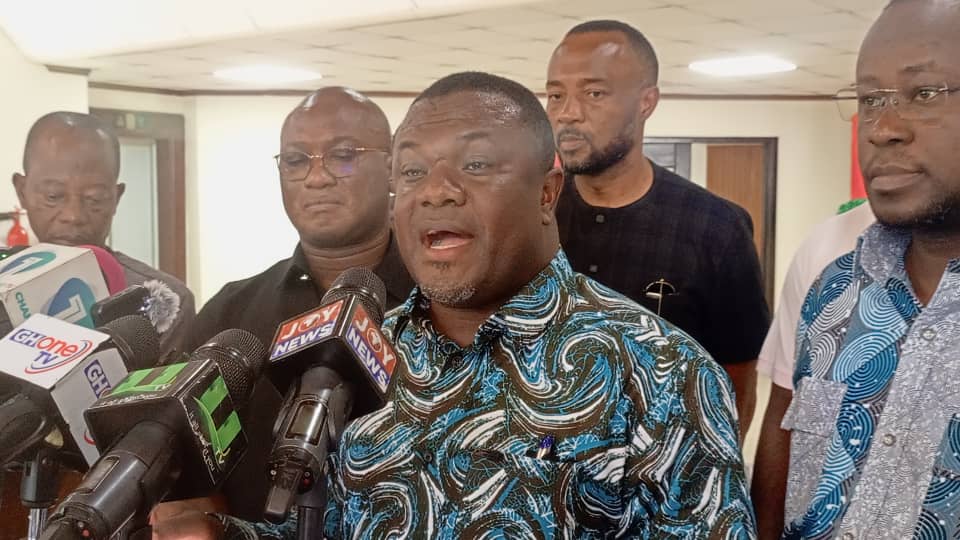
Addressing the press on Tuesday, April 28, on behalf of the Minority Caucus, Deputy Ranking Member on Parliament’s Energy Committee, Collins Adomako Mensah, said the challenges facing the sector extend beyond technical constraints and are deeply rooted in financial difficulties.
“We also know that the problems of the sector are not only technical; they are financial,” he stated.
He noted that although the Minister for Finance, Cassiel Ato Forson, had previously assured that debts owed to IPPs had been cleared, data available to the Minority suggests otherwise, indicating substantial outstanding payments.
“The data available to us is that the government owes IPPs over $500 million and over $200 million to companies that supplied fuel for power generation,” he disclosed.
These figures, the minority argued, contradict earlier government claims of improved financial performance within the Electricity Company of Ghana (ECG) and the wider energy sector.
In response, he called on the government to provide clarity on the true financial position of the sector, particularly following the introduction of the Energy Sector Levy, widely referred to as the ‘Dumsor levy’.
“We are calling on the Minister for Energy and the Minister for Finance to, within the shortest possible time, lay before Parliament and publish a full, detailed and independently verified report on the one Ghana cedi Dumsor levy, covering all collections made to date, all disbursements, and the outcomes of every expenditure,” he stated.
Decisive Action
The Minority mounted pressure on President John Dramani Mahama’s administration, demanding immediate and decisive action to address the recent wave of persistent power outages across the country.
Collins Adomako-Mensah, in his statement, criticized the government’s handling of the situation and rejected suggestions that the outages are primarily the result of a recent fire incident at the Ghana Grid Company substation at Akosombo.
He indicated that the current energy challenges, commonly referred to as dumsor, have been ongoing well before the April 23 incident and should not be attributed to a single event.
He argued that the fire at the Akosombo substation may have temporarily worsened the situation, but insisted that it does not explain the prolonged, recurring outages experienced in many parts of the country since early 2025.
“I must state plainly and without qualification: Ghana’s power crisis, the dumsor that millions of Ghanaians have been enduring since January 2025, was not caused by any incident at Akosombo.
“It was caused by this government. The events of 23 April are the latest and most dramatic symptom of a power sector left to decay under the NDC’s incompetent stewardship,” he said.
“The Mahama government must not be permitted to use this incident as a convenient alibi for a crisis that predates it by more than a year, and the NPP Minority will not allow that cynical rewriting of history to pass unchallenged,” he added.
Across several parts of Ghana, households continue to experience unannounced power cuts, with calls intensifying for a clear load-shedding timetable and long-term reforms to stabilize the energy sector.
Deep-Rooted Issues
Collins Adomako Mensah further argued that recent leadership changes in the power sector will not resolve the deep-rooted issues affecting electricity supply, urging the prioritization of proactive measures.
“The decision to ask the GRIDCo CEO to step aside and to reshuffle ECG’s Ashanti Regional leadership may generate headlines. It will not generate electricity,” he stated.
According to him, the current situation reflects what he described as political management of a crisis rather than genuine accountability, and he accuses the government of reacting to challenges it failed to anticipate.
“What Ghana is witnessing is not accountability; it is the political management and embarrassment by an administration caught off guard by the consequences of its own inactions,” he added.
Adomako Mensah further defended the embattled GRIDCo CEO, insisting that the operational and financial difficulties within the power sector predate his tenure and stem from broader systemic challenges, citing chronic underfunding, unsettled Independent Power Producer (IPP) obligations, and deferred maintenance.
“To hold him publicly accountable while shielding the policy architects of this situation is not justice; it is deflection dressed up as decisive leadership,” he stressed.
He also raised concerns about the maintenance of critical national infrastructure, particularly in the wake of the recent fire outbreak at the Akosombo Power Control Centre, arguing that lapses in safety protocols and maintenance must be addressed at the policy level.
“We do not oppose investigation. Any inquiry into events at critical national infrastructure must be thorough and transparent,” he noted.
His comments come amid a directive by the Minister for Energy and Green Transition, John Abdulai Jinapor, for the GRIDCo Chief Executive, Ing. Mark Awuah Baah, to step aside pending investigations into the fire outbreak at the Akosombo Power Control Centre.
The incident, which affected key control systems at the facility, has significantly disrupted power transmission and contributed to widespread outages across several parts of the country.