

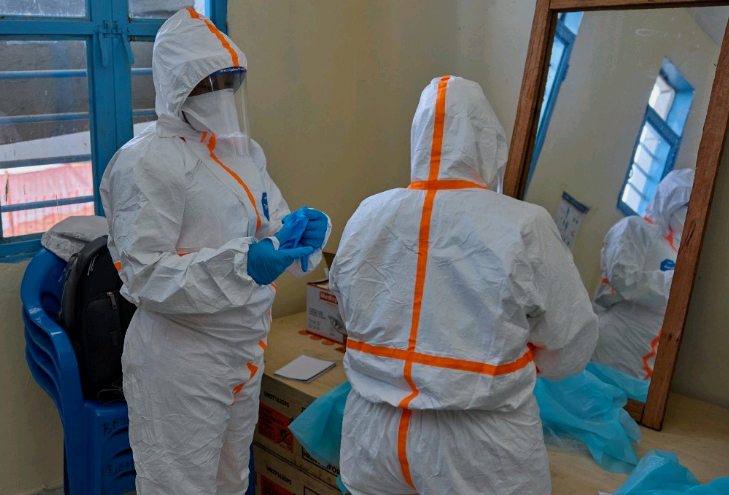
The resurgence of Ebola in the Democratic Republic of Congo (DRC) is sending fresh shockwaves through East Africa, raising concerns that a health crisis could evolve into an economic setback for one of Africa’s most integrated regional blocs.
With more than 280 confirmed cases and over 40 deaths reported in the DRC, governments across the East African Community (EAC) are scrambling to contain the threat while businesses worry about potential disruptions to trade, tourism and cross-border movement.
The outbreak comes at a particularly sensitive moment for the EAC, whose combined economy is valued at approximately $350bn and increasingly depends on the seamless movement of people, goods and services across member states.
The DRC, which joined the bloc in April 2022, has rapidly become one of its most important commercial centres.
The vast Central African nation maintains strong trade links with Kenya, Uganda, Tanzania, Rwanda and Burundi, serving as both a major consumer market and a critical transit hub for regional commerce.
The economic implications of the outbreak are already beginning to emerge.
Uganda, where nine Ebola cases have been confirmed and one death recorded, has moved swiftly to prevent further transmission by closing its border with the DRC.
While health officials view the measure as necessary, economists warn that prolonged restrictions could have consequences for trade flows and business activity between the two countries.
The concern is not merely about the immediate health emergency but about the broader economic ripple effects that often accompany infectious disease outbreaks.
Tourism and trade on alert
In Kenya, the outbreak has triggered an unexpected political storm after President William Ruto’s administration announced plans to establish an Ebola containment facility in Laikipia in partnership with the United States.
The proposal sparked widespread public opposition and prompted Kenya’s High Court to temporarily suspend the project.
Defending the initiative on Sunday, Ruto said the facility was intended to strengthen Kenya’s ability to respond to infectious diseases through longstanding international partnerships.
“The American government accepted to work with us on HIV/AIDS, to work with us on other diseases, and they worked with us on Ebola,” he said.
Ruto argued that preparedness rather than reaction remains the most effective strategy against future disease outbreaks.
Yet the political controversy reflects a broader anxiety among businesses that even the perception of Ebola could damage economic activity far beyond the health sector.
Kenya’s tourism industry, one of the country’s largest foreign-exchange earners, is particularly concerned.
Industry players fear that international media coverage linking Kenya to Ebola containment efforts could trigger travel advisories, discourage visitors and lead to booking cancellations from key source markets in Europe and North America.
“The reality is that Western source markets don’t always differentiate between a highly controlled containment facility in Laikipia and the general safety of the rest of the country.
To a traveller booking a holiday from London, Frankfurt, or New York, an Ebola headline associated with Kenya is an immediate red flag,” said Kenya Association of Hotelkeepers and Caterers (KAHC) chairperson Maureen Obunga.
Her concerns reflect painful memories of previous health emergencies, including the COVID-19 pandemic, when travel restrictions devastated tourism-dependent economies across East Africa.
Analysts say the risk extends beyond tourism.
The EAC’s economic integration framework is built on the EAC Customs Union Protocol and the EAC Common Market Protocol, which allow relatively free movement of goods, labour and capital among member states.
Any tightening of borders or additional restrictions could undermine those gains. Nairobi-based economist David Ndegwa warned that prolonged fears surrounding Ebola could weaken the interconnected economic relationships that have become central to regional growth.
“If this scare persists without proper containment measures being taken, we could see other countries closing their borders, thus affecting regional economic interdependence. This will have a major economic ripple effect across the entire region,” he said.