

“If there’s something I want to see before God takes me to heaven or hell it would be great to see an African nation win [the World Cup], because this is a tournament that we all love passionately in Africa.”
Sunday Oliseh was part of the first African team to win football gold at the Olympics, helping Nigeria make history at the Atlanta 1996 Games, but the 51-year-old is still waiting to see that achievement matched at the Fifa World Cup.
There have been 22 editions of the global showpiece since 1930, and in that time 49 sides have represented the continent, taken from 13 countries, yet Africa has produced just one semi-finalist.
That historic landmark came four years ago at Qatar 2022, when Morocco broke new ground for the world’s second-largest and second most populous continent.
It means the apocryphal prediction made by Brazil’s three-time World Cup winner Pele, who said in the 1970s that an African nation would get their hands on the trophy by the year 2000, has still not come to pass.
The big question is: how much longer will we have to wait?
Following the blueprint
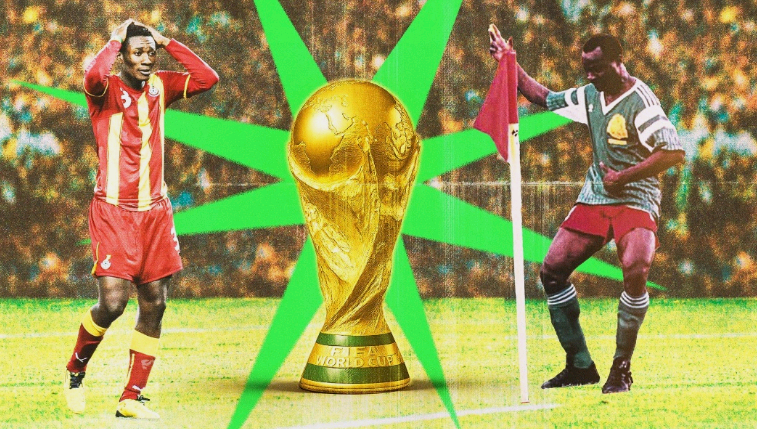
Africa had three quarter-finalists – Cameroon in 1990, Senegal in 2002 and Ghana in 2010 – before Morocco upset Belgium, Spain and Portugal on their way to the last four in Qatar.
Morocco upset Belgium, former winners Spain and Portugal on the way to the semi-finals at the 2022 World Cup, where they lost to France
The one thing underpinning the North Africans’ success has been long-term investment backed by the country’s King Mohammed VI.
An academy and $65m (£48.7m) training complex, both bearing his name, opened in 2009 and 2019 respectively and have helped the Atlas Lions establish themselves as Africa’s top-ranked side.
“Morocco has created a blueprint of how it can be done, which is years and years of investing in grassroot football and academies,” former Nigeria captain William Troost-Ekong told BBC Sport Africa.
“It starts with structure, with planning. Investment [is] very, very important.
“It has to be something that comes from federations being supported from a governmental level.
“Morocco have invested not just money but also time and effort, with a clear idea of how they can progress.
The facilities they have, the consistency throughout their age groups, I think that’s the only blueprint you can follow.”
The Confederation of African Football (Caf), for its part, has been attempting to boost the coffers of national federations and club sides by increasing prize money for the Africa Cup of Nations (Afcon) and its top continental club competitions, as well as investing in schools’ championships.
“An African country will be champions of the world,” Caf president Patrice Motsepe predicted.
“That is what we are working towards, that’s what we are investing in and we are confident it will happen.”
Claude Le Roy, who managed Cameroon at the 1998 World Cup and has coached five other African nations, says investing in youth will reap long-term benefits.
“If you want to permanently have high-level national teams in Africa, you need to work with youth categories,” the 78-year-old said.
A struggle for representation
Africa has previously been held back by its lack of representation at the finals, with colonialism restricting opportunities before a raft of countries declared independence in the 1950s and 60s.
Egypt, in 1934, were the continent’s sole competitor in the first eight editions of the tournament – and Africa boycotted the 1966 finals after Fifa announced it would not have a direct qualifier for that year’s World Cup in England.
The continent sent one side to the 1970, 1974 and 1978 finals – as opposed to at least nine from Europe and three from South America.
Two slots were available from 1982, three in 1994 and five from 1998 onwards when the tournament expanded to 32 teams.
Six competed in 2010 when South Africa hosted, but this year’s 48-team finals in Canada, Mexico and the United States will see the continent’s biggest ever contingent with nine automatic qualifiers as well as DR Congo, who progressed through the inter-confederation play-offs.
South Africa captain Ronwen Williams, who will lead his team in the tournament’s opening match in Mexico City, believes this year’s World Cup will be “a wonderful moment” for the African game.
“We’ve been on the rise – the leagues, Caf, the [African] Champions League, Afcon,” he told the BBC.
“Everything has improved immensely. For so many countries to go out and compete at the highest level, it’s amazing.”
With 37 wins from 162 previous World Cup matches, Williams and Troost-Ekong believe increased representation, and the change in format which sees two-thirds of teams progressing through the group stage, will be a big positive for improving Africa’s record.
“Making it more accessible is going to be the key factor in the long term for teams to be more competitive,” Troost-Ekong said.
“You need that exposure for improvement. The more experience they get, the more capable they will be with handling pressure.
“Experience is invaluable.”
Retaining – and attracting – talent
Where once a talent drain existed which saw players born in Africa or with African heritage choose to represent European nations, the continent is now taking advantage of large diasporas.
The added benefit is that some of those players will have trained in the academies of top European clubs.
Alongside their investment, Morocco have persuaded several players born abroad, including goalkeeper Yassine Bounou (Canada) and Achraf Hakimi and Brahim Diaz (both Spain), to pull on an Atlas Lions shirt.
The 39-year-old now works as a technical consultant identifying players eligible for the national team before aiming to convince them to represent the Leopards.
“You have to get players to believe in your vision. Potentially they can’t play for England, Belgium or France, but they can still get to the World Cup,” he explained.
“The biggest example is Axel Tuanzebe. He’s gone through the system with England and then he scores the goal to gets us to the World Cup.
“That is the fairytale ending, and probably the story I’ll use for the next player I try and get into the country.”
Increasing belief
“What Morocco did, that was the start for us as Africans to believe that we can [go far],” Bafana Bafana goalkeeper Williams said.
“It starts with that belief, and then you need to go out and perform.”
Having the right mindset is also crucial, according to Senegal forward Iliman Ndiaye.
“I wouldn’t even bother packing my suitcase and travelling to the World Cup if it’s not to win it,” he told Newsday on the BBC World Service.
“I don’t play these tournaments to just be a tourist.
“What Morocco did at the last World Cup should give all African teams inspiration.”
The missing ingredient
Senegal was beaten on the now abandoned golden goal law in 2002, while Africa would have had its first semi-finalist back in 2010 had Ghana striker Asamoah Gyan not smashed his penalty onto the Uruguay crossbar at the end of extra-time in their quarter-final, with the West Africans then eliminated on spot-kicks.
With an extra knockout round now added, avoiding injuries and suspensions will also be crucial.
“There’s been a lot of progress,” former Black Stars midfielder Michael Essien told BBC Sport Africa.
“The only thing that’s missing is luck. We just have to keep believing and hopefully one day it will happen.”
Morocco and Senegal, ranked eighth and 14th in the world respectively, offer Africa’s best hope of upsetting the
European and South American powerhouses, but both have tricky groups.
Should the continent’s contingent fall short again then Morocco will have home advantage in 2030, when the kingdom co-hosts alongside Portugal and Spain and hopes to stage the final.
The gap to the game’s established elite is undeniably smaller, and the moment that footballers from the continent lift the World Cup – and become pan-African legends – is edging closer.
Rob Stevens and Ian Williams
BBC Sport Africa