
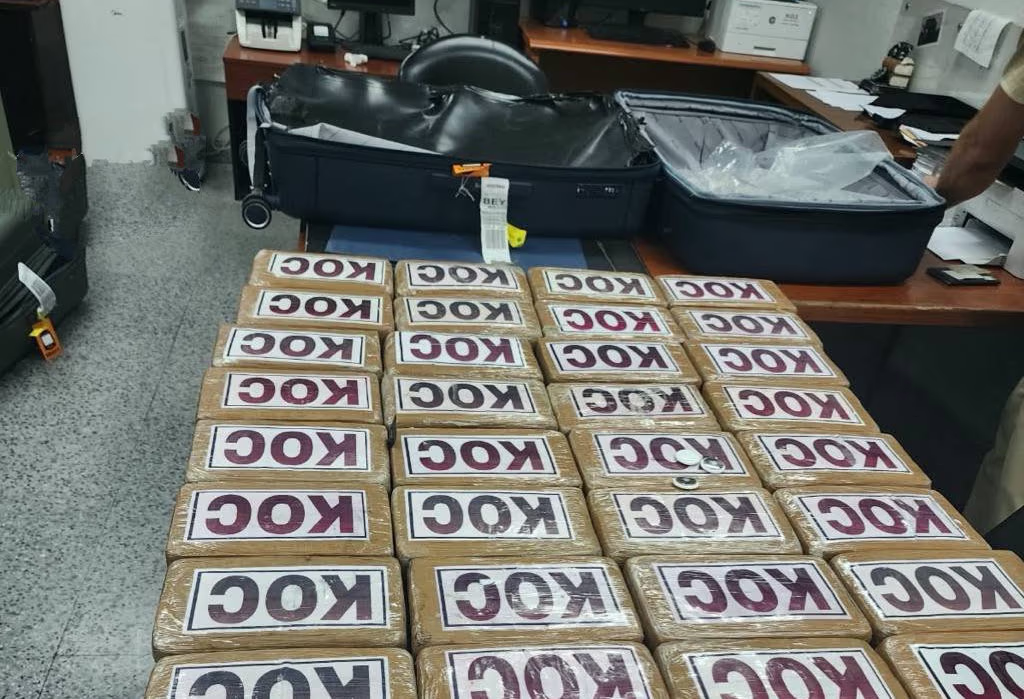
Lebanese security authorities have arrested a Syrian national who arrived at Beirut’s Rafic Hariri International Airport from Accra with 40 kilogrammes of cocaine concealed in two pieces of luggage.
The Directorate General of General Security said the suspect had been under surveillance from the time he departed Ghana until his arrival in Lebanon.
In a statement reported by Lebanese news outlets on Sunday, 1 November 2026, the security agency said its investigators monitored the passenger from the moment he disembarked from the aircraft until he collected his two bags.
The officers subsequently coordinated with Customs officials to search the luggage, leading to the discovery of the cocaine.
The suspect was arrested, although Lebanese authorities have not disclosed his identity or provided further details about the investigation.
Ghana at centre of fresh trafficking case
The seizure places Ghana’s capital, Accra, at the centre of another international cocaine trafficking case, amid growing scrutiny of the country’s role in transnational drug trafficking networks.
The Lebanese authorities have not indicated whether the suspect allegedly acquired the drugs in Ghana or whether other individuals in the country were involved in the operation.
Other drug busts
The arrest comes at a time when Ghana’s drug enforcement regime is under intense international attention.
The Beirut bust is the latest in a string of high-profile drug interceptions linked to Ghana in the last three months.
On September 10, 2026, French customs at the Port of Dunkirk seized nearly 3.9 tonnes of cocaine, estimated at about €225 million, concealed in a container of plastic waste shipped from Ghana.
In August 2026, the Ghana Police Service intercepted 866 parcels of suspected cocaine concealed in sacks of gari at a warehouse in the Tema Port enclave.
Police said at the time that the consignment was being prepared for onward shipment.
Accra surveillance questioned
Security analysts say the Lebanese disclosure — that the suspect was tracked from his departure in Accra — will raise fresh questions about how the drugs evaded detection at Kotoka International Airport (KIA).
“If Lebanese authorities knew he was coming from Accra with drugs, it means intelligence was available before landing. The question is why the baggage was not flagged at source,” a counter-narcotics source told The Source.
The Directorate General of General Security in Lebanon has not named the suspect or stated the street value of the 40kg.
As of Sunday evening, Ghana’s Narcotics Control Commission (NACOC) and the Ghana Airports Company Limited had not publicly commented on the Beirut seizure.
Ghana’s image
The latest interception adds to concerns that diplomatic and service passports, as well as commercial routes from Ghana, are being exploited. The opposition New Patriotic Party (NPP) in a recent petition to foreign missions as an example of Ghana’s growing international embarrassment.
“A diplomatic or service passport is a declaration by the Republic of Ghana that its bearer travels on the business of the State and merits the courtesies that status affords. Where such documents are issued to persons who hold no qualifying office, that declaration can no longer be relied upon.
The risk extends beyond Ghana’s reputation to the border security of every country that honours these documents,” the NPP said in its petition to the US Embassy.