

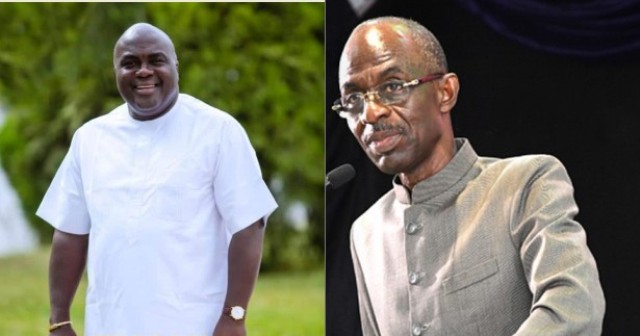
A new survey by Africa Policy Lens (APL) has revealed a neck-and-neck contest between Chief of Staff at the Office of the President, Julius Debrah, and National Chairman of the National Democratic Congress (NDC), Johnson Asiedu Nketia, in the race for the party’s 2028 presidential candidature.
The APL report, released on Tuesday, April 21, 2026, presents findings from a nationwide survey of constituency executives of the NDC, aimed at assessing current dynamics in the party’s 2028 flagbearer race.
One of the most significant findings is that neither of the two leading contenders has secured a decisive advantage, underscoring the tightly balanced leadership landscape within the NDC. Despite their strong positioning, both remain below the threshold needed to take outright control of the race.
Conducted across all 276 constituencies, the study offers a timely snapshot of support levels, voting intentions, perceptions of candidate competitiveness, and the key factors shaping leadership preferences within the party.
The results also provide valuable insights into an increasingly competitive and evolving contest, highlighting both the frontrunners and the broader considerations influencing decision-making among party actors at the grassroots level.
According to the APL survey, the study was designed to capture the perspectives of party actors at the constituency level across Ghana. The target population comprised constituency executives of the NDC in all 276 constituencies.
“A nationwide sampling approach was adopted, ensuring that all constituencies had an equal opportunity of representation in the study. This approach was intended to provide a broad and geographically inclusive view of internal party sentiment,” the report read in part.
“Data collection was conducted over a three-day period (April 17–19, 2026) using a structured survey instrument. The survey was administered via bulk SMS, allowing respondents to access and complete the questionnaire remotely.
“This method enabled rapid deployment across all constituencies, standardized delivery of the survey instrument, and efficient collection of responses within a short timeframe,” the report further noted.
The survey found that Johnson Asiedu Nketia leads with 31.9%, while Julius Debrah follows closely with 30.1%. This margin—less than two percentage points—highlights not only the competitiveness of the race but also its structural balance at the top.
“While both candidates have built strong bases, neither has been able to break away from the pack or consolidate a dominant coalition. The support landscape is therefore polarized but not settled.
“When respondents were asked who they would vote for if elections were held today, the same pattern emerged: Johnson Asiedu Nketia secured 32.7%, while Julius Debrah obtained 30.9%.
“The consistency between general support and immediate voting intention suggests that voter preferences are firm and well-defined, with little evidence of volatility or swing,” the APL survey report indicated.
The study further revealed that respondents’ choices are driven primarily by leadership qualities rather than policy specifics. Experience and track record (66.1%), personal integrity and honesty (56.8%), ability to unite the party (46.8%), grassroots appeal (46.5%), charisma and public image (43.9%), and policy proposals (27.9%) were identified as the most influential factors.
“The electorate is clearly prioritizing credibility, trust, and party cohesion over policy articulation. This indicates that the contest will likely be decided by perceived competence, moral authority, and the capacity to unify the party base, rather than by detailed policy platforms,” the APL survey noted.
“The NDC flagbearer race remains highly competitive but inconclusive. While Johnson Asiedu Nketia and Julius Debrah clearly lead the field, the absence of a commanding margin means the contest is still open and contestable.
“The eventual outcome will depend not simply on maintaining current support levels but also on candidates’ ability to broaden their appeal, consolidate broader backing, and align with the key leadership qualities valued by voters. Until then, the race should be understood as a balanced contest at the top, without a decisive frontrunner,” the report concluded.