

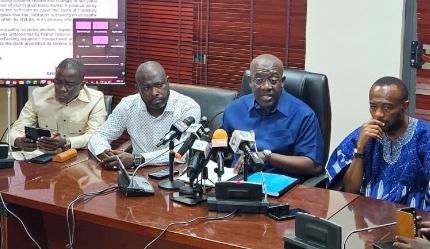
The Minority in Parliament has labelled the Bank of Ghana (BoG) “policy insolvent,” arguing that the central bank can no longer finance its core monetary operations from its own income and has instead resorted to asset sales and accounting adjustments to mask the true scale of its financial challenges.
Addressing the media, the Minority—led by members of the opposition New Patriotic Party (NPP)—insisted that a detailed reading of the Bank’s 2025 financial statements reveals a troubling reality that contradicts official claims of stability and improvement.
What is ‘policy insolvency’?
The Minority grounded its argument in the Bank’s own definition of policy solvency, as outlined in its audited accounts.
According to the BoG, policy solvency reflects the ability of a central bank to finance the full cost of its monetary policy operations—particularly open market operations (OMO) and liquidity management—using internally generated income, without relying on external support or depleting its capital.
By this measure, the Bank reported a policy solvency surplus of about GH¢5.5 billion in 2025, derived from operating income of GH¢22.2 billion against OMO costs of GH¢16.7 billion.
However, the Minority dismissed this conclusion as misleading.
Gold sales ‘artificially inflate’ income
The crux of the Minority’s argument lies in what it describes as “non-recurring and unsustainable income.”
Out of the GH¢22.2 billion operating income, the group pointed to GH¢9.6 billion generated from the sale of gold assets, arguing that this should not be classified as core income.
“The Bank of Ghana is not in the business of trading gold,” the Minority stressed, adding that selling strategic reserves to generate revenue cannot be a sustainable financing model.
Stripping out the GH¢9.6 billion gold proceeds, the Minority recalculated the Bank’s operating income at GH¢12.7 billion.
When compared with the GH¢16.7 billion cost of sterilisation operations, this produces a deficit of about GH¢4 billion.
“Minus GH¢4 billion puts the Bank of Ghana in policy insolvency,” the group declared.
‘Central bank operating on borrowed time’
The Minority further argued that the Bank’s decision to sell nearly half of its gold reserves in 2025 was a deliberate attempt to avoid exposing this deficit.
“This was not portfolio diversification as earlier claimed. It was a rushed move to generate artificial revenue to cover a policy insolvency position,” they said.
They warned that reliance on asset sales to sustain operations is fundamentally unsustainable.
“A central bank that needs gold sales to avoid policy insolvency is operating on borrowed time,” the group cautioned.
True loss ‘far higher’ than reported
Beyond policy solvency, the Minority also challenged the Bank’s headline loss figure of GH¢15.6 billion.
They argued that the actual financial position is significantly worse when broader accounting measures are considered.
According to their analysis, the Bank recorded an additional GH¢19.3 billion in losses under “Other Comprehensive Income” (OCI), bringing the total comprehensive loss to about GH¢34.9 billion.
When the GH¢9.6 billion gold sale proceeds are added back, they estimate the underlying loss at approximately GH¢44 billion.
“That is the figure the country was not meant to see,” the Minority asserted.
Accounting framework under scrutiny
The Minority further questioned the accounting framework used in preparing the Bank’s financial statements.
They cited disclosures by the Bank’s external auditors, KPMG, which highlighted that the financial statements were prepared based on the Bank’s own accounting policies rather than fully in line with International Financial Reporting Standards (IFRS).
Under the Bank of Ghana Act, certain items—such as foreign exchange revaluation gains and losses on gold, Special Drawing Rights (SDRs), and foreign securities—are excluded from the income statement and instead recorded in equity reserves.
This treatment, the Minority argued, allows substantial losses to be shifted out of the headline profit and loss account.
“This is the architecture that creates the gap between the GH¢15.6 billion headline loss and the GH¢34.9 billion comprehensive loss,” they explained.
Policy reversals drive rising costs
The Minority attributed the Bank’s deteriorating position to specific policy reversals introduced in 2025, which they say significantly increased the cost of monetary operations.
They pointed to the abolition of the dynamic Cash Reserve Ratio (CRR) system, which previously allowed the Bank to absorb liquidity at little or no cost.
Its removal, they argued, forced the Bank to rely heavily on interest-bearing instruments, causing sterilisation costs to surge.
Outstanding sterilisation bills reportedly rose from GH¢32.68 billion in 2024 to GH¢93.56 billion in 2025, while interest payments jumped from GH¢6.26 billion to GH¢14.61 billion.
A second policy shift involved the reversal of rules requiring banks to hold cedi-equivalent reserves against foreign currency deposits.
The Minority said this decision released liquidity into the system, which the Bank then had to absorb at high cost through OMO operations.
“They flooded the system with liquidity and then paid commercial banks to mop it up,” the group argued.
‘Wealth transfer’ to commercial banks
The Minority also raised concerns about what it described as a “massive transfer of public resources” to commercial banks.
They noted that the GH¢14.61 billion paid in interest on BoG bills in 2025 largely ended up boosting bank profits.
At the same time, private sector credit growth reportedly declined sharply, falling from 28.8% in 2024 to negative 13.9% in 2025.
“This is not monetary policy. This is a wealth transfer from the public balance sheet to private balance sheets,” they stated.
Reversal of recovery trend
The group argued that the Bank had been on a recovery path prior to 2025, with losses declining from GH¢13.23 billion in 2023 to GH¢9.49 billion in 2024.
However, this trend reversed sharply in 2025, with losses rising again and negative equity worsening from GH¢58.6 billion to GH¢93.8 billion.
“A central bank that was visibly mending is now visibly deteriorating,” they said.
Impact on the real economy
Beyond the financial statements, the Minority highlighted what it described as the real-world consequences of the Bank’s policies.
They cited tight liquidity conditions, reduced access to credit for businesses, weak manufacturing activity, and rising unemployment as evidence that macroeconomic stabilisation has not translated into improved living conditions.
“Stability of numbers is not the same as stability of livelihoods,” they emphasised.
Call for urgent intervention
The Minority concluded that the Bank’s current position requires urgent corrective action, including policy reforms and potential financial support to restore solvency.
They indicated that detailed recommendations would be presented in the coming days.
“For us, this is not about politics. It is about the integrity of our central bank and the future of the Ghanaian economy,” they said.