

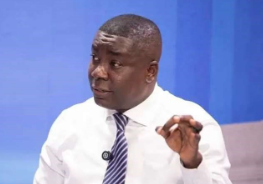
The Bank of Ghana’s 2025 operational loss was driven by politically motivated policy choices, rather than stability, Member of Parliament for Tano North and Member of Parliament’s Finance Committee, Dr. Gideon Boako, has said.
Boako, who has extensively discussed the Central Bank’s financial situation for months, predicted the huge loss, which the Central Bank confirmed in its Financial Statement released today, May 1, 2026.
The Bank of Ghana recorded a significant operational loss of GHS 15.6 billion, the second-highest loss since the Cedi was redenominated in 2008.
Dr. Boako has expressed shock at the situation, especially given that the Bank is performing worse than in 2024, when it showed significant improvement in its financial position following the 2022 Covid-19-related economic crisis.
“2025 was not a crisis year. The Bank’s 2024 financial statements showed a system slowly healing. Operating losses had narrowed from GH¢13.23 billion to GH¢9.49 billion.
Other Comprehensive Income had turned positive. FX valuation losses were moderating. The balance sheet was stabilizing. Then 2025 arrived, and the new management at the Bank of Ghana reversed the progress they inherited, ” Gideon wrote in an article on his Facebook page.
“The question is not whether losses can occur in central banking. They can. The question is: why a central bank that had begun to recover suddenly plunged into the largest non-crisis loss in its history?”
The MP blamed the loss on “politically motivated policy choices, not stability, for driving the huge losses.”
Below is the post by Dr. Gideon Boako: “Do not buy the propaganda that the loss BoG made is only GHc15.63 billion.
It is more than that. Adding the loss of GHc 19.32 billion in Other Comprehensive Income (OCI) gives a total loss of GHc 34.95 billion.
This explains why the negative equity deteriorated from GHc 58.62 billion in 2024 to GHc 93.82 billion in 2025.
This is the true loss made by the BoG. And this is even after reflecting income from gold sales. So, excluding the income from gold sales of GHc 9.57 billion, the total loss would have been GHc 44. 52 billion.
Why is it important to exclude income from the 18 tons of gold sales? Because that is not an operations matter, it was clearly an accounting gimmick to hide the Bank’s policy insolvency.
This is way beyond the Majority propaganda by announcing an operating loss of GHc 15.6 billion.
They quietly pushed aside the huge GHc 19.32 billion losses sitting in OCI. Just note that in 2024, there was a gain of GHc 13.5 billion in OCI and not a loss. God save Ghana.”
The central bank reported a substantially wider net loss of GH¢15.6 billion for the 2025 financial year, marking a sharp deterioration from the GH¢9.4 billion loss recorded in 2024.
This latest performance underscores the mounting financial cost of the central bank’s aggressive policy measures to restore macroeconomic stability following a turbulent period marked by high inflation, exchange-rate volatility, and weakened investor confidence.
According to the central bank’s audited financial statements, the expanded loss reflects the cumulative impact of tight monetary policy, extensive liquidity management operations, and strategic reserve accumulation efforts.
While these measures have placed considerable strain on the Bank’s financial position, they have also contributed to notable improvements in key economic indicators, particularly inflation and external reserve levels.
The headline loss was further exacerbated by a significant adjustment of GH¢19.32 billion recorded under other comprehensive income. This accounting charge primarily captures the valuation effect of a stronger Ghanaian cedi during the year.
As the local currency appreciated, the cedi value of the Bank’s foreign-denominated assets—including reserves held in US dollars and gold—declined when converted into domestic terms. Although this resulted in a large reported loss, it does not reflect an actual reduction in the underlying assets.
The combined effect of these financial pressures has led to a notable weakening of the central bank’s balance sheet. In 2025, the Bank of Ghana recorded a negative equity of GH¢35 billion, pushing its accumulated negative equity to GH¢96.3 billion.
This represents a sharp increase from GH¢61.3 billion at the end of 2024 and a stark reversal from the positive equity position of GH¢1.2 billion reported just a year earlier. The rapid shift highlights the scale of financial sacrifices made in pursuit of economic stabilization.
Bank officials have described the situation as the inevitable “cost of the work that was done,” emphasizing that the losses are closely tied to deliberate policy actions aimed at bringing inflation under control and stabilizing the currency.