

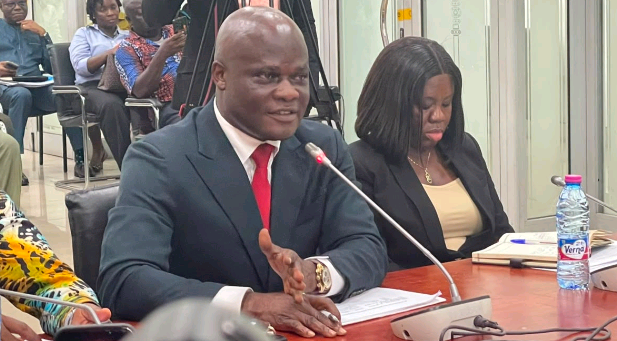
The Ministry of Local Government, Chieftaincy and Religious Affairs has established a working group to compile a national database on shrines, churches, and other religious sites across the country.
The Minister, Ahmed Ibrahim, disclosed this when he appeared before Parliament’s Government Assurance Committee.
“Honourable chair, the Minister of Local Government, Chieftaincy and Religious Affairs has set up a working group comprising officers from the Chief and Religious Affairs, Policy, Planning, Monitoring and Evaluation, Research, Statistics and Information Management directorates to create the database on shrines and other religious sites in the country,” he stated.
According to Ibrahim, the exercise will be supported by the various Regional Coordinating Councils and is necessary because the issue of “shrines” is complex and often misunderstood.
“A shrine is not just one thing. Even as you sit here, if I want to come to a shrine, I need to be given the power… it is not simple,” he explained.
He said the move follows concerns raised about people setting up shrines in communities and presenting them as religion.
“Simply because you go to certain communities, somebody will come there and say he has a shrine and maybe going to be doing things. That is another form of religion, but we are in charge of religion.”
The Minister noted that some misconstrued the question as “jovial,” but stressed that it is a “very sensitive, delicate and important question.”
Ibrahim said a multisectoral committee with expertise has been put in place because defining a shrine requires a firm foundation.
“So, a shrine can be a pen. It can be a photo, a picture. It can be anything. And these are spiritual issues. The lawyers may disagree with you,” he told the Committee.
He added: “We need to have a very firm foundation as to what a shrine is. Are we believing that it is only where a shrine is housed or a shrine that is the asset of the town?”
The Minister said the database will cover churches, traditional African religions, and shrines, and will help the government maintain proper records and oversight of religious sites in the country.
In a related development, Ahmed Ibrahim has also announced that the government plans to construct 261 24-HOUR markets across the country, with one market in every district.
The minister said the project is part of efforts to improve trading infrastructure and support local economies nationwide.
“We intend to build two hundred and sixty-one markets, one in every district. We have two hundred and sixty-one districts, and we intend to build two hundred and sixty-one, one in every district,” he stated.
The Minister noted that while the contractual construction period is 36 months, government has directed contractors to fast-track work.
“The construction period is supposed to be thirty-six months. But we ask the contractors that the government at least does not have thirty-six months to be in office. So, the completion period should be at least… we want you to be able to build it within eighteen to twenty-four months,” Hon. Ibrahim explained.
He added that government is aiming to commission the markets before the end of its current term in office.
Ibrahim said he is personally committed to ensuring a market is delivered in his own district as part of the nationwide rollout.
The project is expected to create jobs, decongest existing markets, and improve trading conditions for thousands of market women and traders across all 261 districts.
Ahmed Ibrahim says the government will step in to build 24-hour markets and modern trading facilities because the collapse of indigenous banks has left Ghanaian traders unable to compete with foreign businesses.
Appearing before Parliament’s Government Assurance Committee, Ibrahim said the state must intervene after seeing how foreign-owned businesses have taken over key commercial areas.
The Minister cited the collapse of local banks as a major reason Ghanaian traders are being driven out.
“Unibank is no more. Sovereign Bank is no more. First Capital Bank is no more. The indigenous bank that used to give you and I, our sisters and our constituents money to go and do business is no more,” he stated.
Hon. Ibrahim said that with unemployment on the rise, traders now lack the capital to rent space in malls and markets dominated by foreign firms.
“When you go to Spintex Road you see China Mall. You go to other shopping malls in South Africa, Shoprite, and Stanbic Bank. But the market women cannot go into them. They don’t have the high capital to go and pay the rent,” he told the Committee.
According to the Minister, the solution is for government to provide “a befitting place in every district.”
“If the President wants to construct a twenty-four-hour market, you can’t go and construct shelves that they should work twenty-four hours,” he said.
He explained that malls like China Mall operate because they are state-partnered businesses backed by government loans.
“The China Mall and the market that you see are state-partnered businesses. The Chinese government gives them money. They go to China Bank for a loan,” Hon. Ibrahim noted.
He argued that without similar state support, Ghanaian traders will continue to be displaced from major trading hubs.