

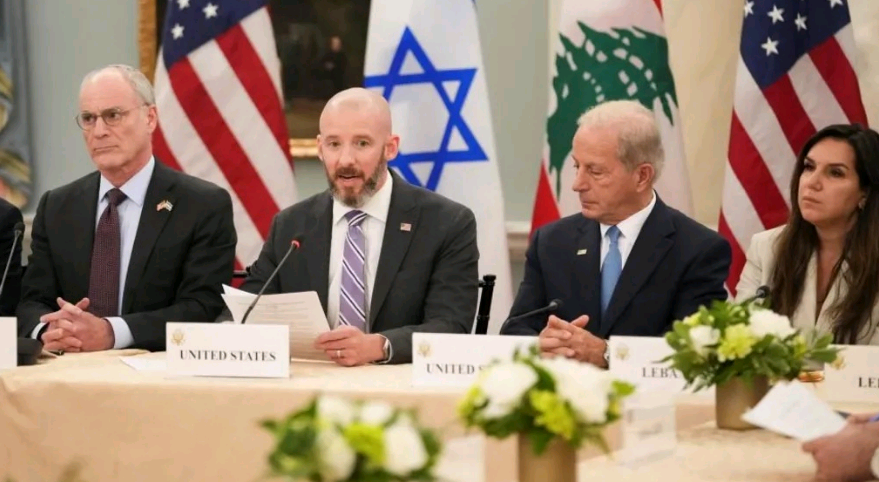
Israel and Lebanon have agreed to renew their fragile ceasefire and create a number of “pilot” security zones inside Lebanon in which Hezbollah operatives would be banned, the US state department has announced.
A joint statement said the agreement was “contingent on a complete cessation” of attacks by the Iran-backed armed group Hezbollah, among other conditions.
The three countries also “rejected any attempt, by any state or non-state actor, to hold Lebanon’s future hostage”.
The agreement was announced in Washington on Wednesday, after Israeli strikes killed at least nine people in southern Lebanon and Hezbollah fired rockets into northern Israel.
Lebanese state media reported that Israeli strikes continued in the south of Lebanon on Thursday, with at least one strike causing casualties.
Hezbollah, a Shia Muslim militia, political party and social movement, is Lebanon’s most powerful group. With support from Iran, it has built an armed force more formidable than the Lebanese army and has fought a series of conflicts with Israel. It is designated as a terrorist organisation by Israel and many other countries, including the UK and US.
The agreement between Israel and Lebanon, reached after a fourth round of US-mediated talks, is contingent on the “evacuation of all [Hezbollah] operatives” from an area between the Israeli border and the Litani river, about 30km (19 miles) to the north, which is currently occupied by Israeli ground forces.
It said the US would help guide the creation of “pilot zones in which the Lebanese Armed Forces will take exclusive control of the territory to the exclusion of all non-state actors”.
It did not include any maps to indicate where the pilot zones would be located, or any explanation of how they might work in practice.
The agreement followed a partial ceasefire announced on Monday, which Lebanon said would see Israel refrain from bombing the Lebanese capital, Beirut, in exchange for Hezbollah not attacking Israel.
The two countries’ representatives will meet again on 22 June to hold further talks “with a view toward reaching a comprehensive agreement”.
Hezbollah told the BBC that it would comment officially in due course.
Far-right Israeli National Security Minister Itamar Ben-Gvir branded the agreement a “serious mistake”, claiming it would allow Hezbollah to “grow stronger”.
Lebanon was drawn into the war between the US, Israel and Iran on 2 March, when Hezbollah launched rockets into Israel in retaliation for an Israeli strike that killed Iran’s supreme leader. Israel responded with an air campaign across Lebanon and a ground invasion in the south.
A US-brokered ceasefire between Israel and Lebanon on 16 April failed to stop the fighting, and last week Prime Minister Benjamin Netanyahu ordered the Israeli military to intensify its strikes on Hezbollah and advance deeper into Lebanon in response to drone and rocket attacks on communities in northern Israel.
At least 3,516 people have been killed in Lebanon since the start of the war, according to the country’s health ministry. Its figures do not distinguish between combatants and civilians.
The UN says more than one million people have also registered themselves as displaced in Lebanon, where Israeli evacuation orders cover more than an eighth of the country.
Israel says 26 of its soldiers and four Israeli civilians have been killed on both sides of the border during the war.
Lebanese media reported Israeli strikes across the south of the country on Wednesday.
The health ministry said four Syrians and two Palestinians were killed in a strike in the al-Housh area, which is just south of the coastal city of Tyre.
The ministry also said that two paramedics were killed and a third was seriously wounded when Israeli forces “directly targeted an ambulance” in the Chehour area, which is about 14km (9 miles) to the east. The ambulance belonged to the Risala Scouts Association, which is affiliated with the Amal movement, an ally of Hezbollah.
The ministry accused the Israeli military of “demonstrating contempt for international humanitarian law”, which specifically protects medical personnel.
At least 128 paramedics and healthcare workers have been killed in Israeli attacks on ambulances and medical facilities over the past three months, according to the ministry.
There was no immediate comment from the Israeli military. In the past, it has claimed that ambulances are being used for military purposes, without providing any evidence.
The Lebanese army, meanwhile, said that one of its soldiers was killed in an Israeli air strike on the road between Nabatieh and Kfar Tebnit, about 27km north-east of Tyre. Lebanon’s state-run National News Agency (NNA) reported that his motorbike was targeted by a drone.
The army said another two Lebanese soldiers were injured in a separate Israeli strike on their vehicle on the road between Deir Zahrani and Nabatieh.