
“The jealous eye sees another man’s possession as extravagance, until the same possession becomes its own necessity.”
There is something profoundly instructive about the politics of opposition in Ghana. Political parties often discover the importance of fiscal discipline, accountability, and the welfare of ordinary citizens when they are outside government, only to develop entirely different interpretations of those same principles when they assume power. The controversy surrounding Ghana’s presidential aircraft is perhaps one of the clearest illustrations of this political phenomenon.
In 2021, when the Akufo-Addo administration considered acquiring a new presidential aircraft, the NDC mounted an extraordinary campaign against the proposal. The intensity of the opposition was such that one could hardly escape the impression that the greatest offence was not necessarily the acquisition itself, but the fact that it was the NPP, rather than the NDC, making it.
Samuel Okudzeto Ablakwa, the North Tongu MP, was particularly relentless. In August 2021, he described the existing Falcon 900EX as being in “pristine condition”, insisting that it could fly non-stop to European destinations. He questioned the President’s preference for alternative aircraft and repeatedly challenged the Government’s justification for acquiring a replacement.
But perhaps his most consequential position came on 28 September 2021, when he declared:
“I must state emphatically that the Akufo-Addo administration will not get the support of the NDC in purchasing a new aircraft.”
He went further, describing the proposed acquisition as being driven by an:
“Insatiable appetite for obscene luxury.”
Haruna Iddrisu, then Minority Leader, was equally emphatic. On 29 September 2021, he asked:
“What is this that we hear that because the President cannot bath in the current Falcon, he must buy a new jet, and then we should be interested in providing for the comfort of the President when Ghanaians are reeling under economic hardship?”
He concluded that it was a misplaced priority and misplaced expenditure that should not receive the Minority’s support.
Sammy Gyamfi, then the NDC’s National Communications Officer, also weighed in. On 2 October 2021, he declared:
“I submit forcefully that the decision by Akufo-Addo-Bawumia NPP-led government to buy a new presidential jet is a misplaced priority and will amount to a waste of the public purse if it is allowed. The mere thought of it at this time is insensitive to the plight of the ordinary Ghanaian and an insult to our sensibilities.”
These were emphatic political positions, delivered with considerable conviction and presented as expressions of concern for the Ghanaian taxpayer.
One cannot discuss that episode without reflecting on Nana Addo Dankwa Akufo-Addo. The public ridicule surrounding the condition and suitability of the presidential aircraft, including the arguments about the President’s comfort, was unfortunate. A President’s safety is not a partisan privilege. It is a national responsibility. One is therefore entitled to ask: was the life and safety of President Akufo-Addo worth any less than that of President John Dramani Mahama? Why should the question of a suitable and reliable aircraft become an extravagant presidential indulgence when one administration is in office, but a legitimate national security requirement when another assumes power?
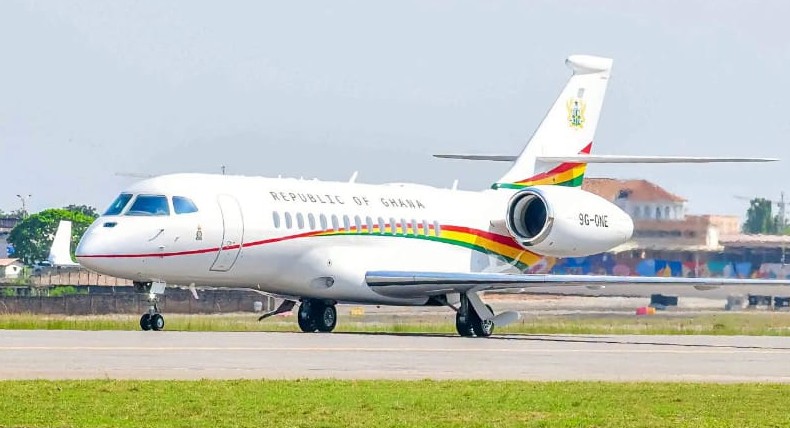
Fast-forward to Monday, 16 November 2026. Ghana has taken delivery of a brand-new Dassault Falcon 6X executive aircraft, reportedly valued at US$60.68 million. The very party that vigorously opposed the acquisition of a new presidential aircraft is now defending its own procurement. The explanation has changed. We are now told that the old aircraft is ageing, has experienced recurring maintenance challenges and needs replacement in the national interest.
Interestingly, James Agalga, the NDC MP for Builsa North and then Chairman of Parliament’s Defence and Interior Committee, told Parliament in November 2025 that the procurement process would take approximately four years. Yet, less than twelve months after that explanation, the aircraft has arrived in Ghana. What happened to the four-year timeline? Was Parliament given a realistic procurement estimate? These are questions that deserve answers, particularly when the same political tradition once demanded rigorous scrutiny of every explanation offered by the previous administration.
But perhaps the greatest irony is that this aircraft has arrived at a time when ordinary Ghanaians are confronted with pressing economic and social difficulties.
Thousands of trained teachers remain affected by recruitment and employment challenges, while some teachers already working have had to protest over delayed staff identification numbers, salaries and outstanding conditions of service. The country continues to grapple with the employment backlog of trained nurses and other health professionals, with recruitment dependent on financial clearance.
The labour front has hardly been without turbulence. Industrial action and disputes over conditions of service, allowances and outstanding payments have affected workers across public institutions. Security personnel have also had to contend with concerns over rent allowances and other conditions of service.
Meanwhile, fuel prices have risen, transport fares have increased, and households have had to absorb higher electricity and water tariffs. Businesses are struggling with operating costs, and ordinary families continue to make difficult choices about how to stretch their incomes.
These are not imaginary difficulties. They affect real people and real households.
So, the question is straightforward: upon what standard of public expenditure does the Government justify a US$60.68 million executive aircraft at this particular moment? What happened to the sensitivity towards ordinary Ghanaians that Sammy Gyamfi preached so forcefully in 2021? Where is the misplaced-priority argument that Haruna Iddrisu once deployed? And what has become of the relentless scrutiny that Okudzeto Ablakwa brought to the previous administration?
For the avoidance of doubt, I do not subscribe to the argument that Ghana must never acquire a new presidential aircraft. Indeed, a reliable aircraft is important for the safety, security and effective international engagements of the President. My difficulty is with the selective application of principles and the political inconsistency that often accompanies it.
Perhaps the only immediate relief is that President Mahama now has a state aircraft of his own and will no longer have to depend on his brother Ibrahim Mahama’s private aircraft for certain official journeys. But even that raises another question about the optics of the relationship between public office and private influence.
Only yesterday, at the Kempinski, during the economic investment engagement, images circulated showing Ibrahim Mahama departing alongside the finance minister, his new prey, Dr Cassiel Ato Forson, in the former’s private vehicle. What exactly should Ghanaians make of these optics? There is no suggestion that sharing a vehicle establishes wrongdoing. However, the boundaries between private influence and public responsibility must always remain clear, particularly when public confidence is at stake.
Ultimately, Ghana deserves political leadership that does not manufacture principles for the convenience of opposition and abandons them upon assuming office. The presidential jet has landed. The arguments of 2021, however, have not disappeared. They remain on record, and Ghanaians are entitled to place them beside the explanations being offered today.
The aircraft may have changed, the occupants of Jubilee House may have changed, but the obligation to account to the Ghanaian taxpayer has not changed.
I rest my case.
Ohene Gideon Kwasi Annor
annorgideonkwasi@gmail.com