

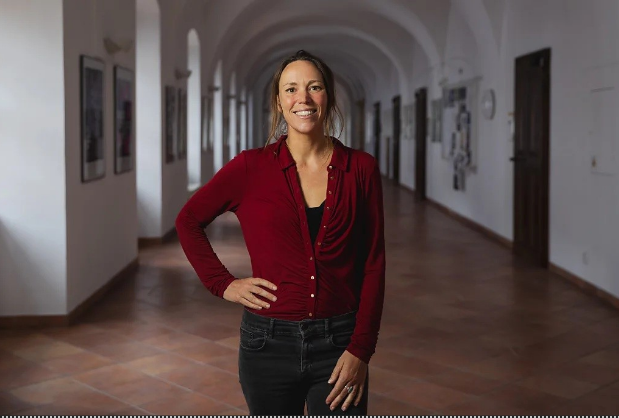
In her new book, “The 21st Century Brain,” neuroscientist Hannah Critchlow explores the overlooked skills necessary to flourish in the age of AI – and how we can cultivate them.
With the world around us evolving at an ever-greater pace, you may fantasise about upgrading your brain to make sense of it all.
At face value, this would seem impossible: our grey-and-white matter has largely the same structure as that of our ancestors living in the Stone Age. If anything, our brains are a bit smaller: archaeological remains suggest they have significantly shrunk in the past 10,000 years.
Hannah Critchlow, a neuroscientist at the University of Cambridge, UK, offers many reasons to be optimistic, however. In her new book, The 21st Century Brain, she describes how we can all cultivate the mental flexibility necessary to navigate the challenges ahead.
“I basically wrote it for myself, so that I can make better decisions and improve my own life, especially as I go through middle age,” she tells me. ”But also, for my parents, so that they can maintain a healthy brain into older age, and for my son, who’s 10 now. What can I do to help his brain flourish?”
Read on to discover her secrets for future-proofing your mind.
What inspired you to explore the concept of the 21st Century Brain?
I first began working on the book three years ago, and in the intervening time, there’s been an explosion of developments in AI. But it was obvious, even then, that this technology was going to start encroaching on all our lives, on a society-wide level, but also on an individual level – and then, as now, there was a lot of excitement about that, and a lot of fear.
I wanted to take a step back and acknowledge that AI was developed using knowledge from neuroscience.
So, what if we flip that around and ask how we can use this understanding to make the most of the intelligence in our own organic brain? The same understanding that has driven these technological developments can unleash the human cognitive potential that we all have.
What were your criteria for selecting the skills that will be most important for the 21st Century?
I wanted to focus on the skills that have often been overlooked by scientists, but which underpin our ability to connect with each other, to imagine a new world, to innovate, to problem-solve, and to think longer term.
Since we’re living at a time of unprecedented social and technological change, I examine our ability to tolerate change, uncertainty, and ambiguity.
All of this basically requires healthy ”bioenergetics”, so I also look at the mitochondria – the power stations of our cells.
Altruism levels were altered by a much more diverse gut microbiome. Isn’t that incredible? – Hannah Critchlow
Let’s start with emotional intelligence and empathy, which are often viewed as ”soft skills”.
Emotional intelligence and empathy scores can be the biggest predictors of how satisfied we are with life, how positive we feel about our relations with others, and academic success.
When we look at the genetic data, it seems to have a heritability of between 10% and 45%, but we can all train our emotional intelligence and empathy.
Jamil Zaki, a psychologist at Stanford University, argues that we can start by showing a little bit of compassion to ourselves. Just take time to ask, ”Why am I feeling this emotion?”
And what is it that I can do to help myself with this feeling, so that I’m more comfortable? Once you start practicing a little bit of self-compassion, the effects will ripple out to others.
You also argue that altruistic behaviour may – quite literally – come from our guts.
There is a really lovely study by Hilke Plassmann from Insead in Fontainebleau, France, and her colleagues, who looked at 100 healthy volunteers taking pre- and probiotics.
After just seven weeks, they had a more varied gut microbiome compared to those taking the placebo, and they were also much more altruistic. The participants were more willing to relinquish their own money in the name of equality, for instance.
In other words, their levels of altruism were altered by them having a much more diverse gut microbiome. Isn’t that incredible?
Indeed! How is it possible that our gut bacteria could change our behaviour?
The mechanism is not entirely known, but there are loads of nerves that live within the gut and our heart.
And when you get a “gut feeling”, that’s because all of those cells are basically sending a signal up via the vagus nerve to the insula, which is the region of the brain that’s involved in sensing our environment and collecting information, and then the decision-making parts of the brain.
It’s thought gut bacteria produce chemical neurotransmitters that alter the activity of neural circuits to shape our behaviour including social interactions.
How about creativity? There’s this amazing sentence in your book where you argue that, from a neuroscientist’s point of view, the difference between a Wolfgang Amadeus Mozart or Ada Lovelace and the rest of us is only one of slight degree. How can we make more of these talents?
One is to make the most of our daydreaming. Twenty percent of our day is spent mind-wandering – so not thinking about anything specifically, or trying to work on a particular goal – and that is when you start to get new ideas.
Your brain just kind of settles on different things that are rumbling through your mind. And we know that just going out for a walk in nature can help with that process.
It helps to increase a very particular frequency of electrical oscillations in the brain called alpha waves, which are associated with calm, creative thinking. It is probably why Archimedes also had his eureka moment in his bath, when he was nice and relaxed in the water.
We also know that sleep is important for creativity, especially when you are first dropping off and thinking in a strange, fragmented way. Once again, it’s encouraging the brainwaves that are associated with that enhanced creativity.
It’s been said that Thomas Edison would hold a metal object over a metal tray; it would clatter down onto the metal tray and wake him up, so that he could scribble down any new ideas that he’d had.
By David Robson