

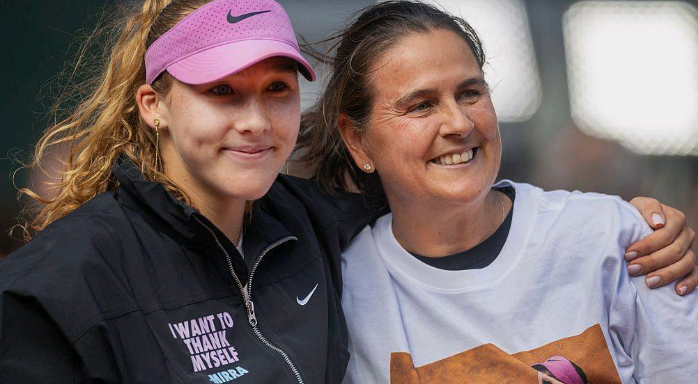
The coaching box is one of the most visible places in tennis.
Players often glance towards it after every point. Television cameras pan to it dozens of times during a match. Commentators spend time dissecting the reactions of those within it.
But if you look closely, whether at regular tour events or at Wimbledon in the coming fortnight, you will usually see that most of the coaching staff inside it are men.
Female coaches, even at the top of the women’s game, are a rarity. Only four players inside the top 50 in singles have a woman as their primary coach.
Yet it was one of those players who walked away with the French Open trophy this year as Conchita Martinez – a former Wimbledon winner – guided 19-year-old Mirra Andreeva to her first Grand Slam title.
Numbers are growing, and a handful of female coaches are thriving at the very top of the game.
But in a sport like tennis, which prides itself on gender equality, why are there still so few full-time female coaches, and what is being done to tackle the issue?
Dealing with ‘egos’ in a changing landscape
When Andy Murray hired former world number one Amelie Mauresmo as his coach in 2014, the decision was met with a wave of sexist backlash that shocked Murray.
Murray’s partnership with Mauresmo is one of the few examples of a female coach working at the top of the men’s game, but the scarcity of women in coaching goes beyond the ATP Tour.
In 2017, women made up just 6% of registered coaches on the WTA Tour – the women’s circuit. That figure has more than tripled since, rising to 19% in 2026.
The perceptions that Murray experienced when he appointed Mauresmo 12 years ago still exist, while family commitments, a relentless calendar, and constant travel all play a part in why there are not so many women in top-level coaching.
Sandra Zaniewska, the coach of world number 13 and French Open semi-finalist Marta Kostyuk, believes the “landscape is changing” – but she has seen the barriers up close.
“Women, when they finish playing, usually think of starting a family and travelling less,” says Zaniewska, a former player who never planned to go into coaching.
“If I had children, I’m sure that I wouldn’t be travelling.
“It’s why I don’t think that it’s ever going to be 50-50 [the split of male-female coaches] – but there is space and the landscape is changing.”
While the biggest stars often travel with both a coach and a hitting partner, many players on tour cannot afford to bring both to every event. As a result, they opt for a coach they believe can fill both roles.
Given that women compete against other women, why is a male hitting partner considered essential? Perhaps it’s not just the extra power and top spin on their shots, but the confidence they exude.
“Sometimes we laugh that you can have male hitting partners and their ego is so big – they come and just think they know everything,” Zaniewska, 34, said.
“When you’re top 100 or top 50, so much is about the mental game and believing in yourself and projecting confidence.
“On that level, it helps, because if you have a player that does not feel that you’re confident and [that] you believe in them and yourself – because it goes together – then they’re going to feel it very quickly.”
A high level of self-belief is something Martinez has been able to transfer to Andreeva.
“She understands me more than anyone could,” the Russian teenager said 12 months before her triumph at Roland Garros.
“She’s been through this. She’s also a woman. She’s played so many matches on tour; she’s so experienced. She’s a Grand Slam champion.”
Zaniewska believes female coaches can sometimes be judged unfairly because they express confidence differently.
“It’s not that females are more insecure, I wouldn’t say that,” Zaniewska said.
“We just think more, so we’re more conscious of things. We really want to make sure that we figure it out before we give advice to someone.
“That can portray a sense of insecurity sometimes.”