

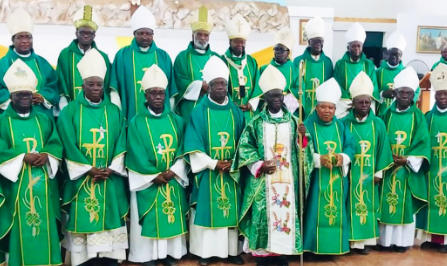
The Ghana Catholic Bishops’ Conference has raised serious concerns over what it describes as a breakdown in law enforcement, moral standards, and regulatory oversight following the controversial Karnival Kingdom Festival, calling for a full-scale investigation and sweeping reforms to prevent a recurrence.
In a strongly worded statement issued through the National Catholic Secretariat, the Bishops outlined a series of demands, including an independent and transparent investigation into the festival, a review of event permitting procedures, and a formal inquiry into the role played by state security agencies—particularly the Ghana Police Service—during the event.
The Conference also called for the public release of findings from any investigation, the establishment of clear decency standards for public events, and the initiation of a broader national dialogue on the limits of cultural expression in Ghana’s public spaces.
It further stressed the need for all stakeholders to allow investigations to proceed without political interference.
At the heart of the Bishops’ concerns are reports of public nudity during the Karnival Kingdom Festival, held from April 22 to 28, 2026, which they described as both a moral affront and a violation of Ghanaian law.
Citing Section 278 of the Criminal Offences Act, 1960 (Act 29), the Conference maintained that the conduct witnessed at the event constitutes a breach of established legal standards.
According to the statement, the festival “was an eyesore, denigrated our values as a nation and breached the laws of our land,” warning that such incidents, if left unchecked, could erode the moral and legal fabric of Ghanaian society.
A particularly troubling aspect of the event, the Bishops noted, was the reported presence of police officers providing security for participants during the festival.
This, they argued, raises fundamental questions about the role of state institutions in upholding the law.
“We unequivocally condemn the act of public nudity and call for immediate investigation into the role of State Institutions, and the importation of foreign cultural practices,” the statement said, adding that the apparent protection of participants by law enforcement demands urgent clarification.
The Conference questioned who authorised the event and approved the deployment of police personnel, suggesting that agencies responsible for maintaining public order may have failed in their duties—or worse, facilitated conduct that contravenes the law.
“Who approved the permits and the deployment of police to protect participants engaged in public nudity?” the Bishops asked, describing the situation as a serious governance concern.
Beyond the immediate incident, the statement pointed to a broader issue of cultural tension, noting that the festival reflects a growing clash between globalised entertainment trends and Ghana’s established moral and legal norms.
While acknowledging the value of cultural exchange, the Bishops insisted that imported events must operate within Ghanaian law.
“An imported event cannot claim exemption from Ghanaian law. Cultural exchange must respect the host nation’s laws and values,” the statement emphasised.
The Conference also commended the Member of Parliament for Assin South, John Ntim Fordjour, for demanding accountability over the incident, describing his intervention as consistent with concerns held by the Church leadership.
As calls for accountability intensify, the Bishops underscored the importance of conducting investigations free from political influence, warning that any attempt to interfere could undermine public trust in the process.
They further proposed a comprehensive review of the regulatory framework governing public events, including stricter enforcement of decency standards and clearer guidelines for the involvement of security agencies.
In their concluding remarks, the Bishops delivered a stark warning about the implications of the incident for governance and the rule of law.
“Provision of police protection for acts that breach the criminal code represents a serious failure of official duty,” the statement said, adding that urgent action is required to restore confidence in law enforcement and regulatory institutions.
The statement, signed by Matthew Kwasi Gyamfi, President of the Ghana Catholic Bishops’ Conference, signals growing concern among religious and civil society leaders over the direction of public morality, governance, and cultural expression in the country.
With mounting pressure for accountability, attention is likely to shift to the government and relevant state agencies, as stakeholders await decisive action on the issues raised.