

I’ve come to an industrial space in a tech-heavy area of San Francisco expecting to see a menacing humanoid robot solider doing something combat-like: the future of land-based warfare, perhaps.
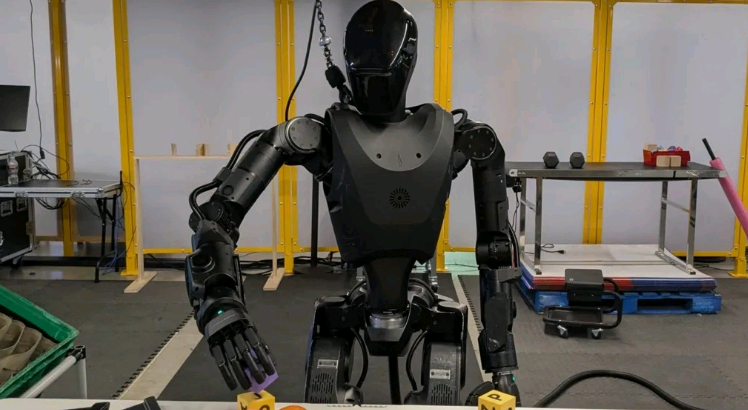
Instead, the black shiny faceless Phantom robot is engaged in “free play”, manipulating a bunch of coloured kids blocks.
“We need data from it just interacting with its environment…[and] this is today’s menu,” explains Sankaet Pathak, co-founder and CEO of two-year-old start-up Foundation Robotics, which is developing Phantom for military and civilian applications.
Later he pushes its 80kg steel-covered body around the room to demonstrate its stability and shows me how it walks.
While many companies are building autonomous humanoid robots for factories, homes or companions, Foundation claims it is the only US firm developing them specifically for a broad range of defence applications.
That includes support roles like supply pickup, reconnaissance, recovery of equipment or casualties, and hazard inspection. But also, more controversially, warfighting to engage and neutralise threats – which Pathak calls “frontline weaponisation”.
Arming robots could keep human soldiers out of harm’s way, he argues. They could enter and search buildings, where chokepoints can be lethal.
They could also reduce collateral damage. Land-based autonomy can be more precise than striking targets autonomously from the air, he says.
That is all well in the future for Foundation’s Phantom.
The company’s first-generation model, Phantom MK-1, which I am shown, doesn’t have a battery, isn’t dust or waterproof and can’t get back up if it falls.
Its hands – still a major robotics challenge – lack strength and dexterity, and it has no proper wrists yet.
A second-generation model is being built in another off-limits part of the facility.
Not only will Phantom MK-2 be element proof, says Pathak, but a large battery will provide about six hours of runtime, and it will be able to recover if it falls and withstand more force.
Better hands are crucial. The robot’s next set will move in far more ways, with wrists that help it to fire weapons, Pathak says.
Foundation’s goal, Pathak adds, is to produce at least 40,000 units a year by end of 2027 with costs in the long term less than $20,000 (£15,000) each.
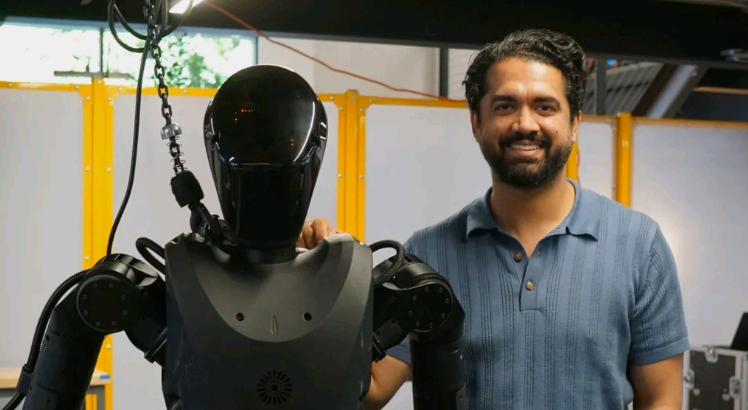
Arming robots could keep soldiers out of harm’s way says Sankaet Pathak
Pathak argues that China is pursuing the technology and the West needs to keep up.
He envisions hundreds of thousands of AI-driven humanoid robots forming a ground force, matching the growing use of autonomous drones in the skies. A fleet of humanoid robot soldiers could be a major deterrent to conflict, he says.
Foundation has $24m (£18m) in research contracts to pilot its technology with the US military as well as two units currently being tested by the Ukrainian military.
The US military pilot is limited to handling rather than firing weapons, Pathak says, though weaponisation is part of the testing in Ukraine.
The company attracted attention earlier this year after Eric Trump, the US Presidents’ son, became an investor and advisor.
Foundation is also an opportunity for Pathak to prove himself – Synapse, the financial services firm he co-founded and led, filed for bankruptcy in 2024.
But are humanoid soldier robots what the military needs, how hard are they to build and what ethical issues do they raise?
The military is clearly interested, says Dean Fankhauser at Robozaps, a humanoid robotics advisory firm that runs a marketplace for commercial systems.
He points to a current US Army contest for humanoids that could eventually support soldiers across a wide range of tasks.
It is “completely inevitable” says Fankhauser that a company would see a business opportunity in weaponising the technology.
There are plenty of simpler robots – namely drones and even some ground robot systems – used to carry explosives, missiles and other payloads, with battlefield use especially visible in Ukraine.
Some firms have also been working to weaponise dog-like quadruped robots, though we haven’t seen them too much in active warfare yet notes Fankhauser.
But other legged robot companies have drawn a line opposing weaponisation, citing risks of harm and ethical issues.
Pathak disagrees with that, arguing it is dangerous that more firms aren’t following Foundation’s lead.
Humanoid robot soldiers make sense, he argues, because the world is built for humans. From screwdrivers to weapons, there is no need to reinvent existing tools.
Humans should be “in the loop”, approving any use of lethal force before the system can act, Pathak says, though he makes exceptions where firing autonomously might be necessary to avoid a catastrophic outcome and sees scenarios where human authorisation is less critical.
Perhaps the biggest challenge, and one faced by all companies building humanoid robots, is developing artificial intelligence that can operate in the real world and cope with unpredictable and complicated situations.
Phantom is directed by an AI system called Cortex, and a new version is also in development.
The idea is that Phantom is given a goal – such as moving supplies or mapping the inside of a building – based on a task it has been trained specifically to carry out through demonstrations using videos, images and text.
It then navigates its environment using cameras in its helmet that provide 360-degree vision, allowing its AI system to assess the surroundings and adapt its movements.
In Cortex, says Patak, two types of AI models work together.
A “reasoning model” trained on task-specific examples interprets the goal and formulates Phantom’s action plan.
A broader “world model”, trained on internet videos as well as data gathered from the robot interacting with the physical world – including its “free play” with blocks – predicts how the environment will respond, helping Phantom move safely and execute actions.
Other robots, such as quadrupeds, can navigate terrain more quickly and efficiently, says Fankhauser of Robozaps.
He also notes, based on what he has seen in the commercial space, humanoid technology still has a long way to go.
Today’s commercial humanoid robots can barely handle warehouse packing let alone open a door, says Fankhauser.
“If there was a war in Taiwan today, the likelihood that China is going to militarise these humanoids and fight effectively is fanciful,” he adds.
While Chinese robots have produced some impressive displays, they have taken place in highly controlled or structured environments – the antithesis of real-world warfare. Though Fankhauser adds things might be different in another five or 10 years.
Robert Griffin works on humanoid robots at the non-profit Florida Institute for Human and Machine Cognition, whose activities include military-funded humanoid projects focused on non-combat applications.
One of its spin-out companies was later acquired by Foundation for part of its core technology.
Griffin sees value in humanoids in reducing risk to human soldiers, but also says unpredictable environments remain a major hurdle.
Getting a robot to jump through a window of unknown height, land on uneven ground, and immediately navigate an unfamiliar interior is hard.
“You get an impression of human-level capability by seeing the human form… but [these autonomous systems] don’t know how to handle open-ended uncertainty yet,” says Griffin.
By Zoe Corbyn, Technology Reporter, San Francisco