

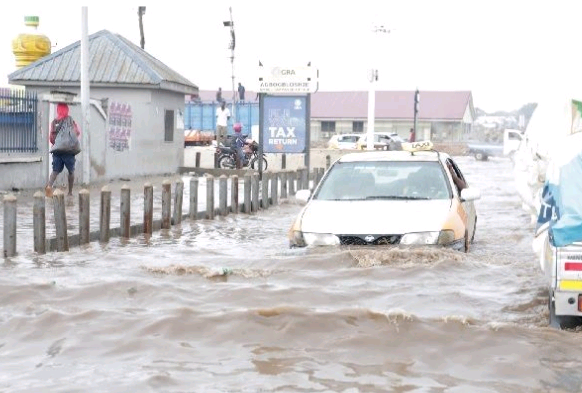
Ghana’s latest floods should not be treated as a seasonal inconvenience or an unavoidable act of nature. They are the visible consequence of decades of failed planning, weak enforcement, political cowardice, institutional neglect, and a national habit of responding to disasters only after citizens have already lost homes, livelihoods, and lives.
The rains that battered Accra in June 2026 were heavy, but heavy rain alone does not explain why roads became rivers, homes were submerged, businesses were destroyed, and commuters were trapped. The deeper explanation lies in the way Ghana’s cities have grown faster than the state’s ability, or willingness, to govern them.
Urbanisation is not the enemy. Poorly managed urbanisation is.
Ghana has urbanised dramatically within one generation. In 1960, only 23.1% of Ghana’s population lived in urban areas. By the 2021 Population and Housing Census, that figure had more than doubled to 56.7%. The University of Ghana’s work on urbanisation confirms that this transition has placed enormous pressure on housing, sanitation, infrastructure and urban services, particularly in Greater Accra and Ashanti, where urban growth has exceeded the national average. (University of Ghana)
The World Bank has also observed that Ghana’s urban population more than tripled over three decades, rising from about 4 million to nearly 14 million people, with urban growth outpacing rural growth. That growth has been driven by jobs, education, services, poverty reduction, commercial opportunity and the concentration of public and private investment in cities. (World Bank)
The reasons are obvious. Young people move to Accra because that is where they believe opportunity exists. Rural communities continue to suffer from weak local economies, inadequate infrastructure, limited employment, poor access to specialist health care, weaker educational opportunities and limited investment. Accra, Kumasi, Tema and Takoradi therefore become magnets for those seeking survival and advancement.
But successive governments have failed to match this population movement with proper land-use planning, affordable housing, drainage expansion, waste management, transport infrastructure and strict development control. The result is that Ghana has achieved urban growth without urban discipline.
Accra’s flooding crisis is therefore not new. JoyNews recently described it as a 66-year crisis, noting that as far back as April 1960 the Daily Graphic carried a front-page story on Accra flooding that could almost be republished today. The same communities continue to flood for largely the same reasons: low-lying geography, occupation of floodplains, choked drains, poor waste management, inadequate drainage, and laws that exist on paper but are weakly enforced. (MyJoyOnline)
This is where the current government’s responsibility becomes unavoidable. It is true that President Mahama’s administration inherited a long-standing structural problem. However, no government can hide permanently behind inheritance. Every administration inherits problems, but leadership is measured by what it does with them.
The incompetence of the present government lies not in causing all the historical conditions that produced the floods, but in allowing predictable hazards to become fresh disasters. The June 2026 response again followed the familiar pattern: floods occur, citizens suffer, government expresses sympathy, NADMO is directed to assess the situation, drains are desilted, task forces are mentioned, and demolition of structures on waterways is promised. That is not a flood prevention strategy. It is political firefighting.
President Mahama reportedly directed NADMO and other agencies to prepare a comprehensive report after the latest flooding, particularly in Accra. (GBC Ghana Online) But the question is why Ghana is still “mapping” restricted waterways in 2026 when Accra’s flood-prone zones have been known for decades. Why does government wait until homes are submerged before desilting drains? Why are wetlands restored only after they have been reclaimed? Why are illegal structures on waterways allowed to stand for years until floodwater exposes the failure of enforcement?
The Ministry of Works, Housing and Water Resources itself has cited human activities as a major cause of the latest flooding. (MyJoyOnline) That admission is important because “human activities” in this context means official failure as much as private misconduct. A citizen who builds on a waterway may be irresponsible, but the state that permits, tolerates, regularises or refuses to demolish that structure is complicit.
The reported cases are painful and familiar. In 1995, severe flooding in Northern Ghana displaced more than 50,000 people. In 2007, widespread floods affected three northern regions and displaced more than 300,000 people. In 2015, the June 3 Accra flood and fuel station fire disaster claimed over 150 lives. In 2023, the Akosombo and Kpong Dam spillages displaced more than 30,000 people in the Volta, Eastern and Greater Accra regions. NADMO’s own flood disaster profile identifies heavy rainfall, dam spillage, poor urban planning, blocked drains, settlements in low-lying areas, deforestation and land degradation as key contributing factors. (NADMO)
The June 3, 2015 disaster should have been Ghana’s turning point. It was not. The World Bank records that the 2015 flood event affected 53,000 people, caused major damage in housing, transport, water and sanitation, resulted in about $55 million in damage and losses, and required an estimated $105 million for reconstruction. (World Bank) Ghana News Agency reported that the disaster claimed 159 lives. (Ghana News Agency) Eleven years later, Accra is still flooding, and the national conversation still sounds like a repetition of old promises.
Successive governments have failed for several reasons.
First, flood control does not produce quick political reward. Governments prefer visible projects that can be commissioned with ribbons, speeches and billboards. Underground drains, retention ponds, zoning enforcement, wetland restoration and long-term maintenance do not provide the same political theatre. Yet those are precisely the interventions that save lives.
Second, land-use enforcement is politically costly. Illegal structures are often linked to voters, party financiers, local power brokers, chiefs, developers and officials. Demolishing unlawful buildings on waterways requires courage. Instead, governments delay, compromise or look away until the rains enforce what the law refused to enforce.
Third, local government institutions are weak. The NDPC Chair, Dr Nii Moi Thompson, has reportedly identified institutional failures in Metropolitan, Municipal and District Assemblies as a major driver of Accra’s flooding, particularly weak enforcement and lack of administrative accountability. (GBC Ghana Online) Planning authorities cannot protect a city if their decisions are overridden by politics, corruption or fear.
Fourth, Ghana has not learned how to maintain infrastructure. Drainage is not a one-off construction project. It is a living system requiring continuous inspection, desilting, repair and expansion. Yet Ghana treats drain maintenance as an emergency exercise shortly before or after the rains. The June 2026 reports of emergency desilting and wetland restoration are therefore evidence of belated reaction, not proof of preparedness. (Channel1 News)
Fifth, waste management remains fundamentally broken. Accra’s drains are not only too small; many are choked with plastics, silt, household waste, construction debris and commercial refuse. The University of Ghana’s urbanisation study notes that although solid waste collection has improved, only 19.2% of urban households use standard waste containers, while 47.5% rely on improvised containers. (University of Ghana) This is not merely a sanitation problem. It is a flood risk multiplier.
Sixth, successive governments have failed to plan for the real size of Accra. The drainage systems serving many parts of the capital were designed for a smaller city. They cannot cope with today’s population, today’s paved surfaces, today’s concrete developments and today’s volume of stormwater runoff. When green spaces, wetlands and open grounds are replaced by concrete, rainwater cannot soak naturally into the ground. It rushes into drains that are either blocked, undersized or absent.
Scientific evidence confirms that Greater Accra is one of West Africa’s most flood-prone regions. A 2026 Scientific Reports study found that flood susceptibility in Greater Accra is influenced by elevation, slope, geology, proximity to urban areas and stream power, with coastal and north-eastern areas highly susceptible. It projected that under certain development scenarios, more than 780,000 to 810,000 building footprints, representing more than 3.12 million to 3.24 million people, could experience high flood susceptibility. (Nature)
This means Ghana is not dealing with isolated flooding. Ghana is dealing with a structural urban risk crisis.
The World Bank’s GARID project was designed precisely because the Odaw River Basin is central to Accra’s flooding problem. In 2023, Ghana received $150 million in additional financing for the Greater Accra Resilient and Integrated Development Project to improve flood risk management and solid waste management for more than 2.5 million people in the Odaw River Basin. The World Bank identified fast-growing development, occupation of flood-risk areas, inadequate and unmaintained drainage systems, and solid waste accumulation along waterways as key causes of the increasing frequency and intensity of urban floods. (World Bank)
That authority is devastating. It confirms that Ghana knows the causes, has received international support, has diagnosed the problem, and yet still has not built a system capable of protecting citizens.
The lessons from other countries are clear.
The Netherlands has shown that flood risk can be managed even in a country where much of the land lies below sea level. Its success comes from long-term planning, flood barriers, retention areas, strict land-use controls, water boards, engineering excellence and political consensus that flood protection is a national security issue.
Singapore offers a more comparable lesson for tropical rainfall. It combines drainage expansion, detention tanks, canals, reservoirs, strict development control and constant maintenance. It does not wait for floods before cleaning drains. It integrates water management into urban planning.
Japan demonstrates the importance of underground flood diversion systems, pumping stations, early warning, public education and continuous maintenance. The Tokyo metropolitan area’s flood control infrastructure shows that dense urban areas can be protected where engineering is matched by discipline.
Rwanda offers an African lesson. It does not possess Ghana’s wealth or coastal commercial advantage, but it has shown that enforcement, sanitation discipline and environmental regulation matter. Urban planning rules are taken seriously. Public cleanliness is treated as civic culture, not occasional public relations.
Ghana must stop pretending that the solution is unknown.
The country needs a national flood resilience law that imposes binding duties on central government, MMDAs, NADMO, the Hydrological Authority, the Lands Commission, planning authorities and sanitation agencies. Flood prevention should not depend on the mood of a minister after a disaster.
Ghana must create a publicly accessible national flood-risk map showing waterways, floodplains, wetlands, drainage reserves and prohibited development zones. Every building permit should be checked against this map before approval. Any official who approves development in a restricted waterway should face personal administrative and legal consequences.
Structures unlawfully built on critical waterways must be removed. Where the state itself wrongly granted permits, compensation may be considered in accordance with law. But where private individuals knowingly encroached on floodplains, public safety must prevail over private convenience.
Drainage investment must shift from piecemeal desilting to basin-wide engineering. Accra cannot be protected by clearing a few gutters after heavy rain. It needs detention basins, retention ponds, widened primary drains, restored wetlands, improved outfalls, pumping solutions where necessary and properly connected secondary and tertiary drains.
Wetlands must be treated as infrastructure. Ghana has wrongly viewed wetlands as empty land waiting for development. In reality, wetlands are natural flood defences. Destroying them is like demolishing a sea wall and then blaming the ocean.
Waste management must also be reformed. Plastic pollution, poor collection, weak enforcement of dumping laws and lack of household-level waste discipline all contribute to flooding. A serious flood policy must therefore include reliable waste collection, recycling incentives, strict penalties for dumping in drains and sustained public education.
Government must also confront the housing crisis. People do not live in dangerous informal settlements because they enjoy risk. Many do so because affordable housing is unavailable and urban land markets exclude the poor. Any flood solution that ignores housing will merely move vulnerable citizens from one danger zone to another.
Finally, Ghana must stop learning the same lesson every year. The June 3 disaster, the 2007 northern floods, the Akosombo spillage, the Weija flooding, and the June 2026 Accra floods are not separate tragedies. They are chapters in the same national failure.
UNDP’s warning after the latest Accra floods is correct: the rains will return, and the floods will return; the real question is whether governments will continue responding after disaster strikes or invest in systems that protect people before it happens. (UNDP)
That is the heart of the matter.
Flooding in Ghana is not simply an environmental crisis. It is a governance crisis. It exposes the gap between law and enforcement, between planning and politics, between speeches and implementation, between sympathy and competence.
The present government must be judged not by how many flooded communities it visits, but by how many future floods it prevents. If, after the June 2026 floods, Ghana merely produces another report, another task force and another short-term desilting campaign, then the next disaster will not be a surprise. It will be a choice.
The rain is natural.
The disaster is man-made.
And the incompetence lies in knowing the danger, seeing the evidence, having the authority, receiving the funding, hearing the warnings, mourning the dead, and still failing to act before the water rises again.
By Bennard Nana Owusu