

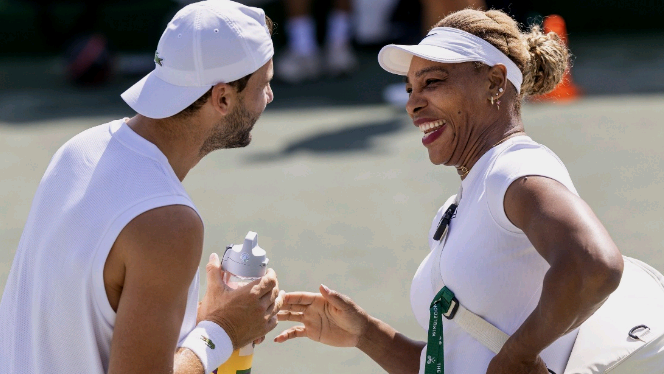
For Serena Williams, everything and nothing has changed on her return to Wimbledon.
She is not the same woman who walked off Centre Court four years ago after a loss to Harmony Tan.
Since evolving away and then back to tennis, she has had a second daughter, co-founded a National Women’s Soccer League (NWSL) team and danced at the Super Bowl.
Some of the faces that practise alongside her have changed. Even some of the grounds have changed, with Williams finding herself momentarily lost on her way to the media centre at Wimbledon.
On Tuesday, the 44-year-old will play Maya Joint, 24 years her junior, in the third match on Centre Court – 1,396 days since she last played in the singles.
No-one knows how it will go. But for the American great, just being on court is a success.
“It’s been a very easy retransition. I’m back in the house that I stayed in [for] several years,” Williams told BBC TV.
“It’s nothing too new, and at the same time it’s everything new. Change is good.
“Success [for me] is just walking out there. I never expected to be here.
“Success is enjoying myself and sticking to my gameplan that my coach gives me, being disciplined – and that’s what I’m trying to do.”
Why Wimbledon is fitting place for return
The Williams sisters – who will team up again for the doubles here – are synonymous with Wimbledon.
For 19 years, at least one Williams sister reached all but four singles finals at SW19.
They won a combined 12 Wimbledon singles titles – seven for Serena and five for Venus – between 2000 and 2016. Elder sister Venus won it first. Little sister Serena won it more.
When they combined, they were dominant, winning six women’s doubles titles together. When they faced one another, it was absorbing – two players who knew each other’s games inside out, from years spent on the practice courts in Compton, California.
If you think of the Williams sisters, you see them in the Wimbledon whites, moving around a grass court, two beautiful service motions, with athleticism, power, and touch at the net to boot.
As Serena said, it is not every day that Wimbledon gives a wildcard to someone.
“I can name probably like a handful of people. I happened to be one of them,” she said.
“I thought, ‘I should really take this opportunity’. Who knows if I’ll ever make it here again? This could be it.
“I was like, ‘What’s wrong with you, Serena? What are you thinking? Are you nuts?’ I have this great opportunity to showcase what I do best.”
Will her age and all that comes with it – being half a step slower out of the corners of the court, having to conserve more energy the longer a match goes on – be too tough to overcome?
Or will her aura, the sheer sense of simply just being Serena Williams, be enough to carry her through the opening round at least?
David Quayle, Williams’ British hitting partner who helped her prepare for her return in the doubles at Queen’s earlier in June, says it is “hard sometimes not to feel a little bit nervous” around Williams.
“It’s a funny thing to see someone that you have watched their serve on TV for so many years, and then all of a sudden that serve is coming at you,” he told BBC Sport in June.
“You’re fighting between admiring some of the shots and actually playing them. She’s got that kind of aura.
“I’m starting to get a little bit more used to seeing her over the other side of the net, but every day is special.”