

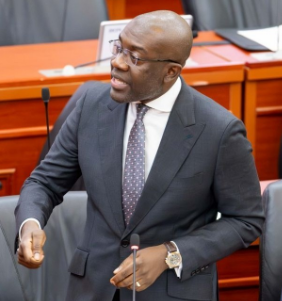
Member of Parliament for Ofoase-Ayirebi and Ranking Member on Parliament’s Economy and Development Committee, Kojo Oppong Nkrumah, has questioned the government’s celebration of Ghana’s exit from the IMF Extended Credit Facility (ECF) programme, arguing that economic stability means little if it does not translate into jobs and improved living conditions for ordinary Ghanaians.
Contributing to a debate on the floor of Parliament following a statement by the finance minister on the economic outlook after the completion of the IMF programme, Oppong Nkrumah said the government’s narrative was focused heavily on macroeconomic indicators while ignoring the daily realities confronting many Ghanaians, particularly the growing challenge of youth unemployment and the rising cost of living.
The former Information Minister began by criticizing what he described as a departure from parliamentary convention, noting that the Minority had not been furnished with a courtesy copy of the Finance Minister’s statement ahead of the debate.
According to him, the practice of sharing statements beforehand allows both sides of the House to prepare adequately and contribute meaningfully to discussions.
He argued that the Minister’s remarks had already circulated widely in the public domain for several days before Parliament had the opportunity to hear a formal response from the Minority.
Turning to the substance of the Finance Minister’s statement, Oppong Nkrumah challenged claims that Ghana had “exited the IMF,” insisting that such descriptions were misleading. He explained that Ghana remains a member of the International Monetary Fund and had merely completed the Extended Credit Facility programme it entered into in 2023.
He noted that the programme achieved its primary objective of restoring macroeconomic stability but pointed out that government is now pursuing another IMF-supported arrangement known as the Policy Coordination Instrument (PCI).
According to him, government must be candid with Ghanaians about the nature of the new arrangement rather than creating the impression that the country has completely severed ties with the IMF.
The Ofoase-Ayirebi MP argued that while the government continues to celebrate stability indicators, many Ghanaians are asking a more fundamental question: what benefits the programme has delivered to their daily lives.
He said two issues dominate public concerns across the country — jobs and the cost of living.
Citing data from the Ghana Statistical Service’s Quarterly Labour Force Survey for the third quarter of 2025, Oppong Nkrumah stated that youth unemployment continues to worsen despite the government’s claims of economic progress.
According to him, unemployment among young Ghanaians aged 15 to 24 stood at 32 percent in December 2024 but rose to 32.5 percent by the third quarter of 2025.
He described the figures as evidence that the economic stability being celebrated by government has not translated into employment opportunities for the country’s youth.
He expressed particular concern about the situation in Greater Accra, where youth unemployment has reportedly reached 49.3 percent.
According to him, the implication is that nearly one out of every two young people in the region is unemployed.
The MP further noted that data from the Ghana Statistical Service indicates that seven out of every ten unemployed persons in Ghana are below the age of 35, a development he described as deeply worrying for the country’s future.
For Oppong Nkrumah, these figures raise serious questions about the real impact of the IMF-backed stabilization programme on the lives of ordinary citizens.
He argued that while macroeconomic indicators may show improvement, the lack of jobs means many young people are unable to experience the benefits being highlighted by government.
He also challenged the government’s interpretation of inflation data, arguing that headline inflation figures do not tell the full story of the cost pressures confronting households.
While acknowledging the decline in headline inflation, Oppong Nkrumah maintained that services inflation remains high and continues to affect the daily lives of citizens.
He pointed to rising rents, increasing electricity costs, and higher charges for essential services as evidence that many Ghanaians are still struggling with the cost of living despite improvements in broader economic indicators.
According to him, the average Ghanaian judges economic performance not by statistical reports but by the prices they pay for necessities and the opportunities available to them.
The Ranking Member also questioned government claims regarding tax reliefs, noting that while officials have highlighted the abolition of certain taxes, Parliament has also approved several new revenue measures introduced by the administration.
He argued that despite the introduction of these new taxes, government has still struggled to achieve its revenue-to-GDP targets and has consequently failed to meet several expenditure commitments.
In his view, this undermines claims of fiscal discipline being promoted by the administration.
Oppong Nkrumah concluded by stressing that the key economic indicators being monitored by many Ghanaians are not necessarily the macroeconomic figures repeatedly cited by government officials but rather employment opportunities, household incomes, and the cost of essential goods and services.
“The numbers that the Ghanaian people are watching in their day-to-day lives are actually getting worse,” he told Parliament, insisting that youth unemployment has risen under the current administration despite the government’s claims of economic recovery and stability.