

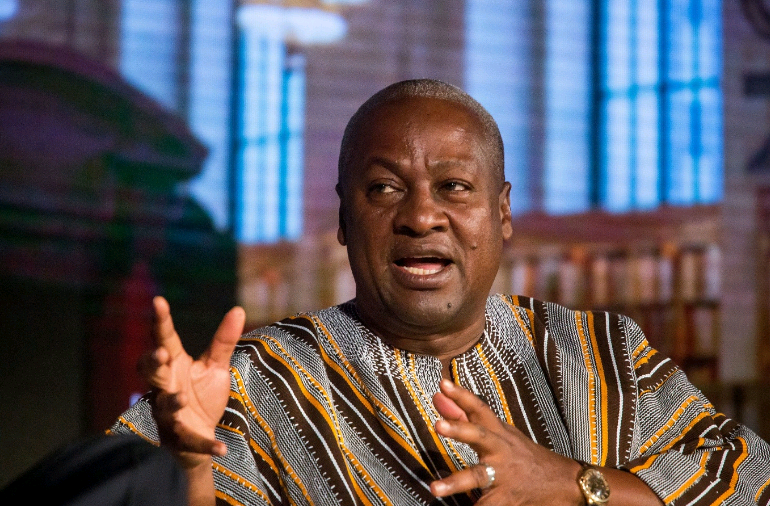
“Four years of a good leader will make more impact than 8 years of a dishonest leader. It is not about how long you serve.
It is about how well you serve. It is not about eight years or four years. It is about how hard you work. It is about truth. It is about trust. It is about doing the things that will create a future for our young people.”
That was John Dramani Mahama’s well-articulated and principled response during the 2024 presidential campaign when his opponents were making the case that he had finished his first four-year term in January 2017 and could only do four years if voted back in the 2024 race.
However, he has now made a dramatic U-turn and is saying four years is not enough, so he supports a constitutional amendment to extend the term limit to two five-year terms.
Let me state my position from the outset. If President John Mahama believes that extending Ghana’s presidential term from four years to five years will provide him with a convenient explanation for why he is failing to deliver key promises, particularly the “24-hour economy”, then he should be opposed vigorously, relentlessly and politically.
But if the question is whether Ghana itself would be better governed with longer presidential terms, then we should have the courage to admit that the answer may very well be yes.
And, therein lies the dilemma because there are actually two debates taking place simultaneously. One is political. The other is national.
The tragedy of Ghanaian politics is that we have become so consumed by the first that we no longer have the honesty to engage the second.
The question of a five-year presidential term is too serious to be dismissed merely because John Mahama happens to support it.
Equally, John Mahama should not be allowed to use the recommendation of the Prempeh Committee as a retrospective justification for any failure to deliver on promises made under a constitutional arrangement he fully understood when he sought office.
The Political Question: No Excuses Allowed
Let us begin with the obvious. President Mahama did not wake up one morning and discover that Ghana’s Constitution provides for a four-year presidential term. He has been President before.
He understands the machinery of government. He understands the constraints of government. He understands what can and cannot realistically be achieved within four years.
So if, after campaigning extensively on the promise of a 24-hour economy, industrial transformation, accelerated infrastructural development and reducing cost of living, he now finds that these objectives are difficult to achieve within a single term, then that is not a constitutional problem. It is a political accountability problem.
The Ghanaian voter did not impose the four-year term on John Mahama after electing him. He sought office knowing exactly what the rules were.
Indeed, one of the most remarkable achievements of the Fourth Republic remains the speed with which President Nana Addo Dankwa Akufo-Addo’s administration implemented Free SHS.
Agree or disagree with the policy, one fact is indisputable: they did not spend four years explaining why it was impossible. They simply implemented it within the first year in office.
I suspect that if one were to compare the inflation-adjusted expenditure incurred during the first four years of Free SHS with the projected expenditure required for the 24-hour economy even over a ten-year period, one might discover that Ghana committed more resources to delivering Free SHS than might ever be committed to implementing the flagship promise upon which the current government sought office.
The argument that “four years is too short” therefore cannot become a retrospective defence for promises that were made voluntarily and enthusiastically. That case must be politically destroyed.
More Difficult Question
But then comes the more difficult question. What if, despite all of that, four years really is too short? That is the constitutional question Ghana has been too afraid to ask honestly.
We claim to want transformation. We claim to want industrialisation. We claim to want railway networks, modern cities, energy transitions, hospital in every district, agricultural mechanisation, digital revolutions and state capacity.
Yet we operate a constitutional system that effectively places governments in permanent campaign mode. The first year is spent settling into office. The second year is spent governing. The third year is spent preparing politically. The fourth year is spent campaigning for survival.
In reality, a Ghanaian government enjoys perhaps two and a half years of uninterrupted governance before electoral considerations once again dominate national life. Can any serious country develop like this? Can we honestly expect governments to conceive, finance, implement and institutionalise transformational programmes within such a compressed timeframe?
Or have we confused frequent elections with effective democracy? Our politicians must be asked: “Did you enter politics merely to win power? Or, you entered politics to govern and to develop our nation?”
And, if we are honest, we may have to admit that the obsession with political competition has itself become one of the greatest obstacles to Ghana’s progress.
My Greatest Suspicion
Which brings me to my greatest suspicion. Now permit me one cynical observation. I suspect that President Mahama’s interest in the five-year proposal may not be entirely disconnected from another constitutional calculation.
One, Azubila Emmanuel Salam, who calls his group Anchoring Democracy Advocacy Ghana (ADAM-GH), has a writ at the Supreme Court since last January seeking clarification on whether President John Dramani Mahama is constitutionally eligible to contest for a third term in office.
The Executive Secretary of the group said the legal action is aimed at addressing growing public debate and political controversy surrounding calls for a possible third-term bid by the President.
There are serious folks at the highest echelons of our politics entertaining some level of hope that Ghana’s Supreme Court could eventually interpret the constitutional two-term presidential limit to mean two consecutive terms rather than two terms in total.
Please, do not dismiss this. Politics requires us to contemplate possibilities, not merely probabilities. How, a Chief Justice who is said to have stood in the way of a judgement against Ecobank can be removed on a petition filed by the claimant in that case, who then can go on to win his case at the Supreme Court and send Ecobank shares into near junk status, is a big sign that anything can happen on those benches.
One can easily imagine a narrow judicial majority, such as 3:2, producing such an interpretation. Stranger constitutional decisions have been rendered in jurisdictions around the world. Extend your research to Belarus and see what you find. Yes, it may even go for a review and two judges will add and at best the decision confirmed 4:3.
Then it becomes a political question, whether, electorally, the people of will accept.
And, if that were ever to happen, who would become the first beneficiary of a new five-year presidential term? Precisely.
That possibility alone means that any discussion about extending presidential tenure must be accompanied by an iron-clad constitutional clarification: two terms mean two terms. Period. Consecutive or otherwise.
Indeed, even if the Supreme Court rules for the absurdity, I would strongly support any political party that pledged, in its next manifesto, to submit precisely that question to the Ghanaian people through a referendum with the view to have it overturned.
Not Thinking Big Enough
In fact, perhaps, we are not thinking big enough. If we are genuinely prepared to reconsider executive tenure, why stop at five years? Why not have the courage to debate two six-year terms?
Six years would allow governments to plan properly, implement properly and be judged properly. Six years would reduce the permanent campaign culture that has infected our politics. Six years would force governments to think beyond headlines and beyond election cycles. And, six years would still preserve the democratic principle that no individual should govern indefinitely.
The real question before Ghana is therefore not whether John Mahama deserves five years. Frankly, that is the least interesting question. John Mahama was elected on a platform of a four-year term. It ends; we bid him our last goodbye and vote for his successor. Mahama should not be part of that discussion.
The real question is whether Ghana deserves a constitutional framework designed primarily for political competition or one designed principally for national development.
My own answer is becoming clearer with each passing election. We spend too much time changing governments.
And not nearly enough time building our country. I am for extending the tenure of the two-term limit from four years to five or even six. My preference would be six. But I will settle for five for now.
By Dr Kofi Omintimminim Apesemaka