

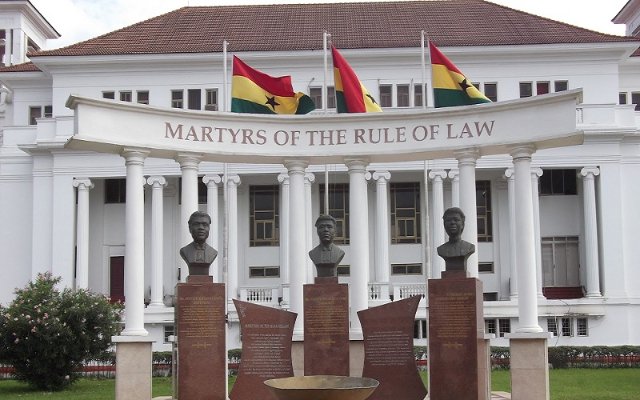
The Deputy Minority Whip in Parliament has called for the judiciary to remain an impartial arbiter, firmly independent, and avoid any entanglement in partisan political activity.
The appeal was made during a solidarity message delivered at the launch of the Supreme Court of Ghana’s 150th-anniversary celebrations at the Cedi Conference Center, University of Ghana, themed “Honouring the past, celebrating the present and defining the future.”
Speaking on behalf of the Minority Leader, Jerry Ahmed Shaib underscored the critical role the judiciary has played in shaping Ghana’s democratic journey and maintaining the rule of law over the decades.
Addressing dignitaries, members of the legal fraternity, and other stakeholders gathered for the event, Shaib highlighted the importance of preserving the integrity and neutrality of the judiciary, especially at a time when democratic institutions across the world are increasingly subjected to political pressures.
He noted that since its establishment, the Supreme Court has been central to defining Ghana’s constitutional order through landmark rulings that have had lasting impacts on governance, civil liberties, and the delivery of justice.
According to him, these decisions have not only strengthened democratic institutions but have also reinforced public confidence in the legal system.
“We cannot forget the landmark decisions that shaped our democracy. These decisions strengthened the rule of law and reminded us in Ghana that justice is not for the privileged few but the right of all. The court must remain an impartial arbiter of our collective destiny.
“As we celebrate the present, let us also safeguard our independence. The judiciary must never be dragged into partisan politics. Its strength lies in neutrality. Its ability to interpret laws without fear or favour.”
Renewed commitment
Chief Justice Paul Baffoe-Bonnie in his address, called for renewed commitment to improving the justice system as Ghana’s Supreme Court marks its 150th anniversary.
Speaking at the launch of the anniversary celebrations, he said the milestone should not only be about reflecting on the past but also about shaping the future of the judiciary.
“Today, we launch the celebration of the Supreme Court of Ghana at 150 under the theme ‘Honouring the past, celebrating the present, and defining the future.’ This anniversary is more than a milestone; it is a moment for honest reflection, quiet gratitude, and bold hope,” he said.
He stressed that the significance of the anniversary goes beyond the number of years the court has existed, urging stakeholders to focus on the institution’s impact.
“150 years is remarkable, but history will not judge us by how long the court has existed; it will judge us by what we did with the moment entrusted to us. Whether we merely celebrated the past or whether we had the courage to celebrate a brighter future,” he added.
The Chief Justice emphasized the need for reforms that will strengthen public confidence in the judiciary and improve service delivery.
“This anniversary, therefore, must be remembered as a commitment to faster justice, accessible justice, to transparent justice and a judiciary worthy of the enduring trust of the Ghanaian people,” he stated.
Reforms
Deputy Attorney General, Dr Justice Srem-Sai, in his address, defended the continued use of jury trials in Ghana’s justice system, describing them as essential to protecting civil liberties.
Justice Srem-Sai’s comments come at a time when stakeholders in the legal fraternity continue to debate reforms to Ghana’s justice system, including the efficiency and relevance of jury trials.
He argued that jury trials remain a critical feature of justice delivery and should be improved rather than abolished.
“The jury trial is considered the palladium of liberty. We have reached a point where we are having a conversation about whether to abolish the jury trial or not,” he said.
He noted that while the role of the Attorney General sometimes intersects with the broader justice system, this should not be grounds for dismantling a key democratic institution like the jury system.
According to him, advances in technology provide an opportunity to modernise and strengthen jury trials, making them more efficient and inclusive.
“We do not think that jury trial should be abolished. We believe that technology has come and would assist us to improve jury trials,” he said.
He highlighted existing national systems, such as the digital address system and the Ghana Card, as tools that can enhance jury selection and administration.
“We have the digital address system, and we have the national identification card. All of these will help us to diversify the jury system and also to educate the public to understand that justice cannot be fully done without the participation of the people,” he added.
Humility and fairness
The President of the Ghana Bar Association, Efua Ghartey, in her remarks, urged lawyers and judges to exercise their authority with humility and fairness, noting that the legal profession occupies a “hallowed position” of significant influence that must be exercised with restraint and responsibility.
“We find ourselves in a hallowed position; a position of emerged power and influence. May we be humbled by this and dispense justice to all men and women without fear or ill will,” she said.
She said the legal profession carries both privilege and obligation, calling on members of the Bar to remain committed to the principles of justice and equality before the law.
She emphasized that the credibility of the justice system depends on the conduct of legal practitioners, particularly in ensuring that justice is dispensed without fear or favor.