
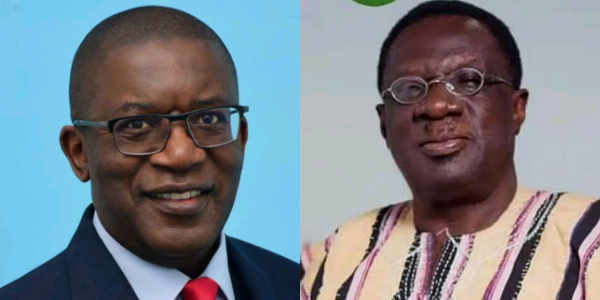
Lawyers for the two men accused in the Sky Train trial — the Republic v. Solomon Asamoah and Professor Christopher Ameyaw-Akumfi — have asked the High Court to throw the case out, arguing the prosecution has not made out even a basic case for their clients to answer.
The applications, known as submissions of no case, were filed ahead of the 11 June 2026 sitting: a 96-page brief from Victoria Barth for Mr Asamoah (1st accused) and a 30-page brief from Yaw Acheampong Boafo for Professor Ameyaw-Akumfi (2nd accused).
At this stage the question is not whether the men are guilty, but whether the State has produced enough credible evidence to put them on their defence at all.
All six charges flow from one transaction: a US$2 million payment the Ghana Infrastructure Investment Fund (GIIF) made in 2019 to take a stake in the company set up to build the Accra Sky Train.
The State says the money was paid without board approval for a system that was never built, and so was lost — amounting to causing financial loss to the Republic and dissipating public funds, with the two men said to have conspired to do so.
To prove it, the prosecution called three witnesses: two former GIIF board members, Yaw Odame-Darkwa and Kofi Boakye, and the lead investigator, Francis Aboagye. The Attorney-General has yet to file the prosecution’s reply, which the court has scheduled for later this month.
The defence’s answer, stripped of legal language, is simple: the money was not spent, it was invested; the investment was approved; and nothing has been lost.
‘Where is the money?’ — In shares
The prosecution’s case is often summed up in one question: a large sum was spent on a system that was never built, so where is the money? The defence says the answer is on the court’s own record.
The US$2 million was never meant to build anything — constructing the line was estimated at about US$2.6 billion and was not GIIF’s job. The money bought a 10% stake in the project company, backed by unchallenged documents: the certificate of incorporation, the directors’ resolution, the share transfer form, and GIIF’s own share certificate. The prosecution itself accepts the payment was for shares.
From there, Ms Barth makes a point any buyer understands: you cannot purchase something and keep the purchase price as well. Once GIIF paid for its shares, the money belonged to the seller — as it would after buying a car or a house. To demand that the accused now “account for” it, she argues, misunderstands the deal. GIIF “could not eat its cake and have it.”
‘You do not monitor a lost investment’
Has any money actually been lost? The defence says the State’s own evidence proves not. The lead investigator claimed that a “net liability” for 2020 as proof the money was gone — but a net liability is just an accounting position, not a loss, and the Auditor-General drew no such conclusion and did not write it off — he recommended GIIF monitor the investment and provide for it only if it later proved unrecoverable.
In 2023 the auditors Deloitte said much the same: it “may not be recoverable if” the project failed to secure approvals. Would reputable auditors, the defence asks, tell you to keep monitoring money that was already gone?
The project was approved
On the central allegation — that no one approved the deal — the defence says the documents are overwhelming. The board minutes of 24 October 2018 record the board approving the US$2 million investment.
Signed minutes are presumed accurate in law unless disproved, and these were adopted without a single objection at the time. The project was repeatedly logged in GIIF’s records as “existing” and “approved,” the payment appears in audited accounts signed by every board member, and none of the auditors — PwC, Deloitte, or the Auditor-General — ever flagged it as unapproved.
The State’s own witnesses
Most damaging, the defence says, is that the prosecution’s witnesses contradicted the records, each other, and themselves. Mr Odame-Darkwa swore the project came up at only one meeting, then accepted he had been shown at least eight sets of minutes mentioning it — and that he had personally signed audited accounts listing the very payment he claimed not to know about.
Mr Boakye shifted from “no approval” to “no final approval” to “some form of approval,” and back. Mr Aboagye admitted he had never seen what a valid GIIF approval even looks like, yet concluded this one was missing — and conceded that key claims were his own assumptions: “I might have inferred.”
And once these two board members had given evidence, the five remaining former board members who had made statements against the accused never took the stand to defend them or face cross-examination.
The defence adds that the project stalled not through any act of the accused but because of COVID-19 — an unforeseeable event that in law breaks any link between the accused and the project’s fate.
In 2021, amid the economic pressures of the pandemic, a new Minister of Railways Development reversed the Government’s policy on the project until conditions improved.
On conspiracy, the defence finds no trace of a secret agreement to loot public funds: every step was recorded, audited, and reported, yet the prosecution never even called the officers who actually processed the payment.
“The transaction was undertaken transparently, within institutional structures, documented in official records, and subjected to audit,” Ms Barth concluded.
“Such conduct is wholly inconsistent with any suggestion of conspiracy or dissipation.” For the second accused, Mr Acheampong Boafo likewise argued the evidence was “so manifestly unreliable that no reasonable tribunal could safely convict.”
Both ask the court to acquit and discharge their clients. The Attorney-General must respond by 24 June 2026, and the court reconvenes on 25 June to fix a date for its ruling on whether the case proceeds.